
What's Really Inside Your Private-Credit Fund?
- For limited partners (LPs) in private-credit funds, security-level transparency reveals risk exposures that a strategy label alone cannot capture, because there is significant variation across funds depending on their exact holdings.
- Three senior direct-lending funds, when modeled with actual holdings data, showed stand-alone risk that varied by more than a factor of three, driven by fundamentally different sources.
- These differences carry over to the total portfolio: Funds that appear similar at the strategy level offer different diversification benefits, with the potential to alter portfolio and hedge construction for private-credit investors.
Private-credit allocations are growing across institutional portfolios, yet the risk of individual funds is often estimated using public proxies or strategy-level averages. But private-credit funds are not static portfolios, and a strategy label cannot capture how their risk evolves. Using the MSCI Private Credit Factor Model and Private Capital Transparency Data, we analyzed three senior direct-lending funds: Top-down modeling based on the fund’s strategy label put them all at roughly 3% risk, but security-level holdings data revealed a range from 2.3% to 7.4%.1 Beyond stand-alone risk, understanding each fund's true risk profile is essential for assessing its role in the total portfolio.
Same fund, different risk: How holdings evolve over a fund's life
A private-credit fund's risk profile shifts over its lifetime. Two patterns stand out for North American senior direct-lending funds, and both shift the nature of risk away from what the strategy label implies.
First, the mix tilts away from senior debt. General partners commonly negotiate equity or warrant positions, known as equity kickers, alongside the loans they originate. Restructurings can also convert debt into equity. Meanwhile, performing senior loans are repaid, but junior capital tends to persist.2 The cumulative effect is a steady erosion of senior-debt weight, though the pace depends on both fund age and vintage.
The extent of this drift varies by vintage. In Q4 2021, the oldest funds held just 61% in senior debt versus 87% for midlife funds. By Q4 2024, with a different vintage in the oldest bracket and a larger sample, the gap had narrowed.3 Tracking the same cohort across both snapshots offers a cleaner read: Funds in the three- to six-year bracket in 2021 had aged into the oldest bracket by 2024, and their senior-debt weight declined.
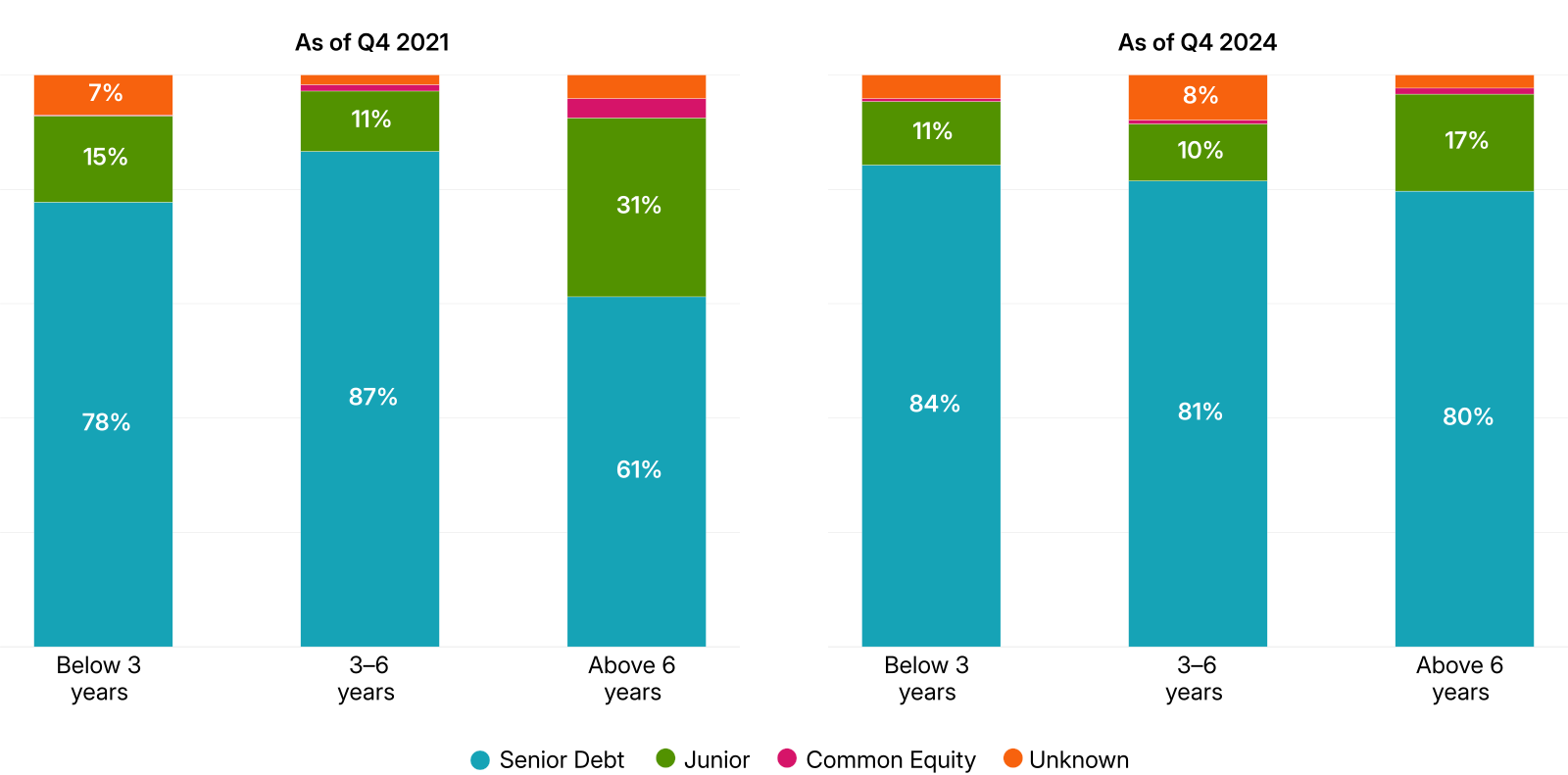
Composition of security market value by fund age group for North America senior direct-lending funds. "Junior" includes mezzanine debt, preferred equity and other equity.
The second pattern is a decline in credit-market sensitivity, as older funds hold loans further into their terms. As of Q4 2024, the median spread duration for loans in the oldest cohort was 2.4 years, roughly 40% below the 3.9 years in the youngest.
Together, these two forces reshape a fund's risk profile: Credit-market sensitivity fades, but the growing weight in subordinated and equity positions introduces a different, typically larger, private-market-specific risk. The net effect depends on the specific holdings, which is precisely why security-level transparency matters.
Under the hood of three senior direct-lending funds
While these aging patterns are broadly predictable, individual funds can diverge significantly from one another. To see how these dynamics play out in practice, we analyzed three North American senior direct-lending funds with two approaches: a top-down approach, where we model these funds using only fund-level information, and a bottom-up approach using actual holdings data.4
Under the top-down approach, the three funds look broadly similar with risk ranging from 2.8% to 3.2% and public-market factors contributing roughly two-thirds of that risk. A public proxy such as U.S. leveraged loans would miss the private-market risk component entirely.
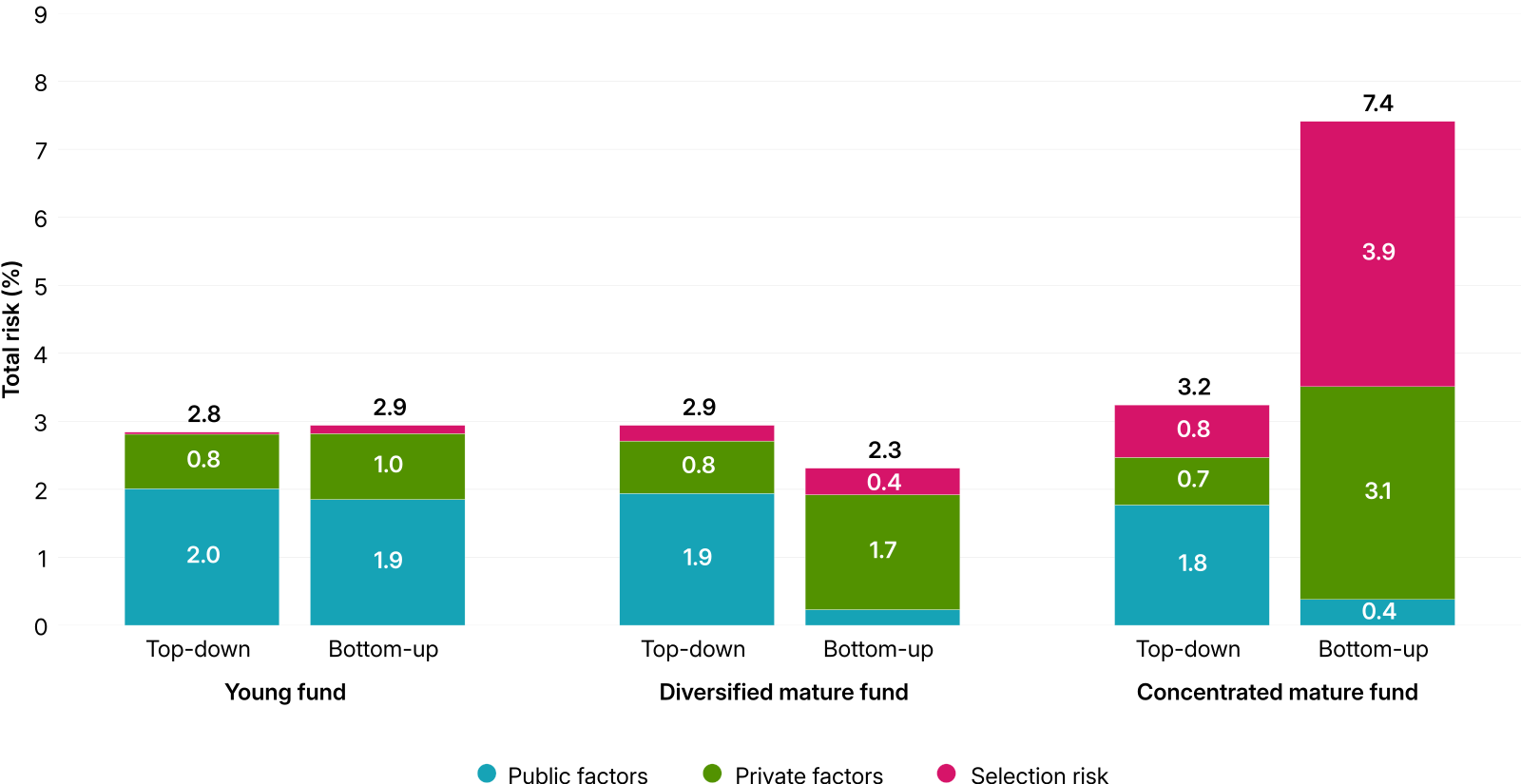
Risk was modeled using the MSCI Multi-Asset Class Factor Model with a long horizon (MAC.L) as of Dec. 31, 2025. "Public factors" include spread, term structure, implied volatility and, where applicable, market and style factors. "Private factors" include pure private-credit and private-equity factors.
The security-level view changes the picture. With actual holdings data, total risk spans from 2.3% to 7.4%, and the sources of risk are fundamentally different (see chart below). The young fund's risk is driven primarily by credit spreads, consistent with a typical senior-lending portfolio, though it already carries exposure to public-equity and private-equity factors. The diversified mature fund's risk comes almost entirely from private-credit factors, as its underlying loans are close to maturity, which reduced its sensitivity to public credit markets.
The concentrated mature fund is the most striking case. It has effectively migrated from a senior to a subordinated vehicle. Nearly all of its systematic risk now comes from subordinated, not senior, direct lending, and more than half of its total risk is concentrated in a handful of remaining positions. This shift is entirely invisible using a top-down approach, and despite being the same age as the diversified mature fund, it has developed a radically different risk profile.
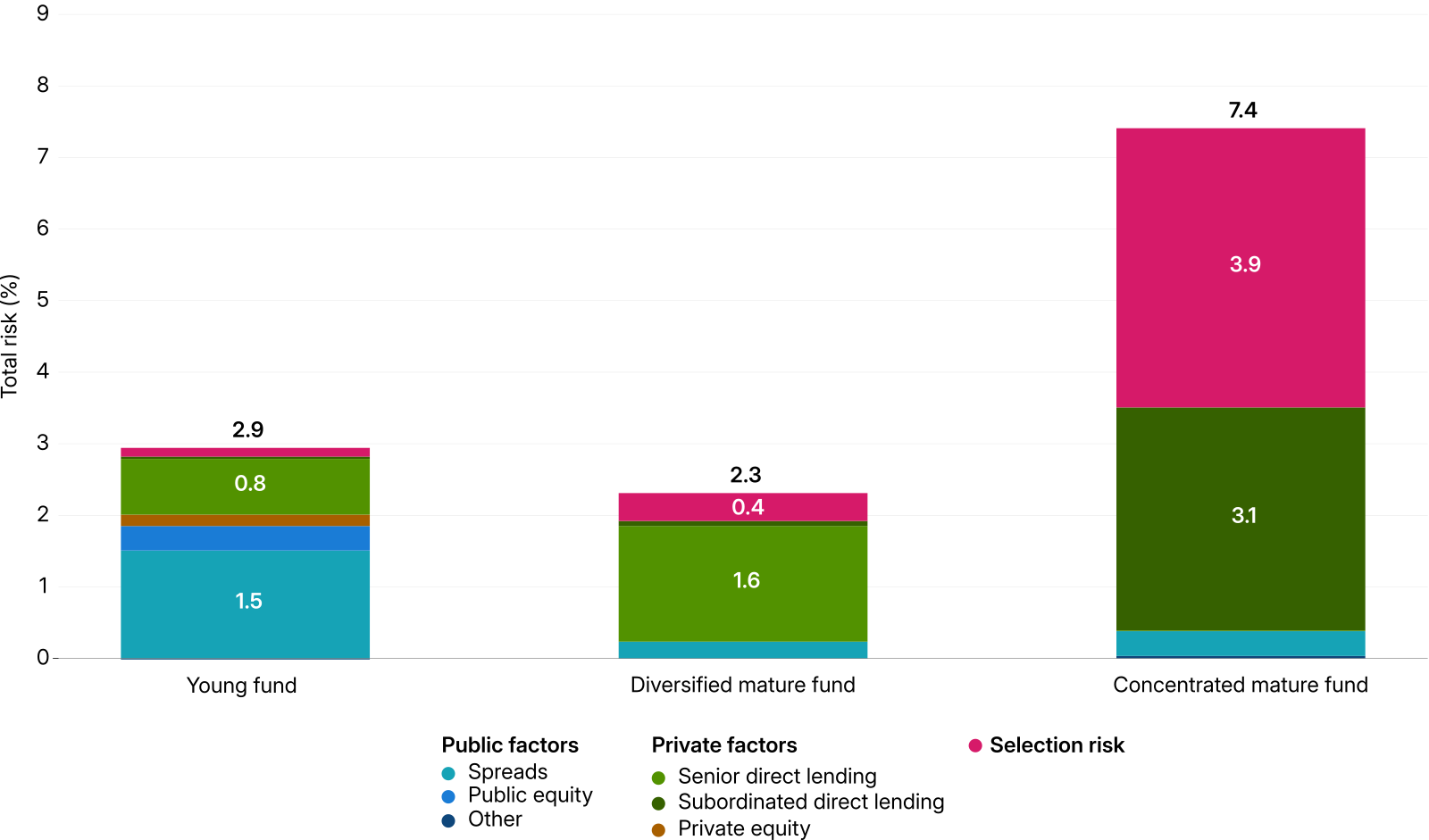
Security-level risk decomposition for three North American senior direct-lending funds. "Other" public factors include term structure, implied volatility and style factors. Risk modeled using the MSCI Multi-Asset Class Factor Model with a long horizon (MAC.L), as of Dec. 31, 2025.
Seeing the full picture: Private credit in the total portfolio
Investors in drawdown private-credit funds cannot easily reallocate away from a maturing fund, but understanding how existing holdings interact with the portfolio helps LPs make better decisions about future commitments. It also reveals whether older funds carry more junior-capital or equity exposure than expected, which can be managed by adjusting liquid equity and bond allocation.
To quantify this interaction with the total portfolio, we examine each fund's marginal impact on a portfolio of 40% U.S. equities, 30% U.S. government bonds, 20% U.S. buyouts and 10% North American senior direct lending. Under the total-portfolio approach, a central question is to what extent each fund diversifies existing portfolio risks. The fund's beta to the portfolio captures this: It ranges from 0.05 to 0.17 across the three funds, meaning some diversify more than others.5
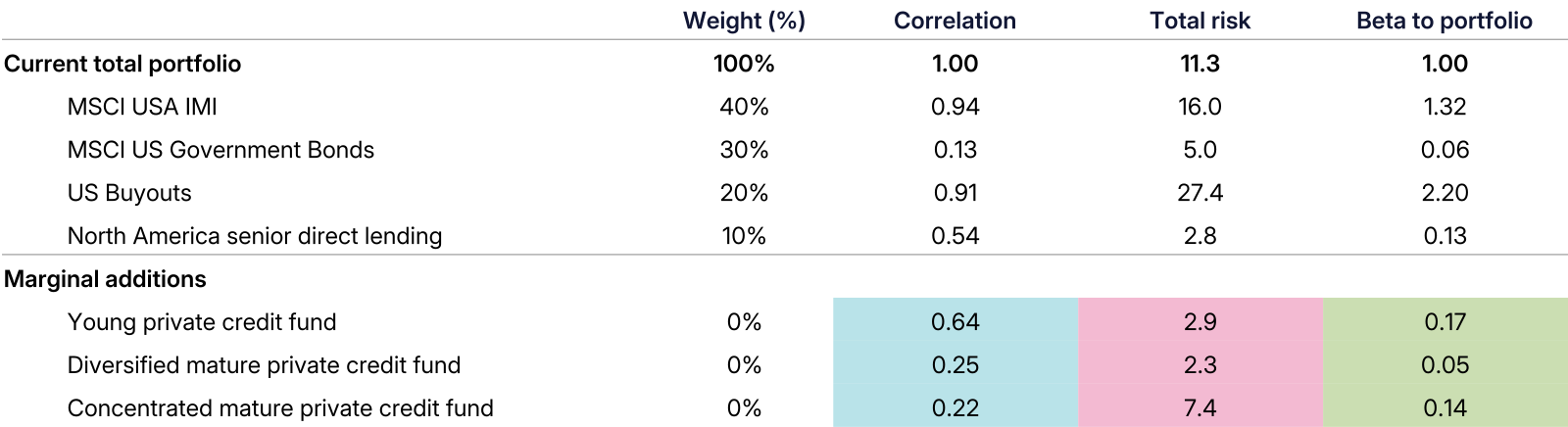
Risk was modeled using the MSCI Multi-Asset Class Factor Model with a long horizon (MAC.L), as of Dec. 31, 2025.
The young fund adds the least diversification. Its risk is dominated by credit spreads, which overlap with the equity and credit exposures already in the portfolio (correlation of 0.64). The diversified mature fund, by contrast, is the most diversifying. Its risk is mostly driven by private-credit factors with minimal spread sensitivity and moves more independently of the portfolio (correlation of 0.25). The concentrated mature fund is more nuanced. It carries by far the highest stand-alone risk, yet most of that risk is uncorrelated with the portfolio (correlation of 0.22).
Security-level data sharpens private-credit risk modeling
Not all private-credit funds age the same way. Our two mature funds share a vintage and a strategy label, yet one remains a diversified private-credit vehicle while the other has effectively become a concentrated subordinated fund. Security-level data captures both dimensions: the predictable arc of aging, as well as the cross-sectional variation among funds, that would be invisible under a strategy label. That transparency extends to the total portfolio too — showing not just what each fund is, but how it interacts with the asset allocation.



Subscribe todayto have insights delivered to your inbox.
What’s (in) the Deal? Transparency in Private-Equity Risk Modeling
Private-equity investors often rely on public benchmarks to estimate risk and return. But those benchmarks can fail to mirror true industry exposures of private-equity portfolios and distort analysis.
Earning a Place in the Portfolio: Using Implied Returns in TPA Decisions
Learn how implied returns enable asset owners to align teams, compare opportunities and make confident, data-driven capital-allocation decisions.
The MSCI Private Credit Factor Model
Investors in private credit contend with the challenges of opacity and illiquidity of the asset class and a dearth of public proxies. Our new model aims to illuminate this market.
1 Risk here refers to the annualized volatility of the estimated "true" underlying return — the hypothetical return if positions were marked to market in orderly transactions, rather than carried at smoothed or par valuations. The MSCI Private Credit Factor Model estimates this true return by applying Bayesian de-smoothing to observed private-credit performance.
2 We use "junior capital" to refer to mezzanine debt, preferred equity and other instruments that sit below senior debt in the capital structure, including securities with insufficient disclosure to classify more precisely.
3 The Q4 2021 sample contained 3,427 securities across North American senior direct-lending funds: 1,333 (39%) in funds below three years, 1,724 (50%) in funds aged three to six years and 370 (11%) in funds above six years. By Q4 2024, the sample had grown to 7,604 securities: 2,423 (32%) below three years, 3,208 (42%) three to six years and 1,973 (26%) above six years — reflecting the growth of the private-credit market.
4 The young fund is a 2021-vintage senior direct-lending fund with a diversified portfolio of loans. The diversified mature fund is a 2019-vintage vehicle with many loans nearing maturity. The concentrated mature fund is a 2019-vintage fund with three remaining securities, predominantly junior-capital assets.
5 Beta is the product of a fund's correlation with the portfolio and its stand-alone risk, divided by the portfolio's total risk. For example, the young fund's beta of 0.17 reflects its moderate stand-alone risk (2.9%) combined with a high correlation to the portfolio (0.64).
The content of this page is for informational purposes only and is intended for institutional professionals with the analytical resources and tools necessary to interpret any performance information. Nothing herein is intended to recommend any product, tool or service. For all references to laws, rules or regulations, please note that the information is provided “as is” and does not constitute legal advice or any binding interpretation. Any approach to comply with regulatory or policy initiatives should be discussed with your own legal counsel and/or the relevant competent authority, as needed.