
What’s (in) the Deal? Transparency in Private-Equity Risk Modeling
- Sector exposures diverge in public and private equity. Compared to U.S. public equities, U.S. buyout funds hold about twice the weight in industrials and health care, and about half in communication services and financials.
- For multi-asset-class investors, deal-level transparency into sector weights delivers more accurate estimates of private-equity risk and clearer insights into its interaction with the total portfolio, improving allocation analysis.
- We show that using actual sector weights raised stand-alone risk by more than four percentage points for an older private-equity fund, which was significantly skewed to the cyclical consumer-discretionary sector.
Private-equity investors often rely on public-market benchmarks to estimate risk and return. But when those benchmarks fail to mirror the true industry exposures of private-equity portfolios, they can distort risk and diversification analysis. With MSCI Private Capital Universe data and the MSCI Private Equity Factor Model, investors can quantify private-equity risk and its interaction with the total portfolio more accurately. For three real-life private funds assessed in this blog post, their total risk could differ by as much as four percentage points, while their beta to the total portfolio ranged from 1.9 to 2.3.
A significant part of private equity’s return and risk can be explained by public proxies. Private equity shares several risk drivers with public markets, including exposure to the market and industry and style factors.1 Because of this overlap, investors often model private equity by leveraging public benchmarks such as the MSCI USA Investable Market Index (IMI), even though sector allocations in private equity may diverge from those in public markets. U.S. buyout funds hold roughly twice the weight in industrials and health care, while other sectors like communication services, financials and energy are underrepresented.
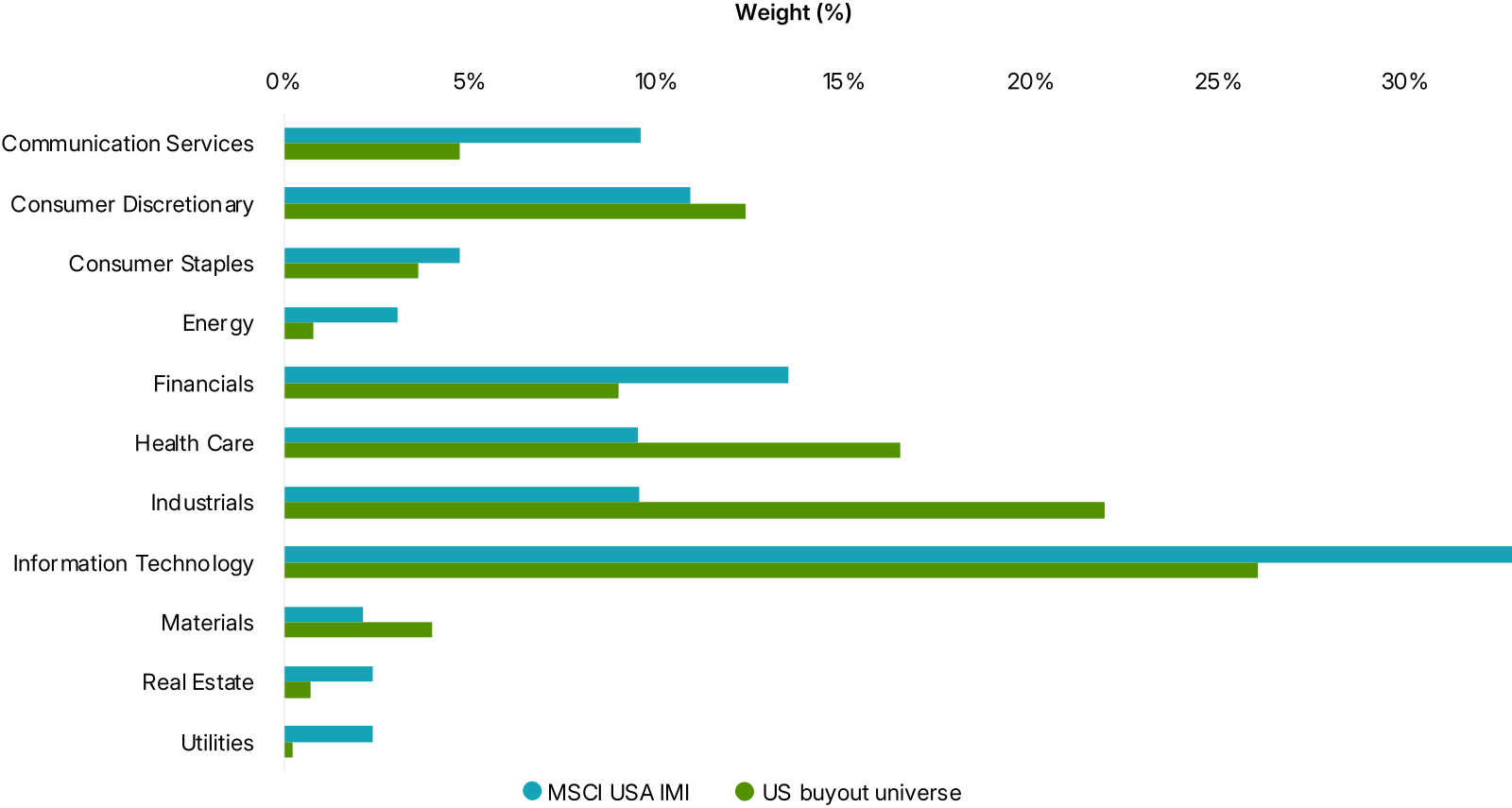
Data as of Oct. 1, 2025. MSCI USA IMI sector allocation based on MSCI PACS, a global industry-classification standard created specifically for private assets. The U.S. buyout universe’s PACS sector allocation is based on pooled investments and their underlying investment-holding valuations, as of Q2 2025.
These differences become even more pronounced when segmenting funds by vintage or age. Compared to the pooled U.S. buyout universe, funds younger than five years are tilted toward information technology and industrials, while funds older than 10 years are significantly overweight consumer discretionary — by 10 percentage points more than the pooled U.S. buyout universe.2
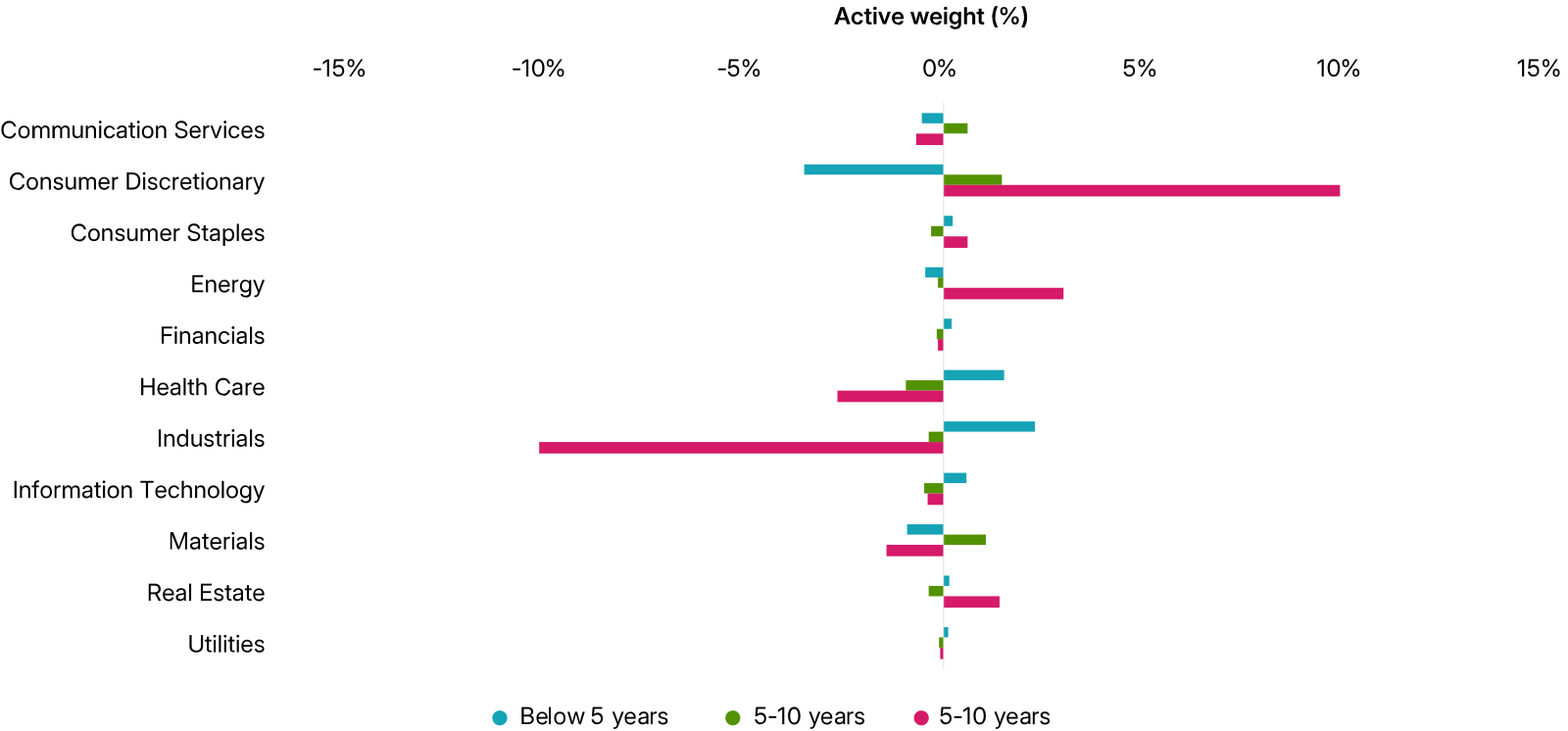
The U.S. buyout universe was segmented based on the funds’ vintage. Active weights reflect the pooled weight of age segments versus the entire pooled U.S. buyout universe, with PACS sectors derived from data on underlying investment holdings. As of Q2 2025.
To illustrate how these sector-allocation differences translate into risk, we analyzed three real-life U.S. buyout funds — one representative fund from each age group, in terms of sector composition.3 Using the MSCI Private Equity Factor Model with actual sector allocations based on underlying investment holdings, we decomposed each fund’s risk. All three funds showed higher systematic risk than when modeled with a generic public proxy such as MSCI USA IMI.
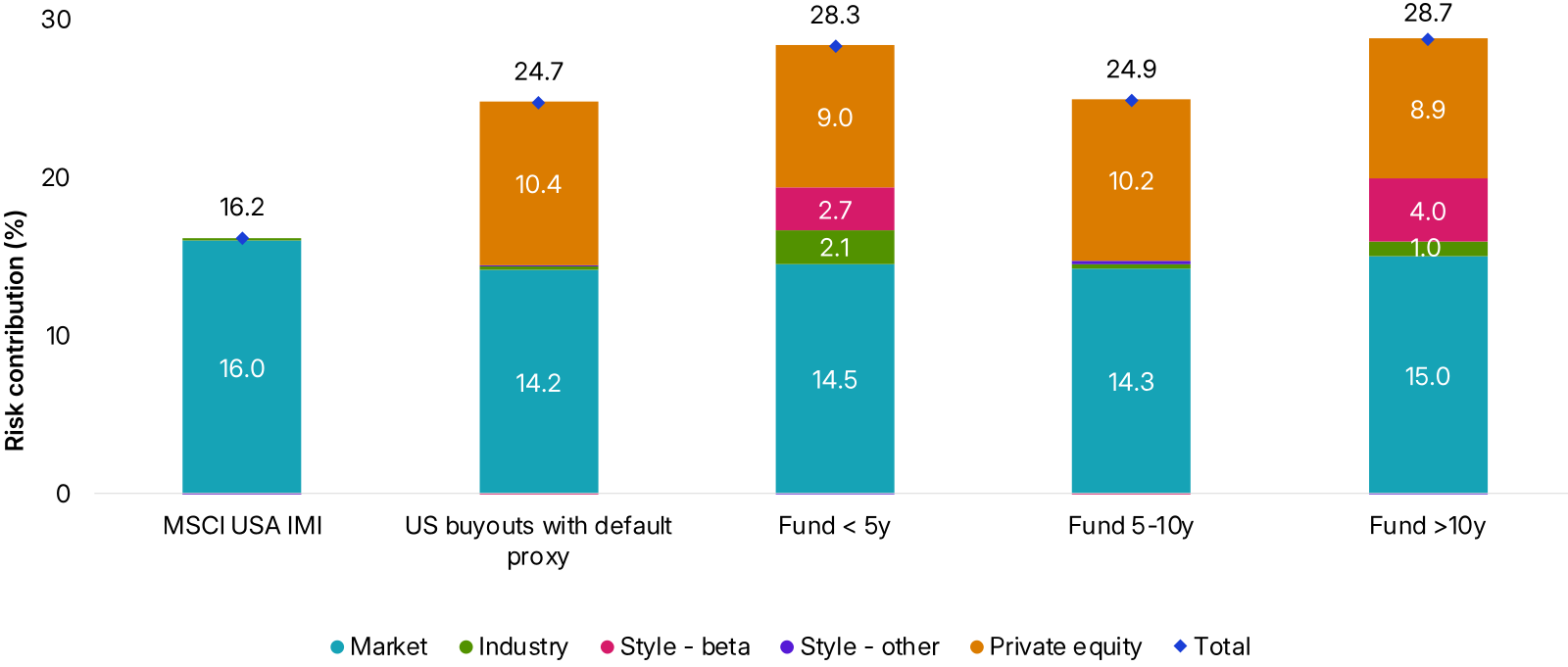
Risk was modeled using the MSCI Multi Asset Class Factor Model with a long horizon (MAC.L). The far-left bar reflects the public proxy, the MSCI USA IMI. The second bar represents a U.S. buyout fund with the default proxy (MSCI USA IMI), while the three bars to the right reflect the risk decomposition of the three real-life funds, using actual sector weights. As of Oct. 1, 2025.
In the broad U.S. equity market, nearly all risk comes from the market factor. When private equity is modeled using the default proxy — implying sector weights from the MSCI USA IMI — an additional pure private-equity factor contribution emerges. This factor captures the unique characteristics of private markets and introduces another layer of systematic risk.
Across the three real-life funds, stand-alone risk is higher than under the default-proxy approach — most notably for the oldest fund, whose risk exceeds risk modeled with a default proxy by more than four percentage points. The decomposition shows that this additional risk stems mainly from style factors, with a smaller contribution from industry exposures. The older fund, heavy in consumer discretionary and IT, has a four-point higher beta style contribution, reflecting its greater sensitivity to economic cycles.4 The middle fund’s more balanced sector mix makes it resemble the default proxy, while the younger fund also shows elevated risk, driven by both industry tilts and its higher beta exposure.
To assess how these funds interact with a broader portfolio, we consider a basic allocation of 50% U.S. equities, 40% U.S. government bonds and 10% average U.S. buyouts. The blue-shaded cells in the table below show the contribution of each existing portfolio component to total risk.5 Private equity exhibits a relatively high correlation with the overall portfolio, reflecting its partial exposure to the same underlying market drivers. This underscores that, while private equity can enhance returns, its diversification benefits may be more limited than they might appear at first glance — because of smooth valuations.
The green-shaded cells highlight the marginal contribution (MC) to risk of the three funds — the approximate increase in total portfolio risk from a 1% additional allocation to the respective line item. Correlations with the total portfolio are broadly similar across the three funds, suggesting comparable diversification potential. The key difference is their stand-alone volatility; hence the more cyclical younger and older funds would increase total portfolio risk most when added.
Finally, the pink-shaded cells show each fund’s beta to the total portfolio. The greater this beta, the greater the return required to justify the allocation.6 This beta measures sensitivity to the total portfolio’s performance — not the “beta style factor” discussed earlier, but the co-movement with the total portfolio’s return. The more cyclical older fund exhibits the highest beta, implying a higher expected-return requirement to compensate for that greater systematic risk.

Risk was modeled using the MSCI Multi-Asset Class Factor Model with a long horizon (MAC.L) as of Oct. 1, 2025.
Using data on underlying holdings in the MSCI Private Equity Factor Model gives investors insights into pure private-equity risk drivers, but also potential style and industry tilts — e.g., for funds skewed to more cyclical sectors — improving alignment with portfolio-level risk targets.



Subscribe todayto have insights delivered to your inbox.
Earning a Place in the Portfolio: Using Implied Returns in TPA Decisions
Learn how implied returns enable asset owners to align teams, compare opportunities and make confident, data-driven capital-allocation decisions.
The MSCI Private Equity Factor Model
Two common approaches to understanding private equity — one based on private-equity valuations, the other proxies of publicly traded securities — can both come up short. Our model aims to tackle this challenge.
Tracking Private Equity: Closing the Performance Gap
Private equity has outperformed public markets by 450 basis points annually. We show that sector tilts and other fundamentals explain nearly half that outperformance, enabling public-equity tracking.
1 Additionally, private equity is exposed to distinct sources of risk and return, including illiquidity and manager skill, which are captured by the pure private-equity factors, as discussed in The MSCI Private Equity Factor Model. To measure the performance of private equity relative to public equity one needs to make similar adjustments, as described in this paper: Ashley Lester, Luis O’Shea and Patrick Warren. “Has Private Equity Outperformed Public Equity?” The Journal of Private Markets Investing 24, no. 1 (2025): 58–70.
2 The pooled net-asset-value (NAV) weights of the three age segments are not equally distributed: 44% in funds younger than five years, 48% in funds between five and 10 years old and 8% in funds more than 10 years old.
3 The fund younger than five years has a 76% weight in IT, a 23% weight in industrials and the rest in other sectors. The five-to-10-year-old fund exhibits a more diversified sector allocation, resembling the pooled weights for the total U.S. buyout universe. Finally, the fund older than 10 years is 75% invested in consumer discretionary and 25% in IT. The number of underlying companies in each fund varied from four to 42, which makes them less comparable in terms of specific risk. We therefore focused on the systematic or common factor risk in the analysis.
4 The beta factor in this context refers to the beta style factor, which captures stocks’ sensitivity to economic cycles and is not to be confused with the beta of private to public equity.
5 A portfolio component’s risk contribution (e.g., 2% for U.S. buyouts) is the product of its stand-alone risk (24.4%), weight in the portfolio (10%) and correlation with the total portfolio (0.82).
6 The beta of an investment relative to the total portfolio helps determine the implied return for this investment: implied return = beta x total portfolio’s expected return. The beta (e.g., 2.3 for the older fund) is the product of that fund’s correlation with the portfolio (0.85) with its total risk (28.7%), divided by the total portfolio’s risk (10.6%).
The content of this page is for informational purposes only and is intended for institutional professionals with the analytical resources and tools necessary to interpret any performance information. Nothing herein is intended to recommend any product, tool or service. For all references to laws, rules or regulations, please note that the information is provided “as is” and does not constitute legal advice or any binding interpretation. Any approach to comply with regulatory or policy initiatives should be discussed with your own legal counsel and/or the relevant competent authority, as needed.