
When the Ground Moves: How Asset Owners Are Keeping Pace with a Fast-Changing World
- At MSCI’s Institutional Investor Forums in Sacramento and Montreal, asset owners described AI as a force that runs through markets, portfolios and workflows – and one that can reverse quickly, as this fall’s AI sell-off showed.
- Pension fund leaders explained the challenges they face in mapping the exposure they hold to AI across public and private sleeves, and then testing associated emerging risks in their portfolios against many scenarios.
- Funds embracing a total portfolio approach are investing as much in people, governance and data as in technology.
Mentioned in this blog post:
For about 500 years, a designated priest at every papal coronation would fling himself to the floor three times before the newly crowned pope and pronounce four Latin words: Sic transit gloria mundi, or “thus passes the glory of the world.” Glory, the ritual reminded, can fade very quickly.
Blocks away from the Notre-Dame Basilica, MSCI’s Chief Research & Development Officer Ashley Lester opened the MSCI Canadian Institutional Investor Forum with this story to liken ancient practices to modern financial market upheaval. The AI trade that seemed absolutely dominant in the first half of 2026 had come to “a very juddering stop,” he declared, speaking as a steep sell-off actively ripped through stocks. He explained that, as of market-close on Nov. 11, “across our AI Value Chain indexes, the correlation between first half performance and second-half is negative 84%.”
That reversal gave the forum’s theme, “When the Ground Moves,” additional resonance.
“Our training and tools, as risk and investment professionals, were developed largely for a world that was approximately stationary. Sometimes you get a bad draw, and that’s a recession; sometimes you get a good draw, and that’s a boom. But you more or less know what types of draws you’re going to get,” Lester explained. “Today, we do not live in such a stationary world. Technological progress is not occurring gradually or incrementally, and institutions, regardless of this or that midterm election, are not capable of generating an orderly set of outcomes that tend to push society towards equilibrium.”
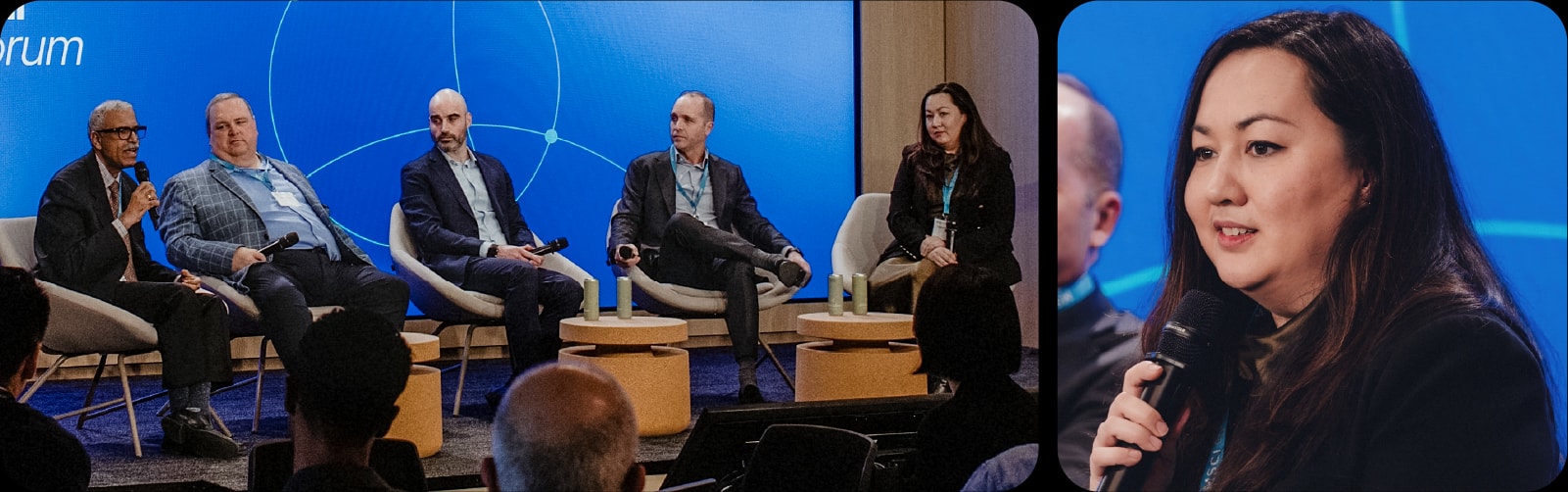
Gathering at CalSTRS in Sacramento on Oct. 15 and at La Caisse in Montreal on Nov. 12, leaders from some of the world’s largest pension funds, asset managers and banks described how they are keeping pace with a world that moves faster than their models, governance structures and portfolios were built for. Systems, technology and talent all need to evolve for organizations to fully understand the impact of AI on their portfolios and workflows, understand shifting lines between public and private markets and embrace a total portfolio approach (TPA).
In Sacramento, AI was the definitive driver of conversation. Through late June, the MSCI ACWI® Index was up more than 12%, and two industry groups that made up less than one-fifth of the index at the start of 2026 delivered more than three-quarters of its gains. Attendees broadly agreed the trade looked stretched, but few were stepping aside. Peter Shepard, Head of Analytics Research & Development at MSCI, characterized the Sacramento mood at the Montreal forum: “We’re highly concentrated in this bubble, but everybody else is, and we’re going to stick with it.”
In the three weeks between the American and Canadian events, the ground had indeed moved. Global AI stocks lost more than USD 6 trillion of market value between Sept. 30 and Nov. 6, a 14% drop in the MSCI ACWI IMITM AI Value Chain Index, according to MSCI’s analysis in The AI Sell-off Puts Diversification to the Test.
A senior investing leader at a Canadian pension fund reflected the shift in sentiment between the forums, noting that the AI narrative has rotated so fast in 2026, from hyperscalers to Korean chipmakers to the software sell-off, that investors must constantly revisit their optimism. Shepard offered a calibrated read on valuation: adjusted for higher real rates, “things don’t look 1999, 2000 dot-com bubble expensive – but they look kind of 1997 dot-com bubble expensive.”
The sell-off also tested how investors are defining diversification. MSCI found that baskets of industries with low correlation to AI rose 6% to 8% when AI stocks fell, while comparable country baskets barely moved; the U.S. made up almost 80% of the MSCI AI Value Chain Index at the end of October, against 64% of the MSCI ACWI IMITM. Emerging markets, Lester noted, were not a diversifier from the main trade in AI, but instead an intensifier of it.
“As AI demand runs into energy and policy constraints, and geopolitics reshapes long-term inflation and rate assumptions, asset owners are examining how these forces intersect with their portfolio allocations,” Laura Nishikawa, Head of Emerging Risk Research & Development at MSCI, explained. “Pension fund leaders agreed the work starts with mapping the exposure they hold today, because the AI buildout increasingly drives risk and return in ways that sector and asset class labels miss. At MSCI, we see first-hand how asset owners are testing every new commitment against a total-portfolio view of exposure, so a new allocation does not add to risk they already hold elsewhere.”
Markets may have grown more sober about AI as an investment theme between each forum – but AI adoption stories from within the funds themselves remained steeped in optimism. In Sacramento, one U.S. fund leader described how they developed an internal agent that grew from about 30 users to roughly 170 in months. In Montreal, a bank executive described rolling out their internal AI tool to thousands of people in their capital markets division.
Leaders at both events agreed that finding and even developing new technology was the easier part of their organizations’ internal AI journeys. Kashi Kakarla, MSCI’s Chief Technology Officer and Head of Product Engineering, told the Sacramento audience that true AI transformation spans “the people, the process, even the product.” Individual productivity can rise via new AI tools across investment and risk teams, he explained, but firms must redesign processes rather than bolt AI onto legacy workflows to ensure that return on technological investment is happening at wider organizational levels.
Panelists shared practical steps that are taking within their organizations, including:
- Define accountability first: Risk leaders at both forums detailed tabletop exercises in which they partnered with investment and other functions to decide what each person and team owns before deploying a tool. In this way, they said, humans stay accountable for judgment and for the exceptions where AI is uncertain.
- Use rules to unleash creativity: One Canadian fund found mandatory training worked as an enabling constraint, and runs “alpha sprints” in which a quarter of employees spend a week reimagining their work with AI.
- Find champions, then teams: Early progress came from enthusiasts, multiple panelists said at each forum, but real change required teams willing to dedicate time to redesigning their work.
- Manage tokens like a budget: Fund leaders said they track spending on dashboards, route simple tasks to cheaper models and tier access to the costliest tools.
In Sacramento, Dimitris Melas, MSCI’s Head of Multi-Asset Investing Research & Development, framed TPA as assessing opportunities and risks across the whole portfolio rather than inside asset-class silos. Pension funds from four continents agreed that, to adopt a TPA, workflows had to change first.
One senior investor who has led TPA adoption at two funds offered a discipline: test each new investment against the reference portfolio’s risk framework, define the key risk, such as the probability of contribution fluctuations, and ask whether a new program changes it. Luke Flemmer, MSCI’s Head of Private Assets, noted in Sacramento that total portfolio work tends to lift the quality of private markets data, as general partners disclose more to plans comparing public and private assets side-by-side.

In Montreal, one Canadian plan that has run a total-fund model for more than a decade said that, measured through risk factors, its true equity exposure is closer to 80% or 90% than the 40% formally allocated to equities. Another fund that adopted TPA this year won board approval by documenting upfront whether each decision was a long-term shift or a short-term trade with a defined exit.
The Montreal forum’s final panel showed how this is changing the chief risk officer’s role at asset owner organizations. As investment teams gain discretion, risk teams are moving from policing individual deals to giving leadership an independent, top-down view. One CRO said his CEO increasingly turns to the risk team to referee between portfolio builders and dealmakers. The CROs shared several practices:
- Swap the base case for many cases: It is now hard to find a scenario worth a 60% probability, but easy to find 10 worth 10% each, one CRO explained while detailing how his fund has expanded stress-testing.
- Stress-test in reverse: Another fund’s CRO said they now use AI to surface the portfolio’s biggest assumptions and hidden concentrations and then design the scenarios that would hurt most.
- Build stress tests with private assets teams: Remarking on the differences between investment and risk leaders with public and private market expertise, one Maple Eight representative said designing scenarios together gives these different teams ownership and surfaces correlations they might miss.
- Rehearse before the crisis: Tabletop exercises were heralded as a way to keep long-horizon investors from becoming short-term sellers.
Sacramento attendees agreed that AI concentration shows up in public index weights and in private vintages, marks and commitments alike. One plan now maps its exposure across an eight-layer AI value chain, from raw materials to robotics.
Multiple Montreal speakers questioned the “Canadian model” itself. Large Canadian plans moved heavily into private assets about 15 years ago for an illiquidity premium, one said, yet that premium has been negative for three to four years. Another warned that the “retailization” of private markets rests on less-sophisticated investors potentially misunderstanding that these assets are illiquid.
“It’s not that privates are good or bad — it’s that we need to work harder to figure out where to get the right value,” Shepard said of the institutional investing landscape today. To make stress tests credible, Shepard explained how MSCI works with clients to speak the language of their private asset teams, modeling how cash flows evolve through periods of stress.
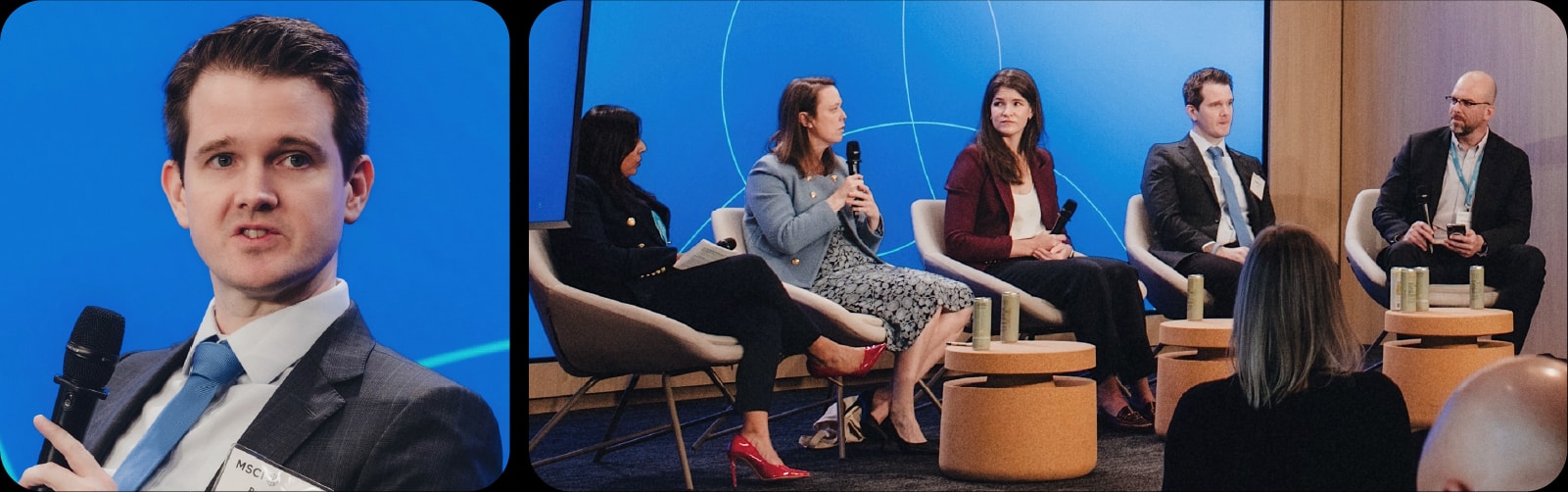
The line between public and private is blurring, too. With Anthropic filing to go public, a Canadian pension leader said much AI value creation happens before the IPO. MSCI research on Anthropic and the History of Headline IPOs finds such listings still reward index investors: headline IPOs are about 1% of the U.S. companies studied but nearly 5% of wealth created.
For Canadian investors, concentration raises a home-market question. MSCI’s paper Breaking Free of Market Concentration notes the U.S. now makes up close to two-thirds of world equity value and examines Canada as a case for deliberate diversification.
From Sacramento to Montreal, forum-goers agreed that organizations must now constantly anticipate change, learn and respond quickly. Asked what young professionals need to succeed, investment and risk leaders named “soft skills” that sometimes can’t be taught: curiosity, judgment and the ability to “connect the dots.”
Lester said those skills will only grow in value as AI integration spreads.
“These all remain distinctly human skills,” he said. “It’s very clear when you’re talking to a human, and they’ve got an actual idea, versus an AI tool that can give a brilliant summary but perhaps not that flash of insight we’re all looking for.” As he noted in his keynote at each forum: the same forces creating these challenges can help investors meet them, provided people stay at the helm.


Subscribe todayto have insights delivered to your inbox.
MSCI AI Value Chain Indexes
MSCI’s range of 14 indexes gives investors a rules-based view of the investable AI value chain, from broad market exposure to granular component-level exposures.
Breaking Free of Market Concentration: Canada Is a Case Study for Deliberate Diversification
U.S. equities hold close to two-thirds of world market value. See why GDP weighting — and an under-owned Canada — offer a governance-defensible way to break the concentration.
The AI Sell-off Puts Diversification to the Test
AI stocks fell 14% in the latest sell-off, while low-AI industries rose 6% to 8%. See how much of your portfolio rides on AI, and which parts move independently of it.
The content of this page is for informational purposes only and is intended for institutional professionals with the analytical resources and tools necessary to interpret any performance information. Nothing herein is intended to recommend any product, tool or service. For all references to laws, rules or regulations, please note that the information is provided “as is” and does not constitute legal advice or any binding interpretation. Any approach to comply with regulatory or policy initiatives should be discussed with your own legal counsel and/or the relevant competent authority, as needed.