
Financed Water Consumption
Mentioned in this paper:
Preview
Financial institutions increasingly recognize water scarcity as a financial risk, but few can say how much water consumption is associated with their lending and investment portfolios. This joint paper from MSCI, Guidehouse and the Water Footprint Network sets out and pilot-tests a PCAF-inspired method for attributing company water consumption to a financial institution’s portfolio.
Drawing on a pilot with five financial institutions, it shows what the approach can deliver today, where data gaps limit it and what needs to come next. For banks and other financial institutions, the approach provides a practical starting point for identifying water-intensive exposures and informing risk management and client engagement. A key consideration is data quality: the framework uses five tiers, ranging from verified company-reported data to sector-level estimates, as shown below.
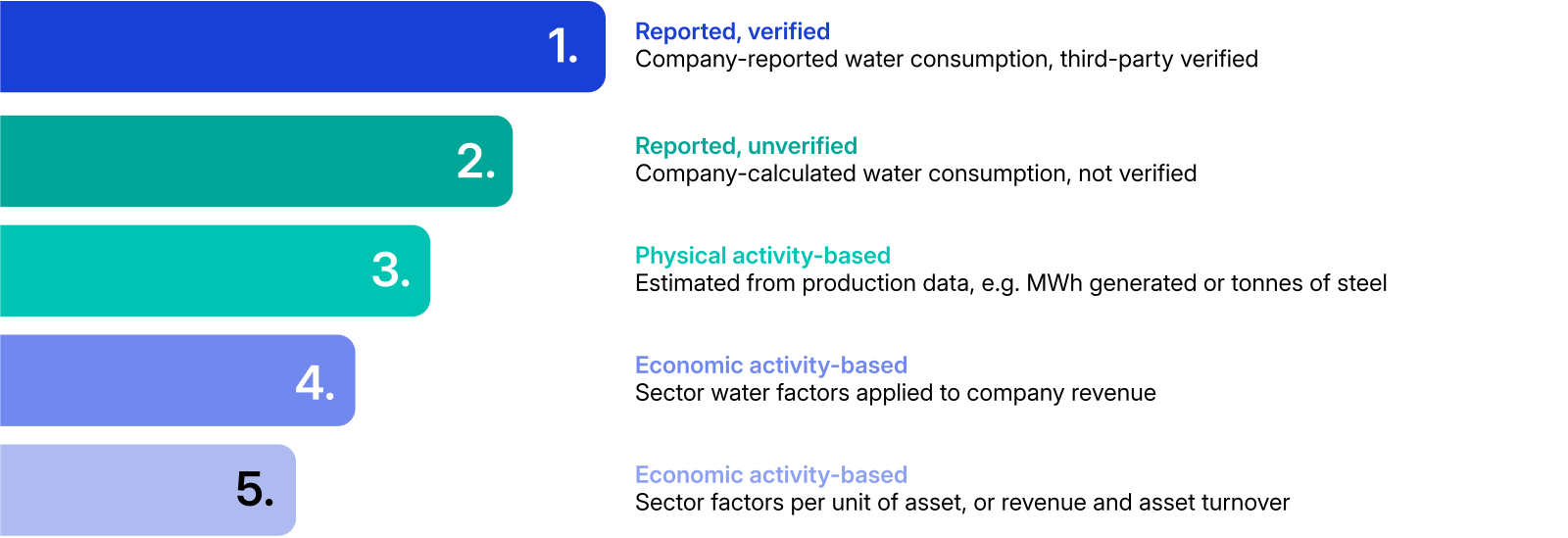
Each financed water consumption figure is scored from 1 to 5 by the data behind it, from verified company-reported water use down to sector-level estimates, showing how much of a portfolio result rests on stronger or weaker data. Source: Guidehouse, MSCI, Water Footprint Network
Read the full paper
Provide your information for instant access to our research papers.
Nature and Biodiversity
Identify and measure nature- and biodiversity-related risks and impacts.
Water Scarcity Already Costs Companies USD 485 Billion a Year
Which companies face the greatest financial risks from water scarcity? New MSCI analysis identifies where losses are concentrated across operations and supply chains.
From Awareness to Action: Assessing Nature-Related Physical Risks
Nature-related risk depends on where companies operate. MSCI’s Nature Risk Matrix assesses 163 sub-industries across seven risk types. See where risks are concentrated.
The content of this page is for informational purposes only and is intended for institutional professionals with the analytical resources and tools necessary to interpret any performance information. Nothing herein is intended to recommend any product, tool or service. For all references to laws, rules or regulations, please note that the information is provided “as is” and does not constitute legal advice or any binding interpretation. Any approach to comply with regulatory or policy initiatives should be discussed with your own legal counsel and/or the relevant competent authority, as needed.