
Too Hot to Work?
Preview
Extreme heat is already affecting workers, companies and the broader economy — and rising temperatures could amplify these effects. This paper examines how heat exposure can translate into lower labor productivity and financial impacts, estimating losses across markets, sectors and MSCI ACWI Index companies and comparing that exposure with what companies disclose about adaptation.
Our modeling suggests that heat-related labor-productivity losses may equate to around 2% of global GDP today, rising to 3.3% under a high-emissions scenario over the next 75 years, with particularly high exposure in Asia-Pacific.
At the company level, around 81% of MSCI ACWI Index constituents show some estimated revenue impact today. As the chart shows, those impacts vary widely, with estimated losses exceeding 5% of revenue for some companies, particularly those with heat-exposed activities.
For investors, that variation matters: geography, workforce sensitivity and adaptation can help distinguish between companies that may look similar by sector or domicile but have very different underlying exposure.
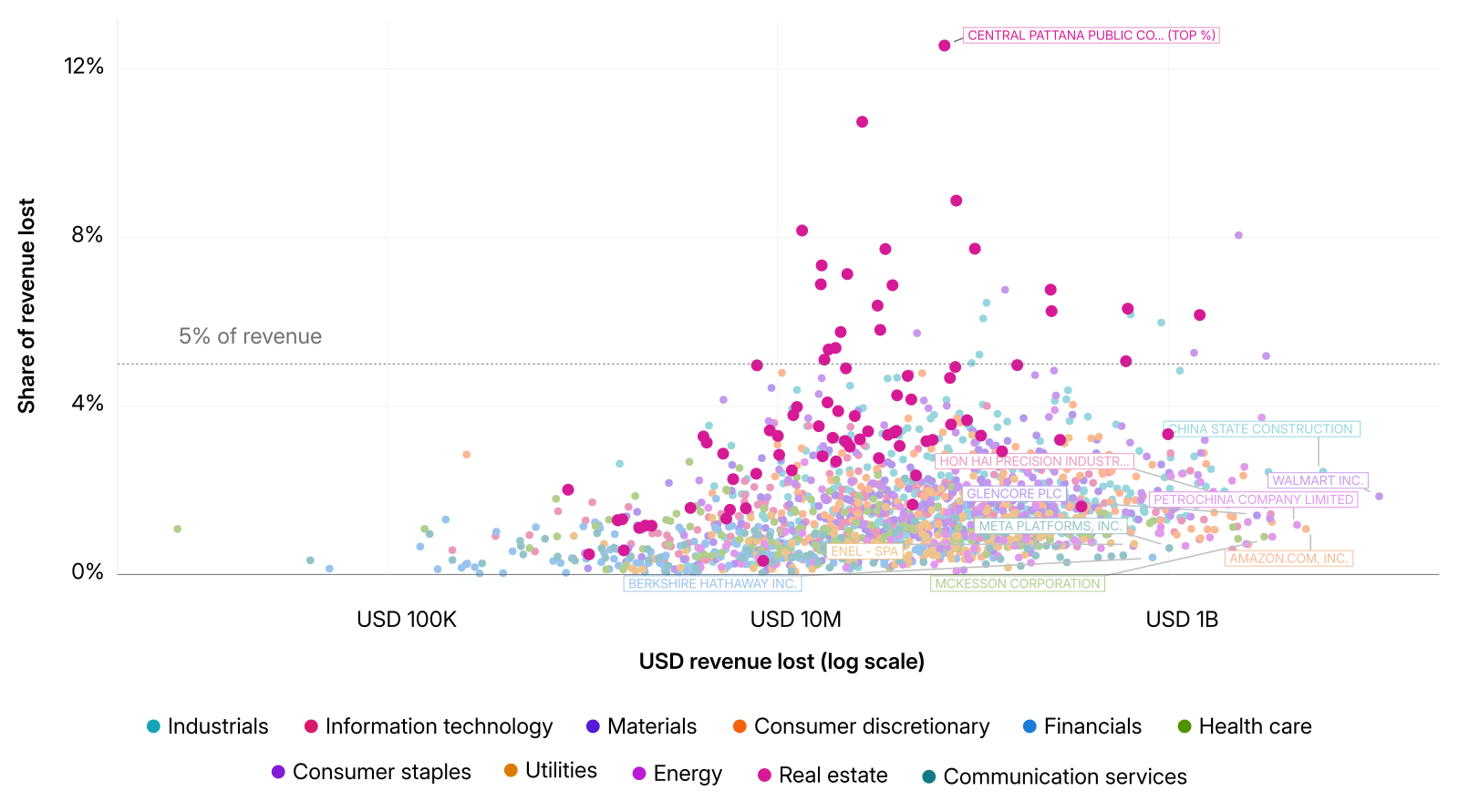
Data as of Sept. 23, 2026. The chart compares modeled heat-related labor-productivity losses across MSCI ACWI Index constituents under current climate conditions and before physiological acclimatization. The vertical axis shows modeled losses as a percentage of company revenue, while the horizontal axis shows modeled USD losses on a logarithmic scale. The dashed line marks the 5% threshold; selected companies are labeled for context. Results represent modeled exposure rather than observed revenue losses. Source: MSCI Sustainability & Climate. MSCI Sustainability & Climate products and services are provided by MSCI Solutions LLC in the United States, MSCI Solutions (UK) Limited in the United Kingdom, MSCI Solutions (Deutschland) GmbH in the EU and certain other related entities.




Read the full paper
Provide your information for instant access to our research papers.
The Price of Not Knowing
Companies often recognized physical climate risk only after a shock. Our analysis shows how asset-level modeling can help investors identify exposure earlier — along with any adaptation opportunities.
HELP Wanted: Using LLMs to Identify Adaptation Gaps
As El Niño raises the risk of drought and other climate hazards, how can investors identify companies that appear least prepared? We combine physical-risk data and LLMs to uncover adaptation gaps.
Turn physical risks into financial insights
Analytical tools and data from MSCI designed to support investors, banks, insurers and other financial institutions in assessing and managing physical risk.
The content of this page is for informational purposes only and is intended for institutional professionals with the analytical resources and tools necessary to interpret any performance information. Nothing herein is intended to recommend any product, tool or service. For all references to laws, rules or regulations, please note that the information is provided “as is” and does not constitute legal advice or any binding interpretation. Any approach to comply with regulatory or policy initiatives should be discussed with your own legal counsel and/or the relevant competent authority, as needed.