
Fundamentals in Private Credit Showed Solid Earnings, Stubborn Leverage
Mentioned in this quick take:
Examining trends in borrower fundamentals helps investors monitor the health of private-credit portfolios and determine if credit risk — informed by leverage, borrowing capacity and earnings trends — is improving or deteriorating across the asset class.
Borrower credit profiles were supported in Q1 2026 by revenue and EBITDA growth. The median private-credit corporate borrower expanded their last-12-month EBITDA by 7.9% relative to Q1 2025 and revenue by 6.4%, according to a credit analysis using MSCI Private Asset and Deal Metrics data. EBITDA margins were steady at 19.1%. Growth in earnings matched that of revenue, suggesting that borrowers absorbed moderately high inflation without margin erosion.1 An environment of moderate inflation can be a tailwind for revenues and profits if interest rates don’t also rise, making it easier for borrowers to repay fixed debt obligations.
Net leverage was steady overall in the first quarter of 2026 versus a year prior. Median net debt rose 9.7%, slightly outpacing EBITDA growth and leaving net leverage at 5.3x versus 5.1x a year ago. Examining the distribution of net leverage across borrowers shows more nuance: The share of borrowers carrying higher levels of net leverage (above 7.0x) ticked up to 31.4% from 29.6%, a modest shift but one worth monitoring. If EBITDA growth slows, the same debt loads could translate into materially higher leverage multiples and higher credit stress for the more aggressive end of the distribution.
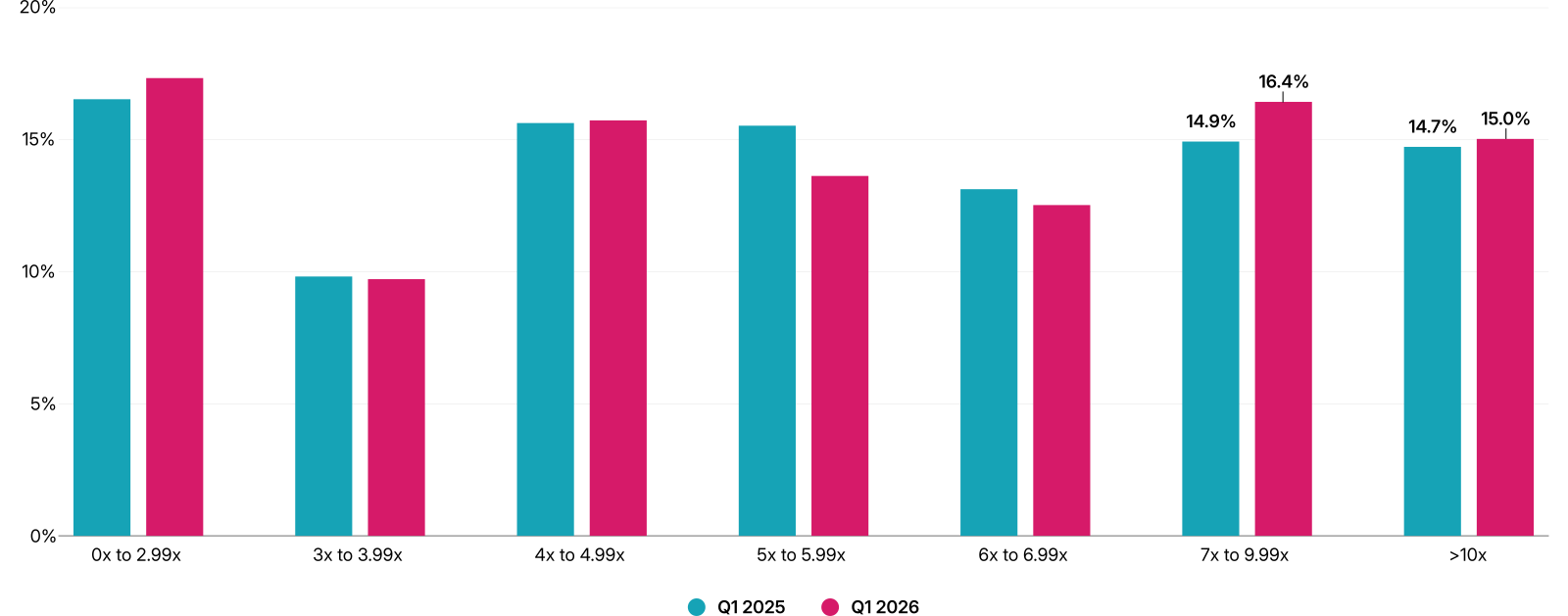
Distribution of private-credit borrowers (by count) grouped by their net leverage. Source: MSCI Private Asset and Deal Metrics

Subscribe todayto have insights delivered to your inbox.
Stress in Private Credit Is Broader than Tech
Managers marked down the fair value of loans for several key sectors in private credit in 2024 and 2025, and stress in IT was evident even before concerns erupted early in 2026.
MSCI Private Capital Benchmarks Summary Q1 2026
Differing views on AI’s impact on portfolio companies divided private equity in Q1. We examine the split, and report on performance, capital flows and dry powder across private capital in the quarter.
1 Year-over-year inflation in June was at 3.5% in the U.S. and 2.8% in the eurozone, according to the Bureau of Labor Statistics and Eurostat, respectively.
The content of this page is for informational purposes only and is intended for institutional professionals with the analytical resources and tools necessary to interpret any performance information. Nothing herein is intended to recommend any product, tool or service. For all references to laws, rules or regulations, please note that the information is provided “as is” and does not constitute legal advice or any binding interpretation. Any approach to comply with regulatory or policy initiatives should be discussed with your own legal counsel and/or the relevant competent authority, as needed.