
SBTi Opens a New Pathway for Carbon Credits
Mentioned in this quick take:
On June 11, 2026, the Science Based Targets initiative (SBTi) updated its Corporate Net-Zero Standard.1 The addition of its Ongoing Emissions Responsibility (OER) framework in v2.0 is the first SBTi-recognized pathway for companies to use carbon credits before their net-zero year. Recognition depends on continued progress against emissions-reduction targets and becomes mandatory for large members from 2035. During the voluntary pre-2035 phase, companies can aim for three recognition levels. The criteria for achieving “Leadership” status are more stringent for larger, higher emitting companies (Category A) than for others (Category B).
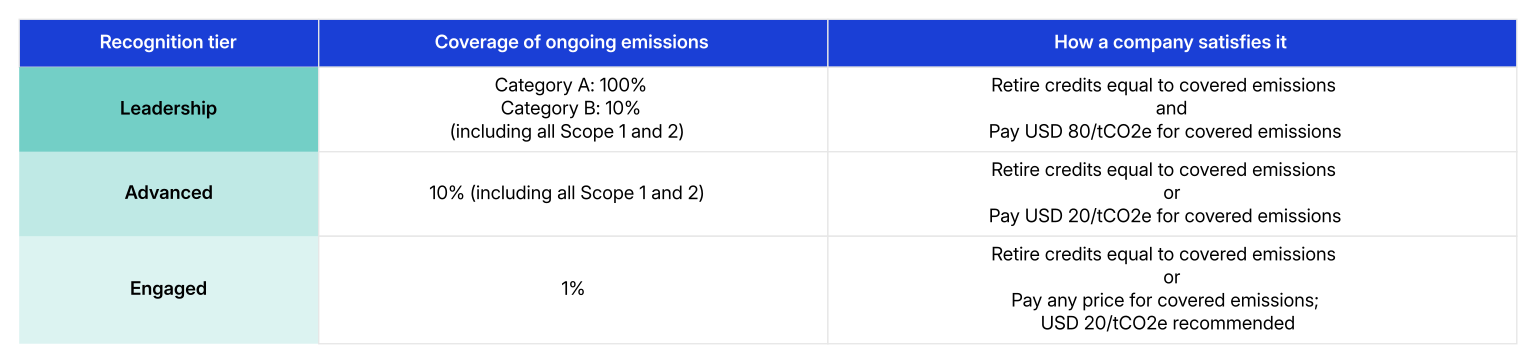
As of June 2026. Source: SBTi Corporate Net Zero Standard v2.0
The OER framework could encourage companies to use carbon credits. We measured the credit retirements of SBTi members and non-members against their estimated emissions, differentiating between Category A and Category B companies.
Based on our database of emissions and credit retirements, covering 16,000 companies over 15 years, we estimate that 563 SBTi members have retired sufficient credits to meet an OER tier, based on the year with the highest ratio of credit retirements to total emissions. Category B companies and those with lower emissions were more likely to have met a higher tier.
Using carbon credits is not the norm — 85% of SBTi members have never retired carbon credits. The SBTi’s OER framework may encourage companies to enter the market for the first time. Many may seek OER recognition during the voluntary phase, but from 2035 Category A companies will be required to linearly increase the use of carbon credits to 100% of emissions by their net-zero target year.
The incentive of OER recognition could lead companies that sit just below a tier to increase their use of credits. It could also encourage a wave of new SBTi joiners among the 661 companies without SBTi targets that have retired enough credits to qualify for recognition.
Data as of June 2026. Large companies in any country and medium-sized companies in high-income countries. A company is Category A if it meets at least one of the following criteria: net turnover ≥ EUR 450m or ≥ 1,000 FTEs (any country); or, in high-income countries, Scope 1 and 2 emissions ≥ 10,000 tCO2e or any two of the following: balance sheet ≥ EUR 25m, turnover ≥ EUR 50m or ≥ 250 FTE}. All others are Category B. This is an estimate of the likely categorization using MSCI company and financial data, coupled with existing SBTi company/SME designation. Source: MSCI Carbon Markets


Subscribe todayto have insights delivered to your inbox.
USD 22 Billion Points to Future Carbon-Market Demand
Carbon markets are shifting from spot demand to forward commitments, with USD 22 billion signaling growing investment in future supply amid increasingly constrained high-quality credit availability.
Carbon Credits Come of Age in 2025
Carbon-credit markets held steady in 2025, while growing demand for higher-quality and removal credits is reshaping pricing, demand and long-term growth prospects.
1 “Corporate Net-Zero Standard v2.0”, SBTi, June 2026.
The content of this page is for informational purposes only and is intended for institutional professionals with the analytical resources and tools necessary to interpret any performance information. Nothing herein is intended to recommend any product, tool or service. For all references to laws, rules or regulations, please note that the information is provided “as is” and does not constitute legal advice or any binding interpretation. Any approach to comply with regulatory or policy initiatives should be discussed with your own legal counsel and/or the relevant competent authority, as needed.