

What are cookstove projects?
Cookstove projects distribute cleaner-burning stoves to households that would otherwise cook on open fires or basic stoves. Replacing inefficient combustion with a more efficient stove reduces the amount of fuel needed for each meal, which in turn reduces the emissions associated with that fuel. Where the fuel being displaced is non-renewable wood or charcoal, the resulting emissions reductions can generate carbon credits.
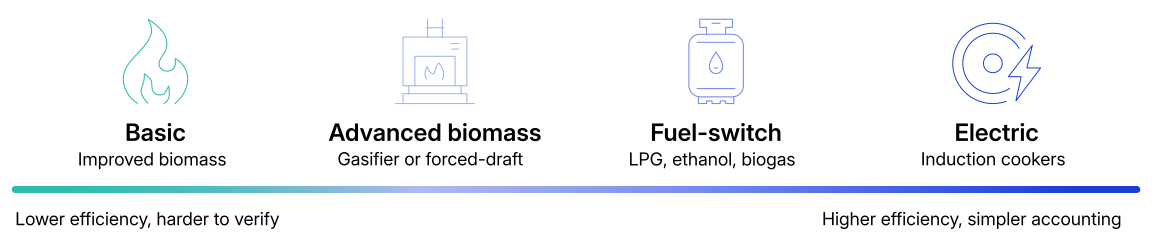
Most projects serve households in low- and middle-income countries where biomass is the main cooking fuel. Stove technology spans basic improved biomass stoves, advanced gasifier designs and fuel-switch stoves like LPG, ethanol and electric induction. More advanced stove designs can deliver larger and more measurable emissions reductions, but generally require higher upfront costs, supporting infrastructure and more intensive monitoring to reach households at scale.

How do these projects work?
Cookstoves are among the largest project types in the voluntary carbon market by total issuance, accounting for a large share of all credits issued under Verra's VCS, Gold Standard and other programs. The project type has grown because the underlying intervention is well-understood, methodologies have existed for over a decade and household deployment can be replicated quickly.
What determines the integrity of cookstove projects?
The concept is simple, but turning it into a verified tonne of avoided CO₂e is not. Several key inputs to the credit calculation are hard to measure, and errors in them can compound. Four issues drive most integrity risk in cookstove projects:
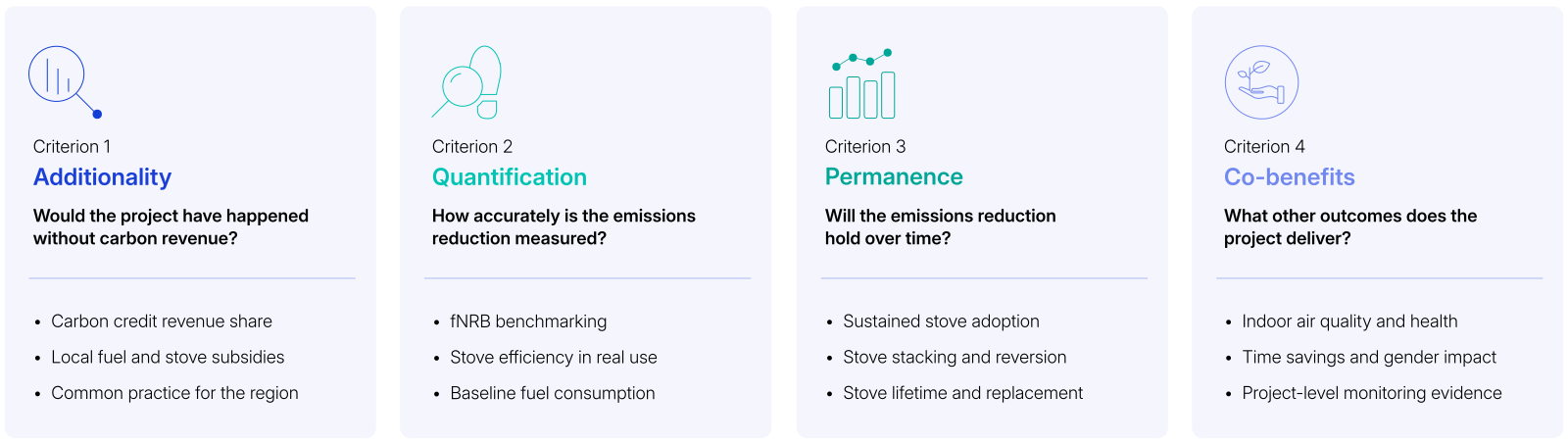
- Fraction of non-renewable biomass (fNRB): This determines what share of avoided fuel use counts toward emission reductions. Project-level fNRB values have historically varied widely and sometimes exceeded country-level estimates from independent sources, contributing to credit volumes that some studies have found to be overstated.
- Stove efficiency and usage: Lab-tested efficiency often exceeds real-world performance and usage can fall over time as households revert to traditional stoves or use multiple stoves in parallel (known as stacking). Both effects reduce actual emissions reductions versus what a project claims.
- Baseline fuel consumption: The wood or charcoal a household would have used without the project is rarely measured directly and is often modeled from default values or back-calculations based on project stove use. Higher baseline assumptions produce more credits.
- Co-benefit evidence: Cookstove projects regularly claim health, gender and livelihood benefits. The strongest projects monitor these outcomes; many do not, and reported benefits often rest on assumed rather than measured outcomes.
MSCI Carbon Project Ratings assess these risks at the individual project level, applying cookstove-specific sub-criteria across additionality, quantification, permanence and co-benefits.
Conclusion
Cookstove projects can deliver real emissions reductions and important benefits for the households they serve. The challenge is measurement. Small errors in key inputs can compound, making project-level assessment essential.
Projects and Transactions
Access roughly 30,000 projects spanning more than 15 registries and 1 million transactions.1

Carbon Project Ratings
Investor-grade ratings for over 4,000 carbon projects grounded in granularity and backed by geospatial intelligence.

1 Data and coverage as of December 2024.