
When Giants Go Public: MSCI's Perspective
Some of the world's highest-valued private companies* are now going public, and more are expected to follow. Each listing raises the same questions about index inclusion, and the risks and opportunities these listings pose for investors. MSCI's insights on the megacap IPO wave are gathered below, kept current as it unfolds.
Featured content
Private Company Insights: Anthropic
Anthropic filed for its IPO in June, heralding another venture-backed megacap listing in the U.S. This report examines the company’s trading activity on secondary markets ahead of its public debut.

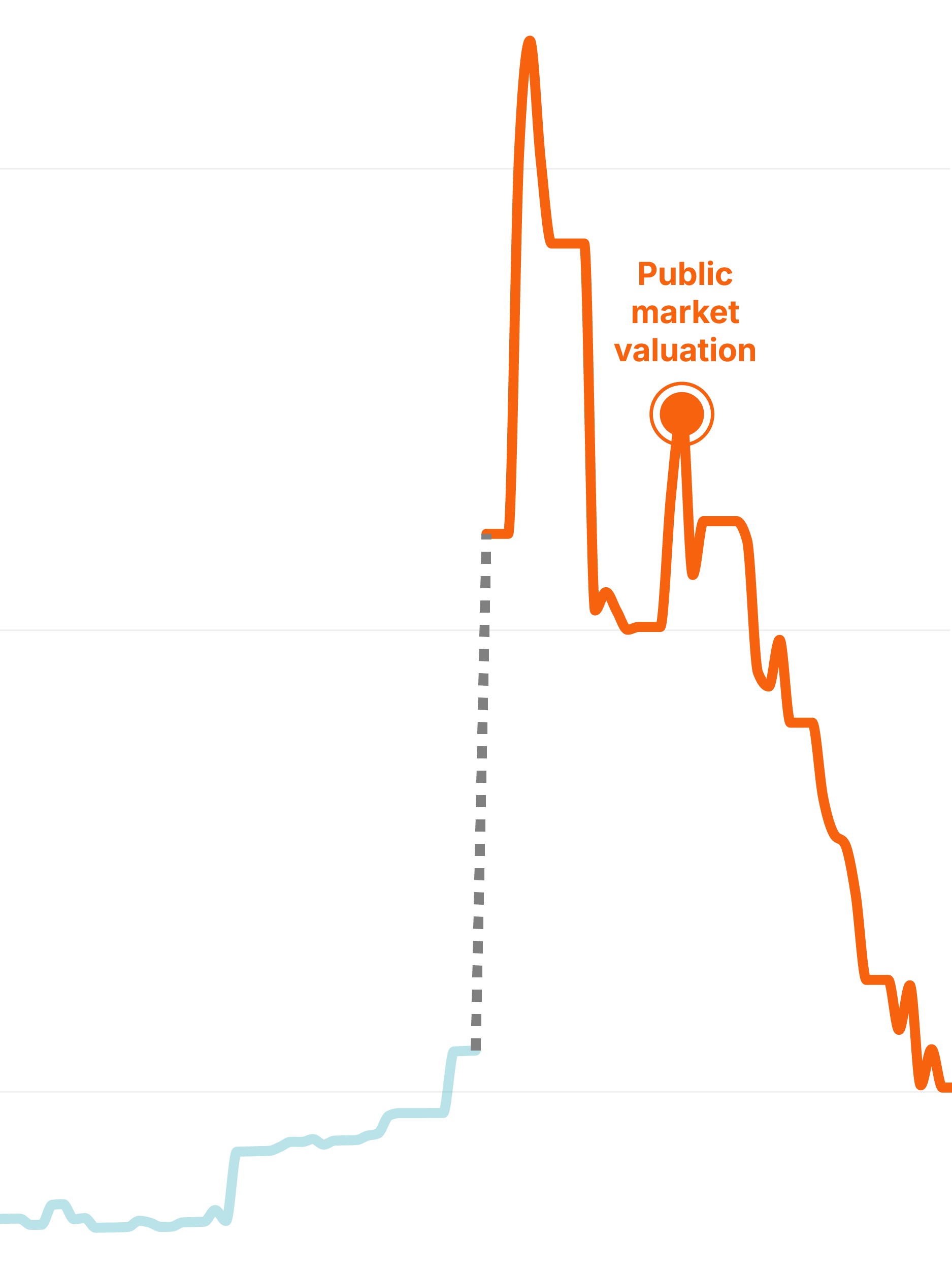
Public price discovery brought SpaceX's valuation closer to its pre-IPO estimate
SpaceX's public valuation has moved closer to MSCI's pre-IPO estimate, illustrating the transition from private valuation to public price discovery.
Tesla and the Trillion-Dollar Question
History shows that large, expensive stocks rarely quintuple over a decade. Winners shared durable profitability and capital discipline — not faster growth — offering lessons for today's megacaps.

The Long Road from IPO Day to Cash for Private Investors
The public listing of a portfolio company is not an immediate payday for private funds — it starts a countdown that could take years, with risks along the way.

New Listing, No History: Estimating the Risk of an IPO
When a stock has no return history, how do you estimate its risk? MSCI’s latest factor model fills the gap with smart proxies from peers — starting day one.

What the SpaceX IPO Means for Investors
We found that a trillion-dollar IPO may change an index less than expected, but the active risk was real. We simulated the additions of SpaceX, OpenAI and Anthropic in the MSCI USA Index.

Mega-IPOs: When Private Goes Public
As SpaceX nears its IPO, Luke Flemmer and Nick Fusco of MSCI explore how secondary-market data helps investors understand true private exposure and navigate the private-to-public transition.

MSCI's approach to large IPOsRules-based, consistent and unchanged
When a major company goes public, questions quickly follow: Will it be added to MSCI indexes? When? What happens to my benchmark?
The answers are in MSCI's methodology — the same methodology that has governed large IPO inclusion since 2007.
MSCI has not changed its rules
MSCI’s GIMI methodology rules are applied consistently and are not tailored to, or modified in anticipation of, any specific IPO. The Global Investable Market Indexes (GIMI), which include the MSCI ACWI, World, Emerging Markets, and EAFE indexes, follow a consistent, published framework applied equally to all eligible companies.
When a large IPO occurs, MSCI evaluates eligibility after listing using publicly available market data and the published methodology.
Have more questions? Read the FAQ
MSCI's approach is rules-based and transparent. The MSCI Global Investable Market Indexes (GIMI) methodology — which underlies the MSCI ACWI, World, Emerging Markets and EAFE Indexes — has included explicit, published rules for the fast-track inclusion of large IPOs since 2007. These rules are applied consistently and systematically across all eligible companies.
*As of May 2026. Estimated valuations are obtained from MSCI data partners and modeled using venture-capital funding rounds, secondary-market trades, price events and public comparables. Classifications of private companies using MSCI PACSTM, a global standardized taxonomy for private assets.
1 The Global Industry Classification Standard (GICS) was developed by and is the exclusive property of MSCI and S&P Dow Jones Indices. "Global Industry Classification Standard (GICS)” is a service mark of MSCI and S&P Dow Jones Indices.