
The Long Road from IPO Day to Cash for Private Investors
Mentioned in this quick take:
SpaceX’s record June 2026 listing, the largest IPO to date, revived a common misconception: that going public is the payday for private funds. The listing only starts the clock for these investors to exit their positions, however.
We examined 2,617 private-capital investments that were exited after IPO and found that neither the listing itself nor the lock-up expiration was when most cash came back. One in four positions had distributed close to nothing for almost two years afterward. These positions did not reach half of their total proceeds until about three years after listing and took as long as four years to complete their exit.
The fastest positions had already returned nearly half of their proceeds by the listing date and were fully realized within about two quarters — broadly consistent with the expiration of a typical 180-day lock-up. The slowest positions returned little for roughly five years and took more than seven years to complete.
SpaceX illustrates why the listing date alone reveals little about distribution timing. Its pre-IPO investors are not released through a single 180-day cliff. Instead, sales are staged.1 Across IPOs, lock-up terms, secondary-sale capacity, market conditions and manager exit decisions all contribute to the differing outcomes in cash return.
With AI megacaps such as OpenAI and Anthropic filing confidentially for IPOs, this pacing question remains important for allocators at limited partners (LPs). Projecting distributions from the offer date alone can overstate how quickly capital comes back and understate how much timing differs across managers. In the interim, those positions remain at risk: The paper gain at listing can erode considerably before a distribution arrives. For LPs, an IPO is not a liquidity event but the start of one.
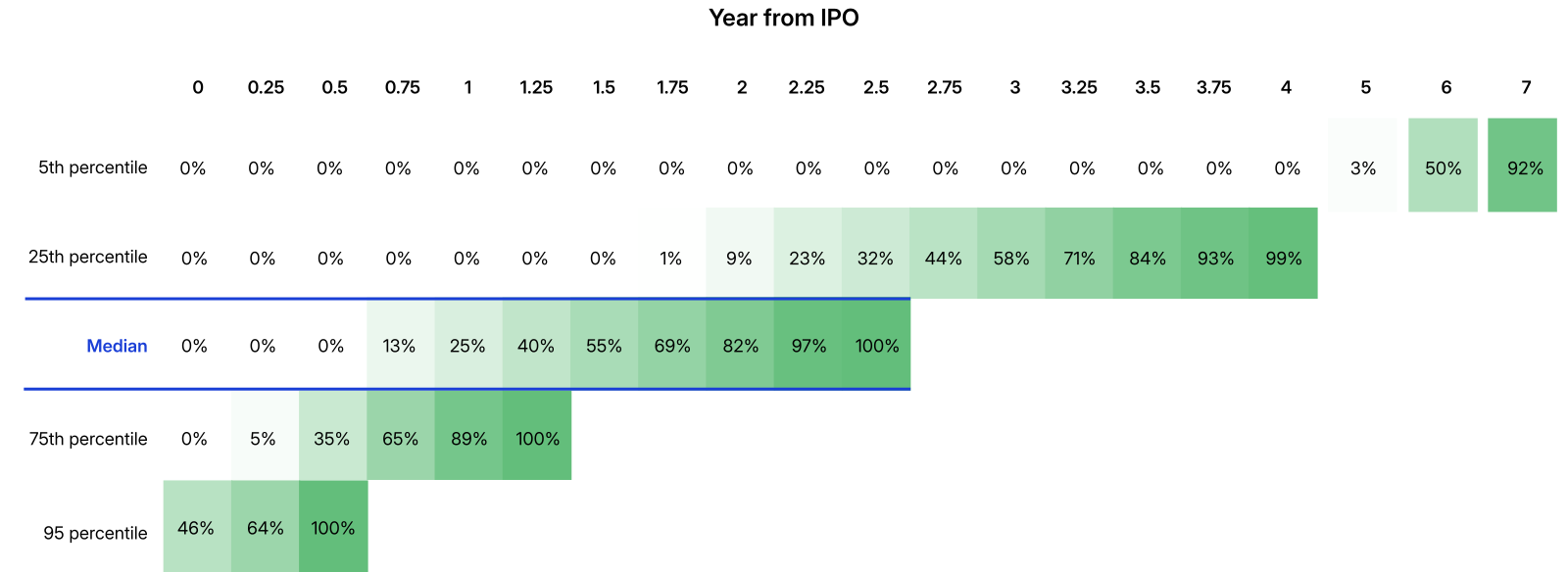
Sample is predominantly U.S. venture and growth-stage positions that listed between 1996 and 2025. Because it includes only fully exited positions, the figures describe historical pacing rather than outcomes for the most recent listings. Source: MSCI Private Capital Solutions
The authors thank Keith Crouch for his contributions to this post.


Subscribe todayto have insights delivered to your inbox.
Private Capital in Focus: VC and Buyout Part Ways on Software
Venture capital and buyout went in opposite directions in Q1 2026, driven in part by differing valuations of software holdings. Returns in private credit weren't immune to software pressures either.
When Buyout Marks Meet the Market
In buyout, managers tend to mark investments conservatively, but for aging assets and weaker performers, the variation in valuations changes — with important implications for asset owners.
Private Capital Intel
Benchmark performance with one of the largest private capital datasets.
1 An initial tranche can be sold after the company’s Q2 2026 earnings update, additional sales are metered out toward the 180-day mark, and founders and major backers remain subject to a one-year lock-up. Space Exploration Technologies Corp., Prospectus pursuant to Rule 424(b)(4), filed with the U.S. Securities and Exchange Commission, June 12, 2026 (SEC accession no. 0001628280-26-042639).
The content of this page is for informational purposes only and is intended for institutional professionals with the analytical resources and tools necessary to interpret any performance information. Nothing herein is intended to recommend any product, tool or service. For all references to laws, rules or regulations, please note that the information is provided “as is” and does not constitute legal advice or any binding interpretation. Any approach to comply with regulatory or policy initiatives should be discussed with your own legal counsel and/or the relevant competent authority, as needed.