
Five Financial Signals from Climate Week NYC
- Location emerged as the common thread linking physical climate risk, AI, energy security and geopolitics to financial performance.
- Across capital markets, the focus is shifting from identifying exposure to translating intersecting risks into inputs for valuation, credit and underwriting.
- Forward-looking signals are gaining importance, from companies' transition readiness to the financial value of resilience and the physical constraints shaping the AI buildout.
Mentioned in this blog post:
MSCI Energy Transition Index | MSCI's Energy Transition Framework
Physical climate risk, AI, energy security and geopolitics are colliding in ways that are reshaping risks and opportunities across capital markets. For investors and financial institutions, the challenge is to see where those forces interact and how they translate into financial performance.
MSCI brought together clients and market leaders throughout Climate Week NYC against a backdrop of rising costs from severe weather, growing energy demand, shifting supply chains and geopolitical tensions. The conversations, which were held under Chatham House Rule, spanned investment practice, underwriting, corporate decision-making and research focused on finding financially relevant signals amid these new market dynamics.
The forces driving investment are increasingly difficult to understand in isolation. "Many investors may view these as separate, unrelated issues, but we are going to explore how they are interconnected," said Richard Mattison, MSCI's head of sustainability and climate, at our flagship event. One increasingly important lens, he added, is location, which is key to understanding where physical climate risk, the energy transition and disruptions across value chains can intersect.
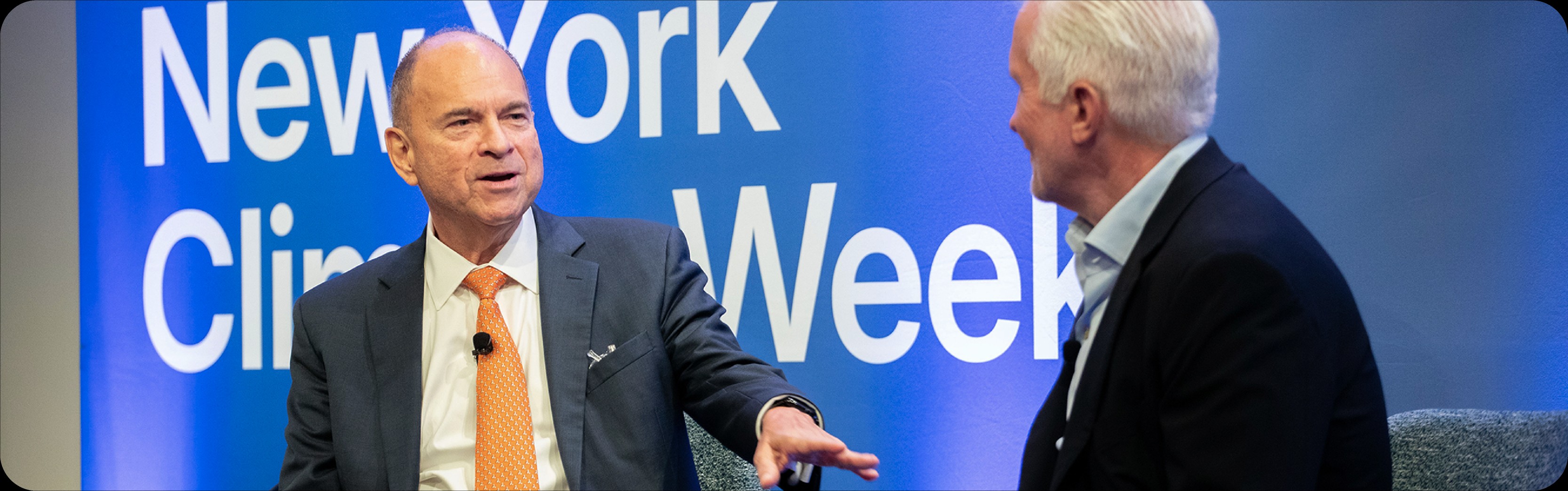
Henry Fernandez, MSCI chairman and CEO (left), and Jim Coulter, TPG founding partner and executive chairman, discussed how decarbonization is converging with the remaking of global supply chains and an increasingly electricity-intensive economy.
That convergence was on display in a conversation between Henry Fernandez, MSCI's chairman and CEO, and Jim Coulter, TPG's founding partner and executive chairman. They examined how decarbonization is converging with the remaking of global supply chains and an increasingly electricity-intensive economy — forces that together are "resetting the real economy," Coulter suggested.
Five themes emerged from the week's conversations.
1. Location is becoming a new lens for financial risk
Company- and country-level averages can obscure risks that become visible when investors know where assets, suppliers, operations and customers actually sit. Physical climate risk, geopolitical tension, tariffs, energy availability and supply-chain disruption can all produce very different financial outcomes depending on location.
Consider how that can matter for geopolitical risk. Companies with more geographically diverse suppliers, operations and revenues tended to be less affected than more concentrated peers during periods of heightened geopolitical tension, according to MSCI research spanning events including the Brexit referendum, Russia's invasion of Ukraine and the April 2025 U.S. tariff announcements.
The same lens can reveal seemingly unrelated risks. AI data centers depend not only on computing equipment but on local power and water availability, climate hazards, insurance and community acceptance. "You're not only investing in the asset, you're investing in that asset and the community around that asset," noted Jeremy Porter, who leads MSCI's research on the economic and financial implications of physical climate risk. One credit investor made the financial connection explicit, describing permitting delays and community opposition around data centers as potential hits to cash flow and ultimately creditworthiness.

Richard Mattison, MSCI's head of sustainability and climate, stressed that location is key to understanding where physical climate risk, the energy transition and disruption across value chains intersect.
The value of greater granularity also surfaced in MSCI's own operations. Tia Counts, our chief responsibility officer, described using geospatial, nature and biodiversity tools to assess dependencies and risks across individual office and data-center locations and translate them into considerations for business continuity and workplace resilience. "You don't assess just to assess, and you don't assess just to report," she stressed. The point is to identify what matters and turn the findings into action.
2. Physical risk is moving from exposure to financial impact
Weather-related events causing off-cycle revenue disclosures among U.S. public companies have increased sixfold over the last 20 years, according to MSCI and First Street research. When such disclosures occur, companies lose just under 5% of their share value on average. Among substantive physical climate-risk disclosers, nearly three-quarters first reported a material climate shock in an off-cycle filing before recognizing the risk in detail in annual reporting.
That disclosure gap helps explain why asset-level analysis matters. MSCI and First Street examined annual reports from more than 25,300 firms between 2023 and 2025 and found that only 27% substantially disclosed how physical climate risks had affected or could affect performance.
Throughout the week, investors, lenders and insurers pushed beyond identifying hazards to understanding how they reach a balance sheet or investment case through cash flow, collateral values, insurance, exit values and underwriting. "These events are material, they're growing and the data is here," suggested Matt Eby, MSCI's head of physical climate risk.
One private-markets investor said that physical-risk analysis needs to produce an input that can actually change a line item in a valuation, rather than another risk score. Bankers described a parallel challenge in translating hazards and asset-level location data into measures that can inform credit risk and, ultimately, lending decisions.
The conversation about the transition to a cleaner, more resilient global economy is moving beyond emissions and targets toward evidence that companies are prepared to navigate policy shifts, geopolitics, energy security and rising electricity demand.
Our research finds that readiness carries a financial signal. Companies better prepared for the shift to a low-carbon economy outperformed less-prepared peers by roughly 18 to 25 percentage points, depending on region, over the five years ended April 2026. Among companies under the greatest transition pressure from technology, policy and emissions, readiness mattered even more.
That thinking underpins the MSCI Energy Transition Index, introduced during the week. Built on MSCI's Energy Transition Framework, it assesses both the pressure on a company to transition and management's readiness to respond, tilting toward companies with higher pressure and higher readiness.
Practitioners described examining what companies are actually doing — evidence that may say more about readiness than commitments alone. "The question investors lead with now is mostly a materiality one," noted Sebastien Lieblich, MSCI’s head of EMEA and APAC index and global sustainability and climate indexes. Investors are looking for signs that transition planning is embedded in business strategy, including C-suite and board ownership, capital allocation and investment in technology.
For companies, climate performance is increasingly tied to capital access. Those that can demonstrate how they are measuring and managing risk, building resilience and executing on their transition plans can give investors a clearer view of their preparedness — with potential implications for investor demand, index inclusion and the cost and availability of capital. "That turns the climate conversation into a capital-markets conversation," explained Jodi Thorp, MSCI's global head of sustainability and climate solutions for the banking sector.
Energy security adds another dimension to the readiness question. Geopolitical disruption, changing supply chains and rising electricity demand are altering the economic landscape companies need to navigate, making it harder to assess transition readiness in isolation, Chris Cote, who leads MSCI's energy transition and energy security research, noted. "It's easy to set the stage quickly but a lot harder to connect the dots back to portfolios, loan books and companies," he said.
The adaptation economy is larger than its label might suggest. Research by the MSCI Institute on roughly 2,500 listed companies found that 89% showed evidence of undertaking some activity to protect against a physical hazard or strengthen operational resilience, while 43% were selling at least one adaptation-related product or service.
Preliminary Institute analysis of over 50,000 U.S. private companies identified more than 5,600 with resilience activity, nearly 90% of which were selling products or services that protect against a physical hazard, noted Linda-Eling Lee, the Institute's founding director.

From right to left: Linda-Eling Lee, founding director and head of the MSCI Institute; Emilie Mazzacurati, founding partner, Tailwind Futures; Katharina Schwaiger, deputy CIO and head of BSI Intel, BlackRock; and Kara Succoso Mangone, head of the sustainable finance group, Goldman Sachs, discussed the adaptation economy.
More than 1,000 provided heat-resilience solutions spanning cooling, sensors, worker protection, analytics and heat-reducing materials. "A large amount of the adaptation resilience that needs to take place is already starting to happen inside companies, but much of it never appears under a climate label," she said.
The challenge for investors may be less about whether those opportunities exist than how to access them. One investor described the bottleneck as translating a fragmented real-economy opportunity into something investors can actually own.
At the same time, the economic case for adaptation at individual assets may be highly concentrated. MSCI research examined roughly 435,000 corporate assets with higher exposure and lower preparedness and found that just 2.2%, or 9,612 assets, had a positive modeled savings-on-investment case under present-day conditions. The top 1% accounted for 99% of the modeled benefit. For investors, that means finding both the companies supplying resilience and the individual assets where resilience spending may generate the greatest economic benefit.
5. AI isn't a single trade and its digital expectations depend on the physical world
AI exposure reaches far beyond technology stocks. MSCI classifies 37% of the world's listed companies as part of the AI value chain, spanning physical infrastructure, digital infrastructure and applications. A hypothetical MSCI scenario involving a relatively modest repricing of hyperscaler debt produced an approximately 11% modeled loss across a multi-asset portfolio, particularly through public fixed income, private credit and equities. "All of the expectations of the buildout of AI are baked into markets and exposures today," said Laura Nishikawa, MSCI's head of emerging risks research and development. Those expectations, she added, are now "colliding with the physical world."
The buildout needed to meet those expectations is running into physical constraints. Our research finds that median energy capacity of newly built U.S. data centers rose from 11 megawatts (MW) in 2016 to 130 MW by June 2026, while average waits for power connections in data-center regions exceed five years. Seventy percent of global data-center capacity under construction is in the U.S., and more than half (52%) of U.S. developments are in counties where previous projects have been withdrawn or data-center-specific rules enacted.
Those constraints can turn water availability, grid capacity, physical hazards, insurance gaps, permitting and community opposition into investment questions. And because data centers are long-lived assets, investors need to understand how these conditions may evolve. "There is no one-size-fits-all answer," noted Jeremy Porter. "The analysis needs to reflect the asset and the vulnerabilities of the particular market in which it sits."
Investors are also looking beyond the hyperscalers to the second-order effects of the buildout. One described examining power-intensive manufacturers to identify where higher electricity prices could put greater pressure on earnings — and where hedging or providing flexibility to the grid could differentiate companies. AI may be a digital technology, but much of its investment story is increasingly physical.
Taken together, the week's conversations pointed to a broader evolution in how investors find financial signals amid changing market dynamics. The emphasis is shifting from measuring risks in isolation to understanding where they intersect, which signals carry financial meaning and how those insights can inform valuation, capital allocation and resilience. The practical challenge is to connect portfolio- and company-level views with asset-level intelligence and the financial pathways through which these risks and opportunities can affect performance.

Subscribe todayto have insights delivered to your inbox.
The Price of Not Knowing
Companies often recognized physical climate risk only after a shock. Our analysis shows how asset-level modeling can help investors identify exposure earlier — along with any adaptation opportunities.
Power, Permits and Pushback: The Risks Facing U.S. Data Center Growth
Power is only one hurdle for U.S. data centers. See how energy constraints, water stress and regulatory pushback could reshape development risks for investors.
MSCI Energy Transition Index
Designed to represent companies positioned to manage energy transition risk, with market-like risk and return characteristics and customization options.
The content of this page is for informational purposes only and is intended for institutional professionals with the analytical resources and tools necessary to interpret any performance information. Nothing herein is intended to recommend any product, tool or service. For all references to laws, rules or regulations, please note that the information is provided “as is” and does not constitute legal advice or any binding interpretation. Any approach to comply with regulatory or policy initiatives should be discussed with your own legal counsel and/or the relevant competent authority, as needed.