
Location Is the New Lens for Financial Risk
- London Climate Action Week underscored the growing importance of location in financial decision-making, as investors increasingly assess climate, geopolitical, supply-chain and infrastructure risks through granular, asset-level data and analytics.
- Physical climate risk is now financially material across investing, lending and insurance, expanding the conversation from exposure alone to building resilience and identifying adaptation-driven investment opportunities.
- Advances in AI, geospatial intelligence and higher-quality data are helping markets turn climate insights into action, improving risk assessment, strengthening resilience and supporting more informed capital allocation.
Mentioned in this blog post:
Physical Risk Solutions · GeoSpatial Asset Intelligence · First Street
London Climate Action Week highlighted broad agreement that companies are navigating a convergence of physical climate hazards, geopolitical turmoil, supply-chain disruption, AI and the clean-energy transition — making location an increasingly important lens for understanding financial risk.
Attendees experienced firsthand what the physical-risk data demonstrates. Climate week took place amid extreme heat and humidity in London, highlighting the increasing frequency of dangerous hot spells in the U.K. and beyond and underscoring one of the most pressing challenges facing investors, banks and insurers: understanding the financial implications of physical climate risk.1
“The three biggest structural changes going on in the world are AI, the new economic and political order being shaped today, and climate change,” said Henry Fernandez, MSCI’s chairman and CEO at a global roundtable convened by the UN Environment Programme’s Finance Initiative (UNEP FI), where he joined leaders from finance, policy and business to discuss financing a resilient future. “Those three big structural changes are going to redefine the prosperity of nations and society as well as the risks and opportunities associated with private capital.”
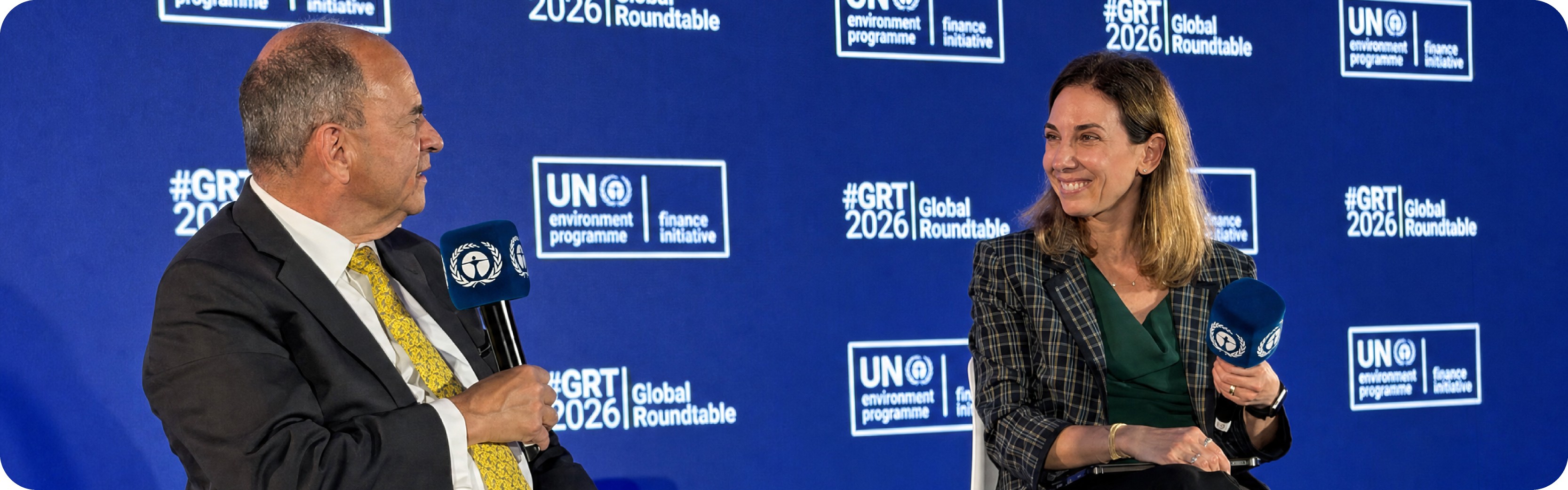
MSCI’s Chairman and CEO Henry Fernandez discusses the evolving investment landscape with Maria Sosa Taborda of the UNEP FI during the UNEP FI Global Roundtable 2026 at London Climate Action Week.
Conversations throughout the week surfaced several recurring themes: the growing financial relevance of physical climate risk and location-based intelligence; the increasing importance of data, analytics and AI as enablers of better investment decisions; the emergence of adaptation and resilience as an investable theme; and the strengthening of integrity across carbon markets.
Here are highlights.
Evidence of the financial materiality of physical climate risk continues to mount as extreme weather events become more frequent and severe, noted investors, lenders, insurers and others throughout the week. An analysis published by MSCI, for example, found that physical climate risk is increasingly reflected in credit markets, where investors have demanded higher returns from companies more exposed to hurricanes, and that physical risk is associated with weaker profitability.
The research suggests that understanding the exposure of portfolios or loan books to physical hazards starts with location. Following MSCI's agreement to acquire First Street, a leading provider of physics-based climate risk data and analytics for every property in the world, MSCI clients will gain access to more granular, asset-level assessments of physical climate risk.
The week’s heatwave illustrated another finding from the data — that the risk of business interruption from physical climate hazards is 14 times greater than the risk of asset damage.2 Companies are now more than 6.5 times as likely to issue a profit warning following an extreme weather event than they were two decades ago, according to an analysis by First Street.
Data centers offer a striking example. Nearly 80% globally face elevated exposure due to acute climate hazards such as flooding, extreme winds and wildfires that can disrupt operations, increase downtime, and drive insurance and repair costs.3 As Matthew Eby, First Street’s founder and CEO, observed this week, “The world is building its most capital-intensive infrastructure where operating conditions are hardest, not easiest, and committing to those sites for decades.”
Physical climate risk, supply-chain disruption, geopolitical uncertainty and energy security are increasingly viewed as interconnected business risks rather than isolated operational challenges. For investors, that means understanding not only what companies do, but where they operate, source, produce and sell.
"If you think about the confluence of forces affecting the world today, we have AI, geopolitical risk and energy, and we have to balance that with climate and sustainability, rather than treat climate and sustainability separately,” said Richard Mattison, MSCI’s head of sustainability and climate, during a panel discussion at the UNEP FI roundtable.

Richard Mattison, MSCI’s head of sustainability and climate, speaks at the UNEP FI Global Roundtable 2026 during London Climate Action Week.
He stressed the value of location in making previously invisible risks more visible, pointing to MSCI’s work to map physical supply-chain exposure, helping investors and lenders better understand how risks can propagate through complex global networks. The geographic concentration of a company's suppliers, production facilities and customers, for example, has helped explain stock returns during major geopolitical events over the past decade, according to an analysis by MSCI published during the week.
- The most resilient assets may be those designed to withstand multiple forms of disruption rather than a single hazard, noted participants at a conversation on the future of infrastructure. Investors increasingly need to evaluate resilience across climate, cybersecurity, energy security, supply-chain disruption and geopolitical risk simultaneously.
- Governments are directing significant capital toward sectors such as energy, food systems, digital infrastructure, advanced manufacturing and critical minerals. Many of these same sectors face substantial physical climate risks.
- Bankers described physical risk as an issue of business continuity rather than solely a climate matter, creating opportunities to engage companies on resilience even in markets where climate-related discussions may be politically sensitive. “Our clients are very eager to talk with us about physical risk,” said one. “It’s an easier in than decarbonization.”
"When people think about resilience today, it's a much wider lens than just climate,” explained a venture capitalist who finances infrastructure. “Climate is only one of many very costly disruptions."
Climate change may be a material financial risk, yet many investors still grapple with translating that understanding into capital-allocation decisions despite the availability of tools, data and frameworks now at their disposal. That was a central theme of a roundtable co-hosted by MSCI and Carbon Tracker that brought together investors and insurers to discuss integrating climate risk into investment decisions and risk management.
The discussion followed a presentation of Carbon Tracker's “Recalibrating Climate Risk” report, which highlighted growing evidence that real-world climate losses are often driven by local extremes poorly captured by global average temperatures.4 That gap can contribute to capital inertia through underpriced risks, false precision and an incomplete understanding of cascading impacts.
- Participants discussed the challenge of financing the transition to a cleaner, more resilient economy when investment incentives and performance horizons often remain focused on the near term. While public markets can be constrained by short-term pressures, speakers noted that private markets have already directed significant capital toward long-duration investments such as infrastructure, renewable energy and other transition-related assets. Currency risk, regulatory constraints, benchmark availability and due-diligence costs remain important barriers to investment in emerging markets.
- Strengthening the market infrastructure that supports climate investment also emerged as a priority. Taxonomies can help define green and transition activities, while insurance can improve risk pricing, narrow protection gaps and help investors better understand climate exposures.
Looking ahead, several speakers suggested that improving economics, technological advances and energy-security concerns could create "green tipping points" that accelerate the deployment of low-carbon technologies, including solar power, battery storage and electric vehicles.

Linda-Eling Lee, founding director and head of the MSCI Institute, leads a discussion on investment in adaptation and resilience during London Climate Action Week.
As the cost of physical climate risk rises, so does the investment case for adaptation and resilience, according to investors, lenders and insurers throughout the week. Research by the MSCI Institute finds that adaptation is already embedded in public markets, with nearly 90% of listed companies showing evidence of at least one resilience activity and almost half generating revenue from products or services that help customers adapt to physical climate risks.
“The data challenges the narrative that companies are doing nothing,” said Linda-Eling Lee, the Institute’s founding director, at a roundtable co-hosted by the Institute and the Global Adaptation & Resilience Investor Working Group (GARI).
Several themes emerged:
- Companies may understand their physical risks but not disclose them in ways investors can use. Insurers possess sophisticated risk models, but much of that knowledge remains difficult to translate into broader investment decisions. While roughly half of companies' adaptation and resilience activities are not disclosed in sustainability reports, AI large language models (LLMs) may offer an efficient way to identify them by unlocking insights from unstructured data. The Institute has demonstrated how LLMs can identify companies whose products and services could qualify as adaptation solutions.
- The conversation about resilience is shifting from downside protection to competitive advantage. Rather than asking only how investors can avoid losses, participants increasingly discussed how adaptation can create stronger businesses, new products and more resilient business models.
- The combination of AI to identify a thematic universe and frameworks such as those developed by GARI are helping investors identify relevant companies. “Leaders will label themselves as leaders, but there are other companies that don't advertise themselves,” noted Jay Koh, founder and chair of GARI.
A conversation hosted by MSCI about the scaling of integrity in carbon markets reinforced a similar message: better measurement, independent assessment and greater transparency can reduce information gaps and help investors make more informed decisions.
Running through nearly every discussion was the growing importance of high-quality, location-specific data and analytics. Several participants suggested that data and physical-risk intelligence are themselves becoming a form of critical infrastructure. As one adviser observed, “The data associated with an asset is becoming almost as valuable as the asset itself.”

Subscribe todayto have insights delivered to your inbox.
Hidden in Plain Sight: Physical Risk in Asset Owners’ Portfolios
Where assets are located matters. MSCI and Swiss Re Risk Data Solutions uncover how physical hazards are reshaping asset-owner portfolios — and how insight can drive resilience.
Physical Risk Guide for Asset Owners and Asset Managers
A practical framework for asset owners and managers to measure physical climate risk exposure, assess materiality and integrate findings into investment decisions across functions.
1 “Extreme Heat Warning extended as temperatures forecast to reach 38°C,” Met Office, June 21, 2026.
2 See, e.g., “Europe’s heatwave curbs French nuclear plants,” Reuters, June 24, 2026.
3 “The Overlooked Climate Risk in Global Data Center Markets,” First Street, June 18, 2026.
4 “Recalibrating Climate Risk,” Carbon Tracker, Feb. 5, 2026.
The content of this page is for informational purposes only and is intended for institutional professionals with the analytical resources and tools necessary to interpret any performance information. Nothing herein is intended to recommend any product, tool or service. For all references to laws, rules or regulations, please note that the information is provided “as is” and does not constitute legal advice or any binding interpretation. Any approach to comply with regulatory or policy initiatives should be discussed with your own legal counsel and/or the relevant competent authority, as needed.