
Real Assets in Focus: Trends to Watch for 2026
Global real-estate markets have softened again after a brief post-pandemic rebound, constrained by cyclical weakness and persistent structural headwinds. At the same time, competition across private markets has intensified. In 2025, target allocations to real estate declined for the first time in 13 years as institutional investors shifted toward infrastructure and, increasingly, private credit.1 Roughly 60% of investors now view these alternatives as direct competitors to real estate, and many — particularly across EMEA and APAC — are formalizing real estate within a broader real-assets framework. Real estate is having to work harder for its place in the portfolio.2
Across both Europe and the U.S., equity fundraising has become more difficult as real-estate returns continue to lag, while debt strategies are delivering higher yields — effectively inverting the traditional risk-return hierarchy. Investors who once relied on equity real estate for superior returns are now finding that real-estate debt, often with stronger downside protection, is offering more attractive risk-adjusted outcomes. The result is a pronounced tilt toward private credit within allocations to real assets.
The U.S. market illustrates this shift most clearly. Debt funds now account for a growing share of new originations, and dry powder for U.S. closed-end real-estate debt vehicles continues to climb. Managers, flush with capital and facing less competition from traditional lenders, are able to structure deals on highly favorable terms. This widening spread between equity and debt opportunities has heightened the competitive pressure on real-estate equity to justify its role relative not only to infrastructure and private equity, but increasingly to private credit.
However, allocations shift between the different private asset classes; understanding the underlying drivers of real- and private-asset portfolios’ performance cannot be done through aggregate global asset-class indexes alone. Such aggregates obscure the meaningful variation in return drivers, risk exposures and operational realities across sectors and geographies. They also hide the increased blurring of boundaries between asset classes. Data centers, life-science facilities, hospitals and care homes regularly appear in both real-estate and infrastructure strategies. And although infrastructure as a whole has outperformed real estate since the 2008 global financial crisis (GFC), the distribution of individual asset-level returns over the past five years overlaps almost entirely — meaning that shifting capital from real estate to infrastructure would not have guaranteed a better outcome.
Even the niche segments like data centers, which continue to gain more attention than the traditional property types, aren’t free from their own issues. Escalating technical requirements, especially those driven by AI workloads, mean the viability of assets increasingly hinges on micro-location and on whether buildings can support high-density power, cooling and connectivity. This potential lesson in obsolescence will be familiar to real-estate investors who have learned the hard way what this looks like in the shopping-center and office sectors over the last 10 years or so.
Looking ahead, 2026 will likely remain a challenging year for real estate overall. But opportunities to re-enter the market are emerging, as pricing adjusts and capital markets stabilize. Understanding how real estate compares with infrastructure, private equity and especially private credit will require a more granular assessment of which segments offer compelling risk-adjusted returns within an integrated real-assets allocation.
1. Tide of market liquidity has yet to turn
Global property markets have endured an extended period of low liquidity since high inflation and rising interest rates killed off the lower-for-longer environment that had pushed so much capital into real estate. The decline in dealmaking has been a shock for a market grown used to abundant liquidity through the post-GFC boom.
The market had expected 2025 to be the year the real-estate recovery would really take hold — “Survive Until ’25!” was the industry’s rallying cry — but the many geopolitical and economic uncertainties that emerged in the first half acted as a brake on dealmaking. In aggregate, global deal volumes were only slightly higher than those recorded in the first half of 2024 and 2023; and market liquidity, as measured by MSCI Capital Liquidity Scores, remains well below the long-run average in the major global metros.
The extended period of low liquidity is not only affecting those investors directly involved in the dealmaking process; it has negatively impacted investment managers’ ability to raise new capital. Distributions from closed-end funds’ managers have flatlined amid weak market conditions, with owners unable to trade assets and return capital to investors. In turn, investors have been reluctant to recommit to the sector while awaiting returns from prior vintages. This dynamic has emerged amid a very competitive landscape for private-capital allocations, where returns and distributions from private credit and infrastructure have held up much better than those for real estate since mid-2022.
The missing link in the liquidity chain is core capital: Acquisitions by traditional core real-estate investors are at extremely low levels, particularly in Europe and North America. The tide may be starting to turn, however. Inflation has fallen from its post-pandemic peak, allowing central banks to begin lowering interest rates — to varying degrees — while valuations have stabilized across much of the market, according to the MSCI Global Quarterly Property Index. These developments are creating the right conditions for renewed price discovery, and core assets in a handful of segments are now starting to look fairly priced again, especially where buyers can price in strong income growth and debt is accretive.
Concerns over inflation and the path of interest rates set by central banks nevertheless remain a drag on market activity. For that reason, the recovery will likely resemble a steady upward climb rather than a rapid rebound; but once transactions begin to flow, liquidity itself should become self-reinforcing, helping facilitate the next phase of the real-estate cycle.
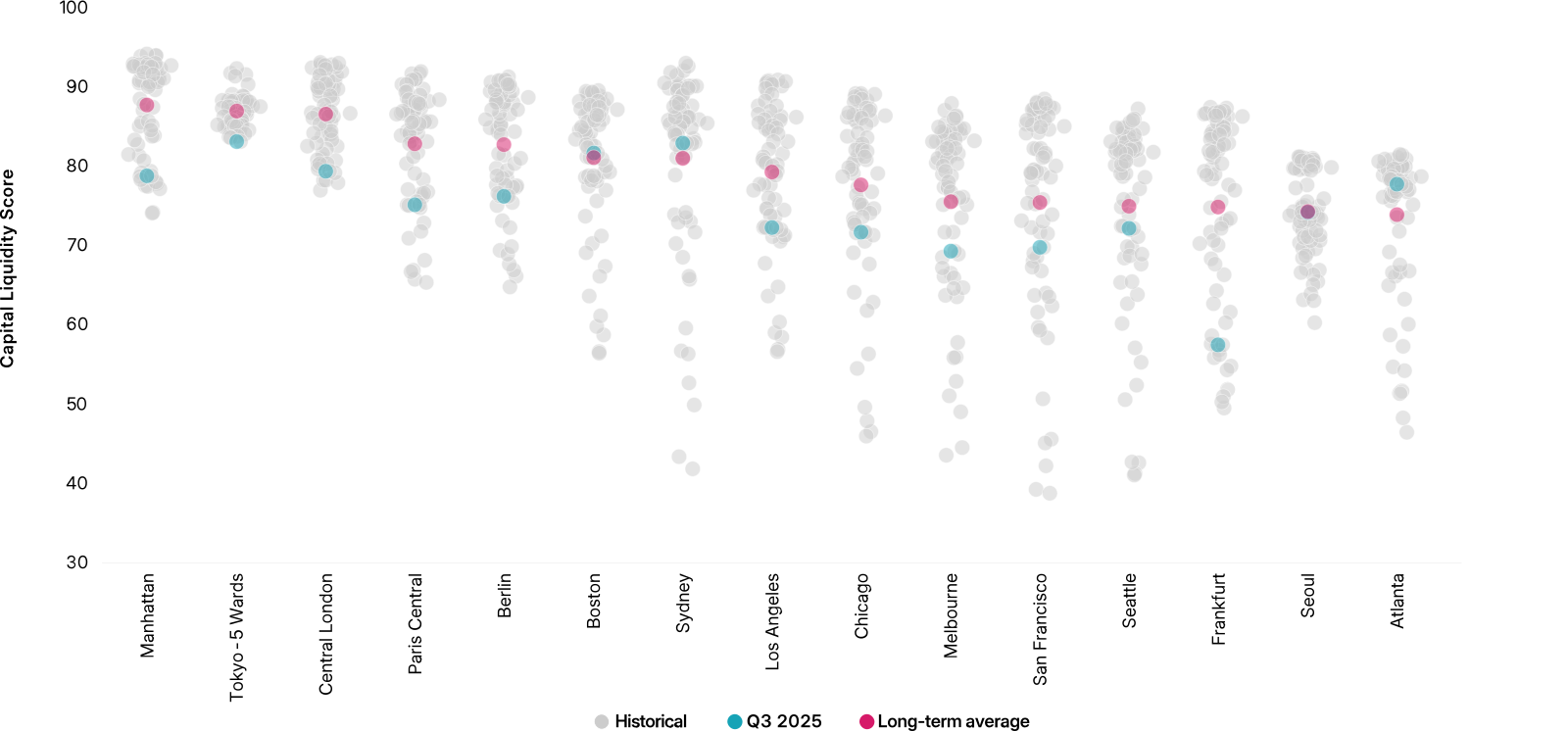
Source: MSCI Capital Liquidity Scores
2. Overlapping assets — and performance — in real estate and infrastructure
Given the complementary operational and financial relationships between real estate and infrastructure, it is not surprising that many investors are moving toward unified real-asset allocations. Investors would be wise to more carefully compare performance between the strategies to help determine allocations and harness opportunities.
At first glance, analyzing the MSCI global infrastructure and property indexes, infrastructure returns seem to have been far superior since June 2019. In fact, infrastructure has delivered stronger, more stable returns with lower volatility, particularly in stressed market circumstances like the GFC and COVID-19 pandemic. Such comparisons overlook an important detail, however: Leverage is often embedded within infrastructure assets themselves, whereas real-estate indexes typically measure returns at the unlevered building level.
Infrastructure assets in the MSCI index, for example, typically have around 50% loan-to-value ratios. When real-estate index returns are scaled using similar leverage assumptions, the comparison becomes more balanced. The additional gearing amplifies volatility — making real estate appear even riskier relative to infrastructure — but the level of returns becomes less dissimilar (at least outside of market turning points), lagging by only 77 basis points (bps).
Looking beneath the headline numbers, the distribution of individual asset returns tells an even richer story. While infrastructure has outperformed real estate in aggregate, the range of infrastructure returns over the last five years is much wider and encompasses the entire distribution of real-estate outcomes on an unlevered basis, although, again, applying similar leverage makes the breadth of the distributions more similar.
This pattern reinforces our earlier research showing that the spread of returns across infrastructure sectors is broader than across property types. For investors, this means that index-level results can mask significant variation — in practice, a well-constructed real-estate portfolio could outperform one focused on infrastructure, depending on asset and sector selection. These findings underline the critical importance of active portfolio construction and selection decisions within both asset classes.
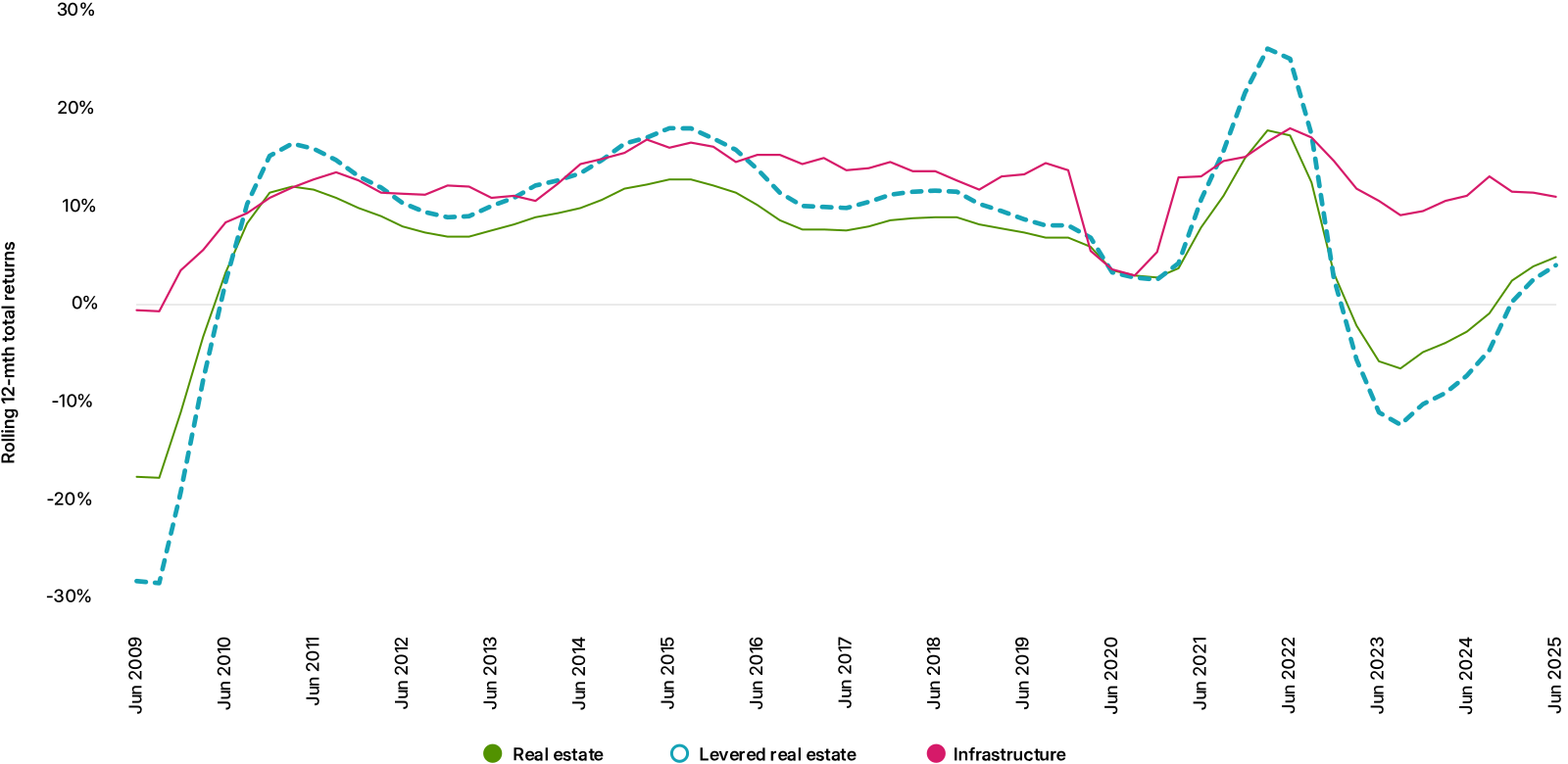
Real Estate: MSCI Global Quarterly Property Index (Unfrozen). Infrastructure: expanded dataset of the MSCI Global Quarterly Private Infrastructure Asset Index. Levered real estate applies MSCI’s custom index leverage methodology assuming a constant 50% loan-to-value ratio. Distributions of five-year returns are derived from a sub-sample of assets that were held in contribution portfolios for the full five-year period to Q2 2025. Leverage was applied to each asset in the real-estate sample using the same leverage methodology.
3. Data centers: Rapid evolution, rapid obsolescence?
A structural shift in the engineering technology of data centers has taken place over the past couple of years, moving toward high-power-density environments capable of supporting AI workloads. NVIDIA’s Blackwell superchips, launched in 2024, have now become a staple for the most intensive type of AI workloads — those used for model training — which feature densities of more than 100 kilowatts (kW) per rack. As a result, hyperscalers have increasingly turned to data centers with direct-to-chip or immersion liquid-cooling capabilities. The share of construction starts of new data centers with direct liquid-cooling capabilities has soared in 2025.
While model training may be the rarefied domain of a smaller group of hyperscale technology tenants, model inference is likely applicable to a far broader group of corporations. Model inference requires lower rack densities compared with model training, in the region of 20 to 50 kW per rack, but this is still much higher than what traditional air-cooled data centers can support. Even for regular cloud-based data centers under development, many of their operators are branding these offerings as “AI-ready,” while concurrently refurbishing older data centers to incorporate newer cooling technologies to target demand from this segment.
There are several implications for private-market investors. For one, the increasing prevalence of model inference as a use case across most leading global technology companies implies an increased risk of obsolescence for older data centers. This would apply especially to those without “future-proofed” designs that allow newer technologies to supersede older ones without a substantial redevelopment of the entire data-center shell.
More important, the increased specifications of data-center fit-out — whether electrical systems, advanced cooling or specialized mechanical engineering — has raised the development cost per megawatt materially. Data-center developments today are much more capital-intensive than in the past, often requiring billions of dollars of investment and, consequently, much larger equity- and debt-raising exercises.
Also important, the capital-intensiveness of the data center’s fit-out means more depreciation for investors to account for. Investors have balked at the substantial amount of capital expenditure required to refurbish office buildings following the pandemic era or risk their falling into obsolescence. Could the same theme repeat itself several years down the road, when hyperscale customers near the end of their leases and real-estate owners are left with building shells fitted out with by-then outdated cooling and electrical systems?
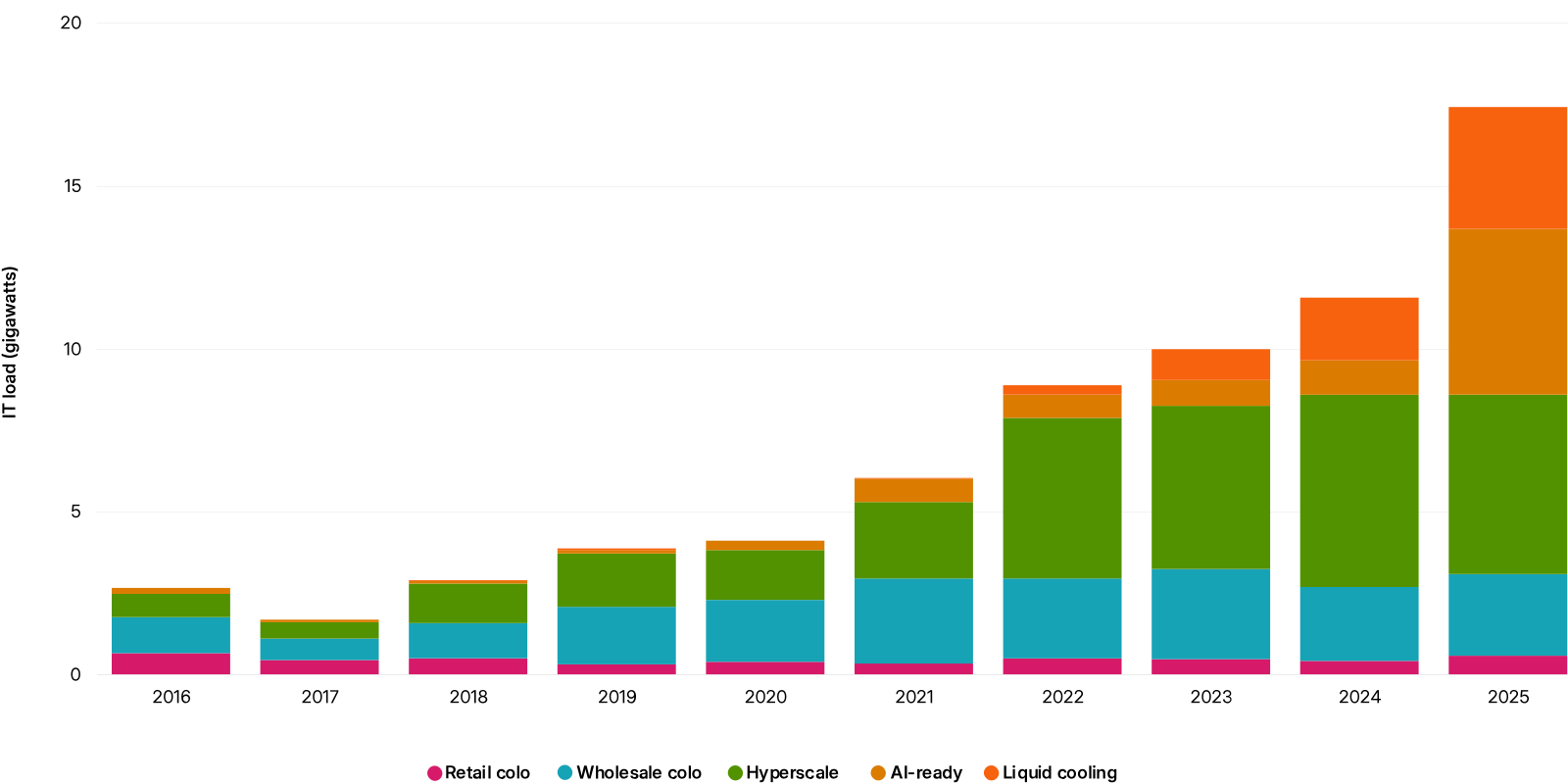
Colocation data-center construction starts; excludes data centers for crypto-mining. Data as of Dec. 19, 2025. 2025 starts through November. AI-ready refers to data centers that support high-density racks, typically 30 kW and greater. Liquid cooling refers to data centers that have liquid-cooling compatibility for at least some of their racks.
4. Debt holds its performance allure
When investment returns falter, asset managers face a difficult time raising capital. Managers may see opportunities in the chaos of falling returns, but until performance turns a corner, it can be challenging for asset owners to commit to new funds.
Real-estate debt funds have outperformed private-equity real estate over the past few years, as some fund vehicles have been better protected from the declines in asset prices that followed the interest-rate spikes. As the global property market moves past price declines, investor preferences for debt versus equity investments can change in line with a new mix of options around risk and return.
Event risk around price declines is a critical factor for real-estate investors, and the position a fund takes in the capital stack can shelter an investor from such event risks to a degree. The safest position from this event-risk perspective is the senior debt, where losses from price declines are first felt elsewhere. The equity portion of the stack, by contrast, absorbs losses before others.
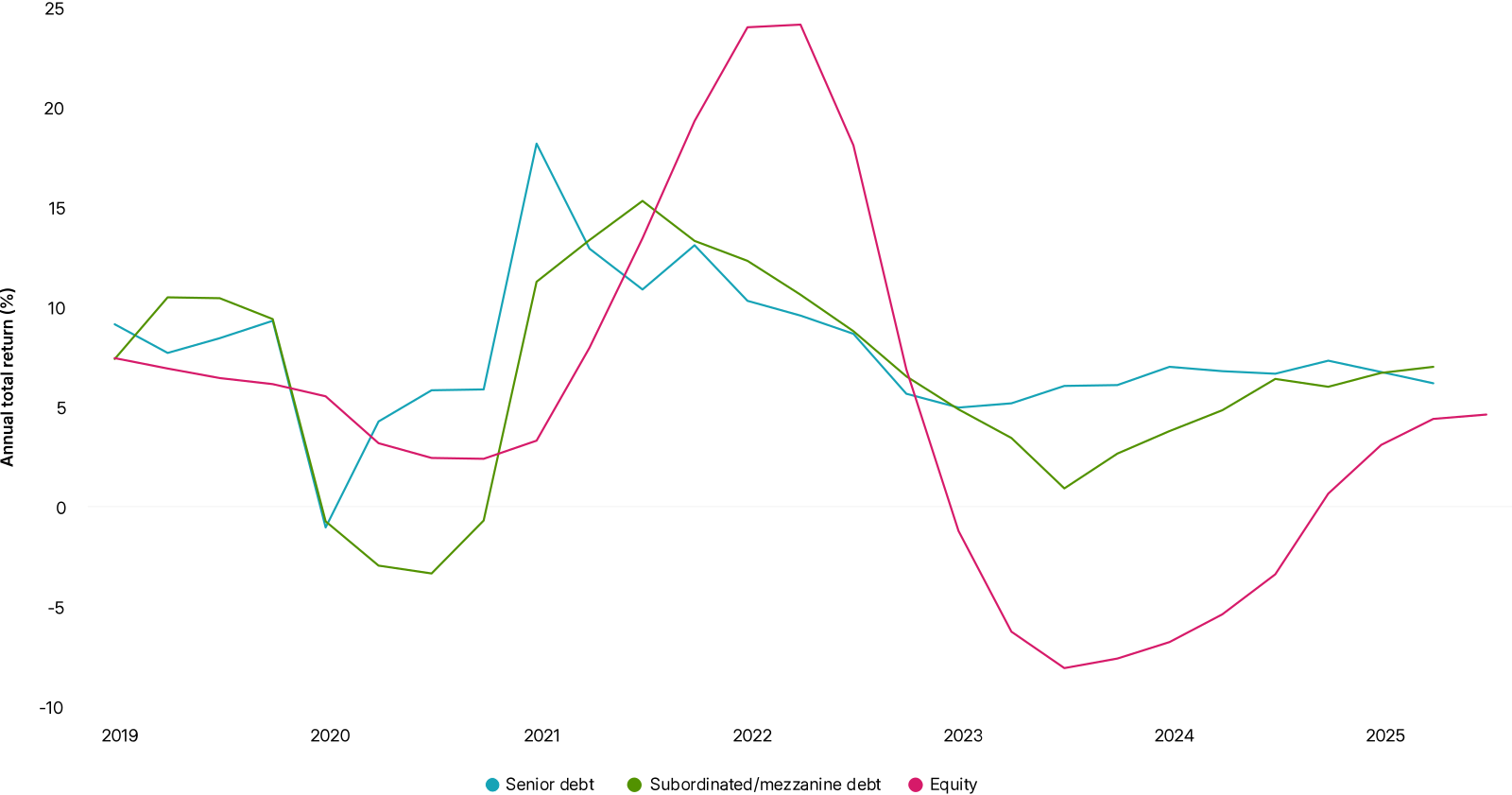
Senior-debt and subordinated-/mezzanine-debt returns from the MSCI North America Real Estate Debt Closed-End Fund Index, data through Q2 2025. Equity returns from the MSCI/PREA U.S. AFOE Quarterly Property Fund Index, data through Q3 2025.
This lower-risk senior debt outperformed the higher-risk equity portion of the capital stack beginning in late 2022, an outperformance that continued into the middle of 2025. When commercial-property prices faltered following the rate shocks of 2022, falling appraisal values pulled equity returns — as measured by the MSCI/PREA AFOE Quarterly Property Index — into negative territory. Returns for senior-debt funds — as measured by MSCI’s closed-end-fund data — slipped as well, but retreated only to a low of an annualized 4.97% in the first quarter of 2023 before recovering.
The subordinated-/mezzanine-debt funds outperformed equity as well beginning in 2022. But returns slipped below the senior debt as these portions of the capital stack can be more like equity when losses mount.
With these stronger returns, U.S. real-estate debt funds have not just attracted capital but been able to displace other lenders in the marketplace. Looking at debt originations in the real-estate debt market, the investor-driven lenders — a collection of hard-money lenders, mortgage REITs and debt funds — have grown from single-digit share of the first-mortgage market to a 15% share within a decade.
Capital availability helped these lenders. MSCI data shows that some of the recent rises and falls in the lending share for these groups were a function of capital availability. As dry powder surged, so did share of the commercial-mortgage market as these groups then put money to work.
Changing market structures such as tighter oversight of bank lending also helped lift the market share of investor-driven lenders. These lenders were able to step in and provide solutions needed where traditional lenders could not act.
If equity returns gain ground on the back of resumed growth in commercial-property prices, it raises a question about the ease of raising debt and equity funds moving forward. Managers that survived the lean times since 2023 through the fees earned in lending may be loath to give up such a stabilizing portion of their business, however, even if other lender groups step up their competition.
Identifying real opportunities in a complex and competitive operating environment
As investors adjust to a higher-rate and more competitive private-markets environment, traditional real-asset-class labels are becoming less useful than an understanding of the underlying factors — liquidity, capital-structure positioning, asset-level specifics and exposure to technological change, among others — that drive risk and return. A sharper focus on fundamentals will help investors build more sophisticated and resilient portfolios across real estate, infrastructure or private credit.
Looking into 2026, success may hinge on precision — selecting appropriately priced assets in the right locations and sectors rather than broad allocations and market timing. Investors that take a more integrated, data-driven approach across equity and debt will be better positioned to identify where risk is being appropriately rewarded as liquidity returns and price discovery improves.






Subscribe todayto have insights delivered to your inbox.
In Focus
Essential insights for navigating today’s complex markets — delivered quarterly.
Investment Trends in Focus: Key Themes for 2026
Markets are moving faster than ever. Explore the research revealing and analyzing the key forces that will shape markets in 2026 — and what these forces could mean for investors.
Sustainability and Climate in Focus: Trends to Watch for 2026
As governments pivot toward security and technology, markets are increasingly defining the sustainability agenda. We explore how capital, data and risk are driving the next phase of the transition.
1 “2025 Institutional Real Estate Allocations Monitor,” Hodes Weill & Associates and Cornell University Baker Program in Real Estate.
2 Ibid.
The content of this page is for informational purposes only and is intended for institutional professionals with the analytical resources and tools necessary to interpret any performance information. Nothing herein is intended to recommend any product, tool or service. For all references to laws, rules or regulations, please note that the information is provided “as is” and does not constitute legal advice or any binding interpretation. Any approach to comply with regulatory or policy initiatives should be discussed with your own legal counsel and/or the relevant competent authority, as needed.