
Private Credit Deserves a Daily Performance View
- Private credit is close to USD 3 trillion in AUM and a core institutional allocation, yet standard benchmarks report with a significant lag, leaving managers and asset owners without a current view of performance.
- The MSCI All Country Private Credit Index nowcasts a daily index level by combining public-market data with fund-reported data as it emerges to produce an estimate of where returns would be if net asset value was reported daily.
- As of March 26, the index estimates a -0.5% month-to-date return and a 1.2.% return for the quarter so far. Investors relying on lagged quarterly data would wait until June for first-quarter results to be published.
Private credit is close to USD 3 trillion in AUM and a core allocation for most large institutions, yet fund performance is mostly reported quarterly, with up to a quarter lag.1 This means investors are navigating with data that is, structurally, always behind.2 The recent repricing of the public credit markets, around AI’s perceived threat to some sectors and heightened geopolitical uncertainty, underscores the need for more frequent and timely performance data.
The MSCI All Country Private Credit Index was created to address this lag. It is designed to provide a high-frequency valuation view for private-credit managers and asset owners to better understand and analyze this rapidly expanding asset class.
Building on a quarterly foundation
The MSCI All Country Private Credit Index (subsequently in this blog, the “daily index”), provides a daily estimate of private-credit fund performance, drawing on both public-market data and fund-reported valuations as they become available. Its foundation is the MSCI Global Private Credit Closed-End Fund Index, which is published quarterly (subsequently, the “quarterly index”). The daily index does not independently appraise the economic value of underlying loans in the private-credit funds; rather, it estimates where GPs’ reported marks are heading before the quarterly index publication catches up.
The public-market signal comes from two sources: first, daily changes in the option-adjusted spread of a composite high-yield corporate-bond index, reweighted to match the sector and geographic composition of private-credit fund holdings; and second, currency return data to capture the impact on returns from non-USD-denominated assets.
In the chart below, we show the daily index (green line) alongside the quarterly index (pink dots) from Dec. 31, 2009 to March 26, 2026. The close alignment between the two series is intentional. The daily index is designed to track the quarterly benchmark, not to diverge from it. What the chart also shows, less obviously but more importantly, is a timing gap. Each pink dot represents a quarterly return that becomes available roughly three months after the quarter closes, while the green line is available continuously throughout the quarter. By the time the quarterly mark is published, the daily index has already spent most of the prior quarter reflecting that same information.
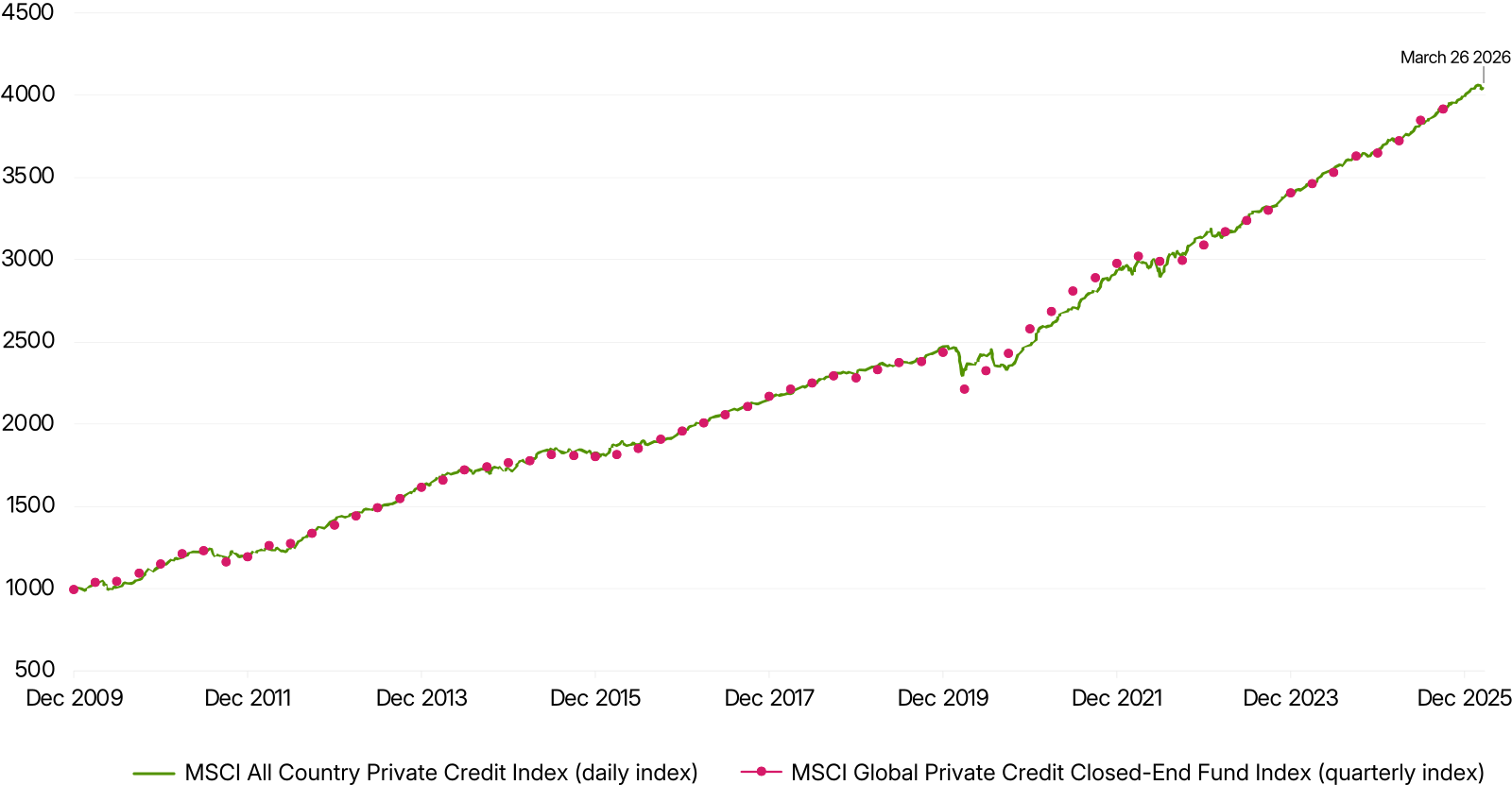
The MSCI All Country Private Credit Index has been backtested to Jan. 1, 2010. For ease of comparison, the quarterly index levels (shown as pink markers) are displayed without their reporting lag of roughly one quarter.
Translating public-market stress into private-market impact
The drop in the MSCI All Country Private Credit Index in late March demonstrates how the index captured the impact of public-market stress without the need to wait weeks for the fully reported data.
The daily index estimates a return of -0.5% month-to-date for March as of March 26, and a below-average return of +1.2% for the first quarter as of the same date. The main driver for these estimates is wider spreads in the public high-yield markets, specifically in sectors where private-credit funds are heavily concentrated. In the U.S., sectors where private credit is most exposed were adversely affected: Spreads of financial corporate bonds widened by +84 basis points (bps) year to date, with spreads in information-technology bonds, industrials and health care also widening by double digits. In contrast, one of the top-performing high-yield sectors has been energy, where private credit is underexposed; here, spreads tightened on rising oil prices.
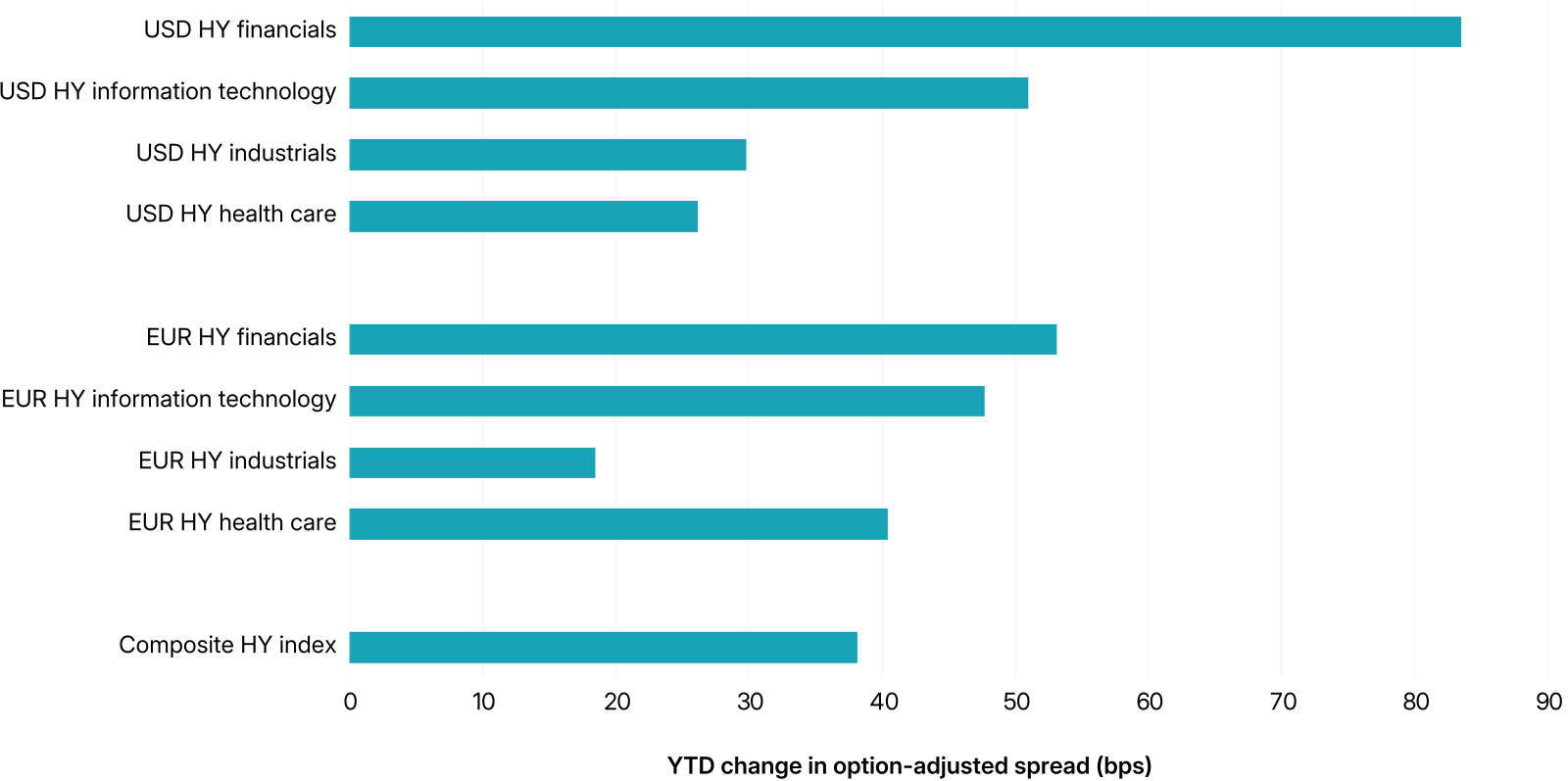
Change in option-adjusted spread (OAS) of a selection of MSCI high-yield bond indexes. Sectors displayed where private credit has large concentrations. Composite displays the OAS change weighted by private credit’s sector and currency exposure. Data as of March 26, 2026.
This divergence illustrates why a generic high-yield index has not served as an adequate proxy for private credit. Our public-proxy composite high-yield index is reweighted to reflect the actual sector and geographic composition of private-credit fund holdings, which is why its option-adjusted spread widened by +38 bps year to date.
What investors can do with a daily index
The gap between quarterly marks and current market conditions is not just a data inconvenience, it constrains what investors can do. Closing the gap allows for analysis and decision-making not feasible with quarterly data alone.
Asset allocation
For asset allocators managing against policy benchmarks or risk budgets, knowing where private credit stands relative to target weights requires timely performance data. With quarterly marks, an allocator may be meaningfully over- or underweight for months before the data confirms the position. Rebalancing is thus reactive by the time a quarterly report shows the drawdown, with any rebalancing decision based on information the market priced weeks earlier. The daily index is built to give allocators a current read on private-credit performance that can feed directly into tactical allocation frameworks, when the information is actionable rather than retrospective.
Semi-liquid fund management
Managers of semi-liquid private-credit funds face compounding pressure around net-asset-value (NAV) transparency. Redemption requests, gating decisions and investor scrutiny of valuations have all intensified as this segment of the market has grown and, in some cases, faced stress. The long reporting cycle makes these decisions harder than they need to be, with a fund manager deciding whether to meet or gate a redemption request often working from marks that are many weeks old.
The daily index seeks to provide a continuously updated, independent reference point grounded in the same asset class and driven by the same fundamentals as the quarterly published benchmarks. It does not replace the GP's own valuation process, but it is designed to give fund managers, boards and investors a market-consistent read on where the portfolio likely stands between quarterly publications, which is precisely when decisions have to be made.
High-frequency monitoring for investment committees
Quarterly marks mean that CIOs presenting to investment committees or boards are routinely working with lagged private-credit data. A portfolio that has moved materially in the current quarter will not show that movement in the official NAV until weeks after the quarter closes. The daily index is constructed to provide investment teams with a current number to anchor those conversations — not a final mark, but a well-grounded estimate of where the market is now.
Looking ahead
As the market for passive and rules-based private-credit strategies matures, a daily index can provide a reference foundation. GPs may also find value in tracking their own fund performance against a daily market reference between reporting periods, a use case that becomes more relevant as investor demand for intra-quarter transparency grows.
How the model works
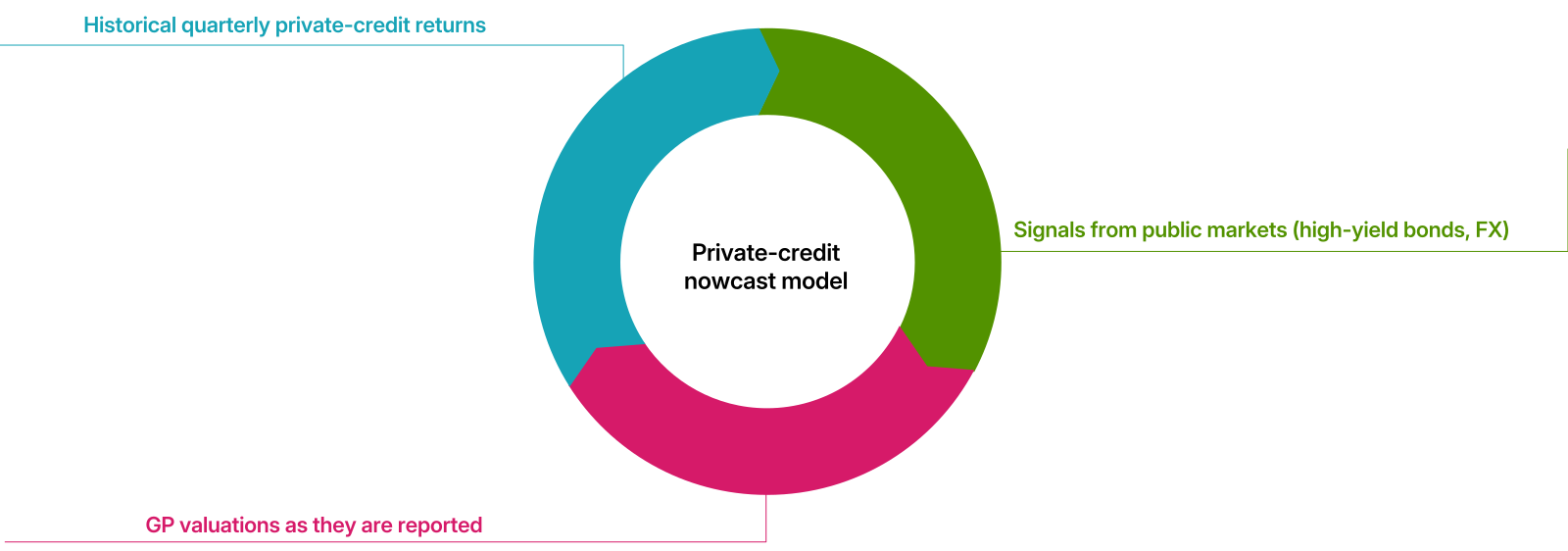
The model combines three inputs. The first is the return history of the MSCI Global Private Credit Closed-End Fund Index. Private-credit returns are predominantly income-driven, so prior quarter returns provide a useful baseline.
The second input is a public-credit proxy, as noted earlier. A weighted average of 21 USD and EUR high-yield corporate-bond indexes, reweighted quarterly, mirror the sector and geographic composition of private-credit fund holdings. We use changes in option-adjusted spreads rather than total returns to isolate the credit signal.3 In addition, EUR/USD returns are included to capture the currency exposure from holdings denominated in EUR (roughly 20% of total).
The third input is GP-reported NAVs as they arrive. The fastest-reporting GPs typically begin submitting valuations around 30 days after quarter-end (which is approximately 50 days before the quarterly index is published). As those early marks come in, the model blends them with the public-market nowcast in a Bayesian framework, giving increasing weight to actual fund data as the reporting sample grows.
Private equity and private credit on a common footing with public markets
The MSCI All Country Private Credit Index uses the same methodological framework as the MSCI All Country Private Equity Index. A quarterly benchmark sourced from limited partner data is the anchor, a public-market proxy is calibrated to the private-asset universe and Bayesian blending is used for incoming fund data as reporting progresses. Institutions holding private equity and private credit can now run analytics and benchmarking across both asset classes using indexes built on a consistent structure.
But the more significant shift is how these new daily frequency private indexes interact with total-portfolio management. Public equity and credit indexes update continuously and they are the baseline against which everything else is measured: Portfolio construction, risk management and allocation decisions are all built around that cadence. Private markets have always been the exception, with meaningful portfolio allocations that nonetheless had to be treated as slow-moving, quarterly inputs. With both private equity and private credit now available at daily frequency, that exception is diminished. A portfolio spanning public equities and credit and their private counterparts can now be monitored and attributed using indexes that all operate at the same cadence.



Subscribe todayto have insights delivered to your inbox.
Run Risk or Rational Repricing? Private Credit’s Software Stress Test
The AI update that rattled equity markets in early 2026 also exposed a fault line in private credit. We examine the selloff in business development companies and the wider implications for investors.
The Ascendance and Implications of Evergreen Funds in Private Markets
The rise of semi-liquid vehicles comes bundled with challenges for GPs, asset owners, wealth investors and regulators. MSCI US Evergreen Fund Monthly Indexes show the performance so far.
MSCI All Country Nowcasting (Daily NAV) Indexes
Decision-grade daily insight for private equity and private credit — built on established benchmarks, LP-sourced data and a rigorous governance framework.
1 The total size is based on MSCI’s aggregate estimation of closed-end, listed and unlisted BDCs and other private-credit vehicles. Other industry sources, such as the Alternative Credit Council, vary in their estimates.
2 The term “lag” in relation to private-credit NAVs can refer to the delay between the quarter-end and the release of GP NAVs and hence the publication of quarterly private-credit indexes, as well as to the valuation lag arising from GPs incorporating market and operating conditions into NAVs slowly. The nowcasting approach described here addresses the first, by seeking to provide daily aggregate NAV projections.
3 Private-credit lending is predominantly floating rate while public bonds are mostly fixed spreads.
The content of this page is for informational purposes only and is intended for institutional professionals with the analytical resources and tools necessary to interpret any performance information. Nothing herein is intended to recommend any product, tool or service. For all references to laws, rules or regulations, please note that the information is provided “as is” and does not constitute legal advice or any binding interpretation. Any approach to comply with regulatory or policy initiatives should be discussed with your own legal counsel and/or the relevant competent authority, as needed.