
Private Credit Unwrapped: The Asset-Level View on Performance
- Fund-level benchmarks are a natural starting point for analysis in private credit, but more granularity is needed to examine the drivers of risk and returns in an asset class that's reached an estimated USD 3 trillion in AUM.
- MSCI Private Credit Holdings Indexes aim to provide new insights into the composition of private-credit funds, at a time of increased scrutiny due to pressure on evergreen credit funds and fears over concentration in software lending.
- Holding- and loan-level indexes give asset owners and asset managers the tools to decompose returns by borrower and loan characteristics — a level of transparency that fund-level data alone cannot provide.
Private credit has faced increased public scrutiny early in 2026. Redemption requests have butted against stated redemption limits for some evergreen funds, raising questions about how these vehicles value their underlying assets. Additionally, concerns about AI-driven disruption of software business models have focused attention on sector concentration in private-credit portfolios.
These developments share a common thread. Investors in private credit — an asset class with an estimated USD 3 trillion in AUM — need to see through fund labels and into the performance of underlying assets to form independent views on value and risk, unobscured by fund fees and leverage.1
For instance, private-credit funds hold more than just loans. Across the funds in the MSCI Private Capital Universe, roughly a quarter of fair value sits in equity, warrants, convertible bonds and other non-debt securities — instruments that can meaningfully influence a fund's return profile but that may be obscured in a fund-level measure.
Asset-level transparency matters
New asset-level indexes from MSCI aim to provide deeper transparency into the asset class: First, a set of private-credit holdings indexes that track all assets held by private-credit funds, and second, a narrower set of direct-lending loan indexes that isolate lending facilities specifically. Both are gross of fund fees and fund-level leverage, and are built from manager-reported valuations and cash flows.
The distinction between holdings indexes and loan indexes matters empirically. In full year 2025, the loans of direct-lending funds returned 14.0% and their holdings returned 12.3%, both outperforming the corresponding net-of-fees fund-level benchmark. Over this period, the loan index led, reflecting the steady income from lending facilities. Over five years annualized, however, the relationship inverts: The holdings index pulls ahead, as non-debt positions (equity, warrants, convertibles, etc.) contributed meaningfully to asset-level performance. This is precisely the kind of variation that a fund-level view can mask.
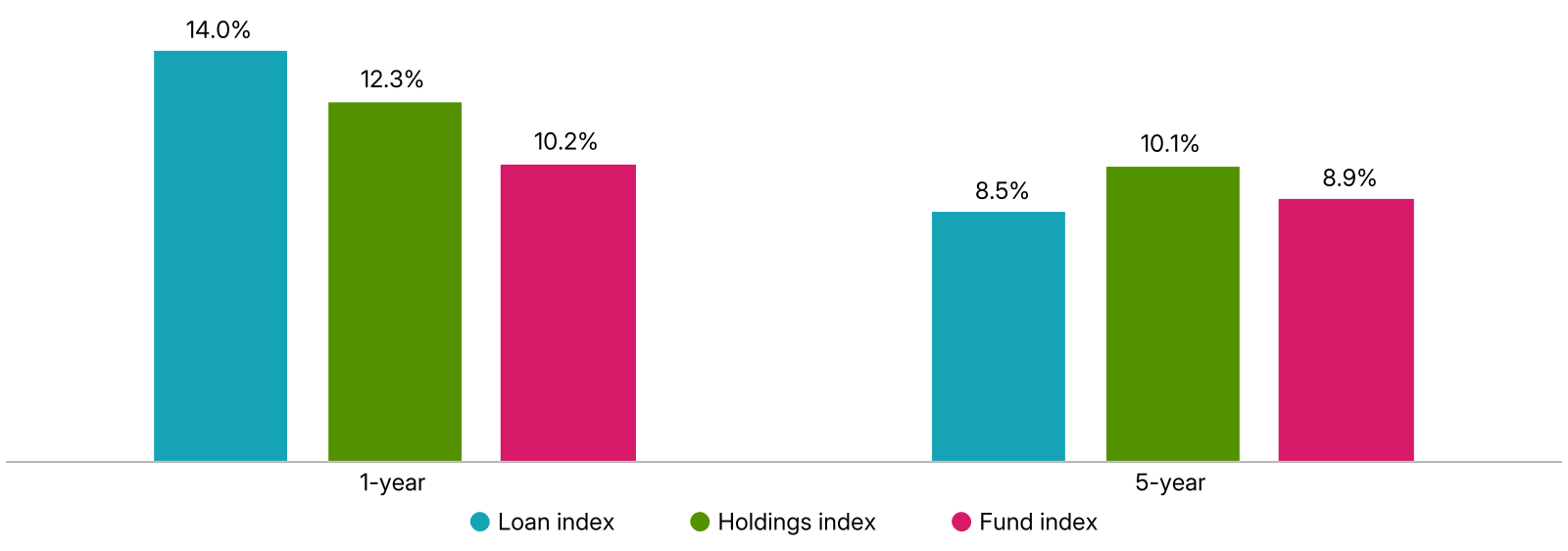
Annualized index total returns through Dec. 31, 2025. Loan index is the MSCI Global Direct Lending Loan Index; holdings index is the MSCI Global Direct Lending Holdings Index; fund index is the MSCI Global Direct Lending Closed-End Fund Index.
Decomposing returns by sectors
Private-credit funds' holdings are concentrated in five major sectors: Industrials, financials, health care, information technology and consumer discretionary together constitute 76% of asset fair value. Unsurprisingly, this concentration mirrors that of private-equity buyout funds, underscoring that private-credit portfolios carry many of the same sector-level macro exposures as the equity side of private markets.
Returns for health care and information technology were the strongest in the year through December, returning 16.9% and 15.6%, respectively, the holdings index shows. These returns were supported by the high yield of the underlying assets. Returns in the IT sector, which includes software companies, remained strong in manager-reported data through the end of 2025. (These marks do not yet reflect the repricing that impacted listed private-credit vehicles with software exposure in early 2026 because of the reporting lag in drawdown funds.2)
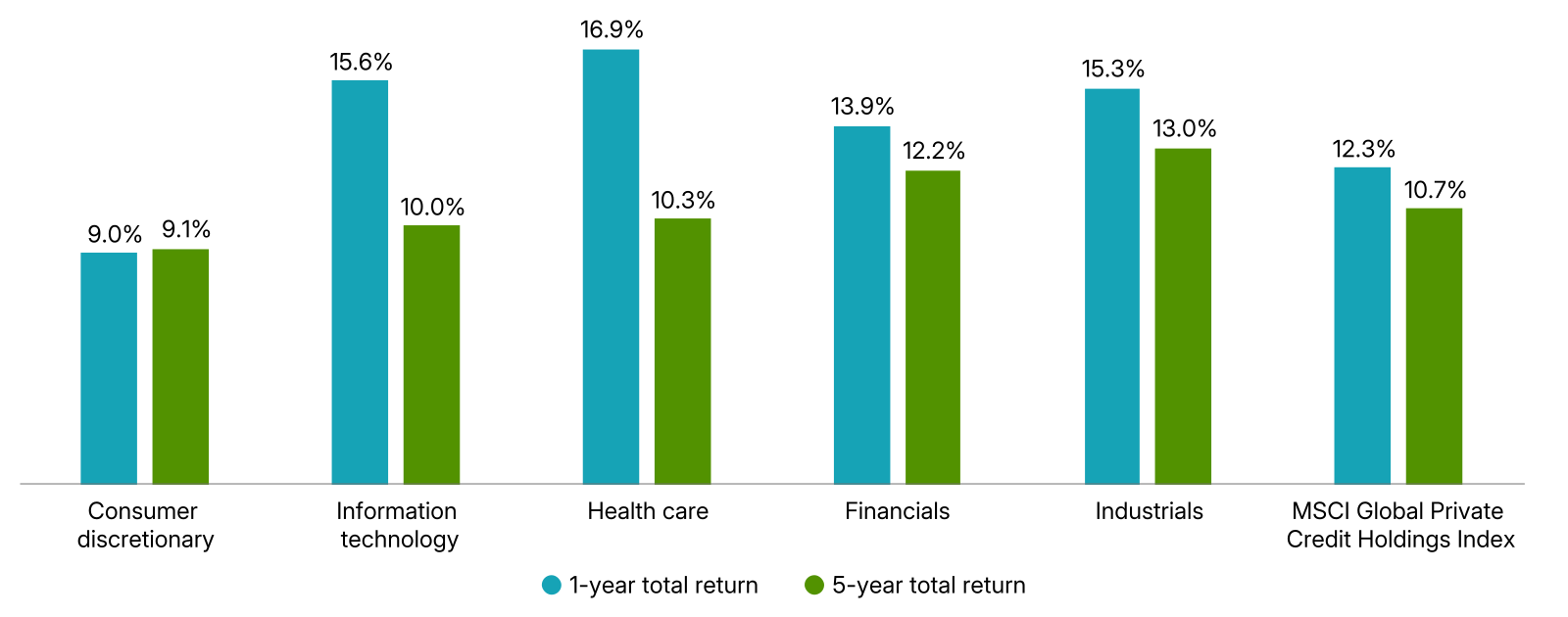
Annualized total returns of private-credit holdings through Dec. 31, 2025.
Borrower size matters
Turning to borrowers, we see that private-credit funds in the MSCI Private Capital Universe are invested in companies across all sizes, with a slight skew toward larger borrowers. About 57% of all lending facilities go to upper-middle-market (annual EBITDA USD 50 million to 150 million) and large-capitalization borrowers (EBITDA greater than USD 150 million). Historical returns show that direct-lending loans to large-cap borrowers returned 10.8% annualized over the last five years, outperforming loans to smaller borrowers by 2 to 3 percentage points.
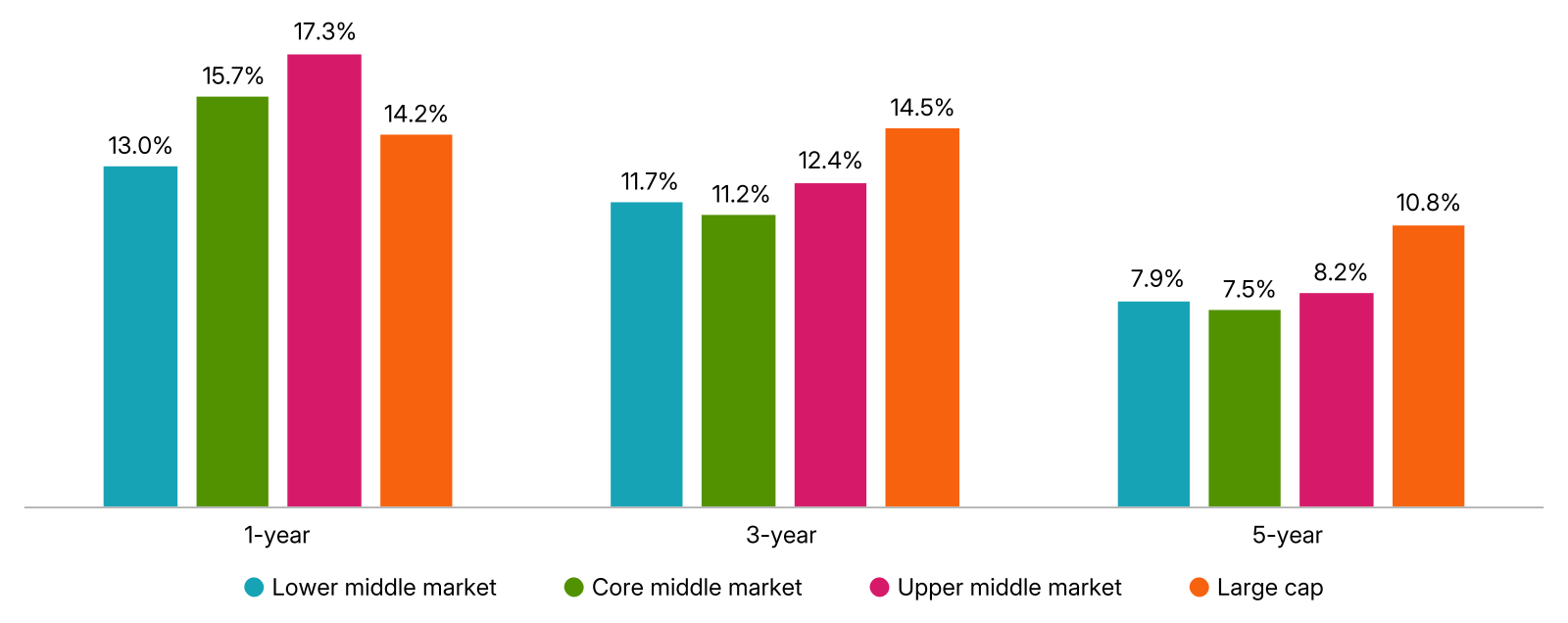
Total returns by borrower size, annualized, through Dec. 31, 2025; MSCI Global Direct Lending Loan Index. Borrower size based on latest reported 12-month EBITDA. In USD million: lower middle market 10-25, core middle market 25-50, upper middle market 50-150 and large cap greater than 150.
All else equal, larger borrowers are considered to have lower credit risk, given their more diversified revenues and better access to funding markets in distress scenarios. They do, however, carry more debt: Median net leverage rises from 4.5x for lower middle market to 5.8x for large cap.
Yet, interestingly, current yields remain broadly flat across borrower sizes, ranging from 9.9% to 10.8%, suggesting that lenders view these stronger credit profiles as sufficient to offset the additional leverage. The combination of higher returns and higher leverage without a corresponding yield premium points to lower realized losses and fewer write-downs rather than higher income as the main drivers of large-cap outperformance.
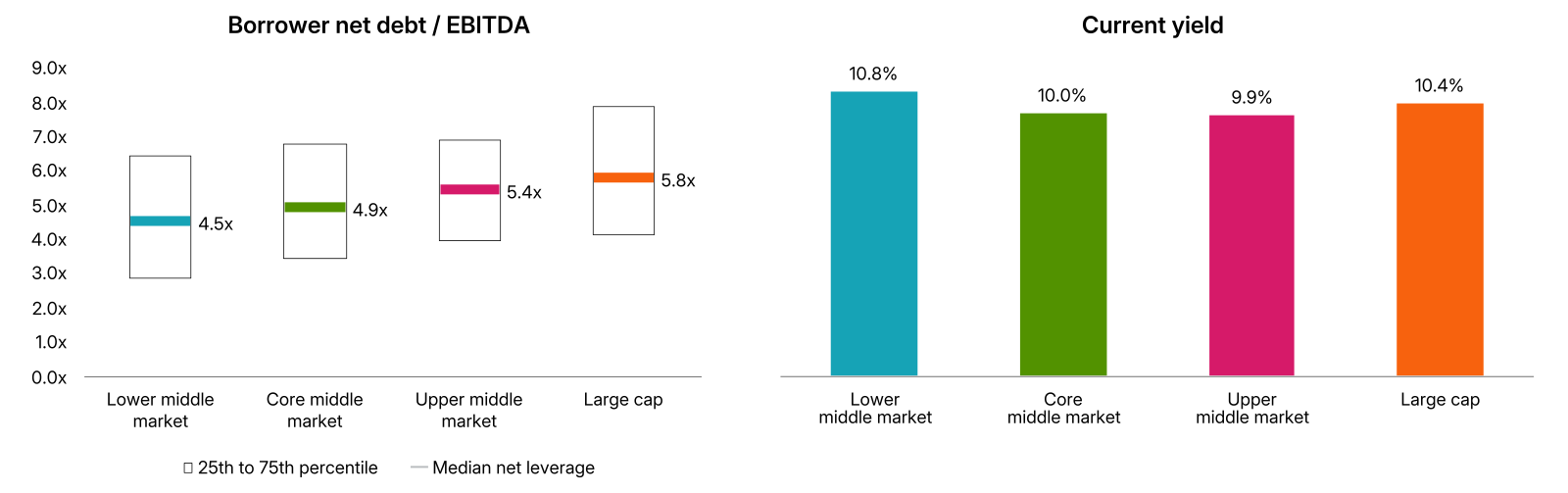
Borrower size based on latest-reported 12-month EBITDA. In USD million: lower middle market 10-25, core middle market 25-50, upper middle market 50-150 and large cap greater than 150. Source: MSCI Private Capital Universe
Increased transparency amid increased scrutiny
Private credit has grown rapidly to become a core allocation for institutional investors, and a broader analytical toolkit is required. Fund-level benchmarks serve a clear purpose: They capture the net-of-fees and net-of-leverage experience of investing in private-credit funds and remain the appropriate yardstick for evaluating managers and fund performance. But as the questions asked of the strategy increasingly extend to the composition and behavior of the underlying assets, a different lens is needed.
Concerns around marks and AI-driven disruption have sharpened the focus on what sits inside private-credit portfolios. Holding- and loan-level indexes give asset owners and asset managers the tools to decompose returns by borrower and loan characteristics — a level of transparency that fund-level data alone cannot provide.



Subscribe todayto have insights delivered to your inbox.
Private Credit Deserves a Daily Performance View
Investors trying to manage private-credit portfolios and assess risk have been handcuffed by quarterly, lagged benchmarks. The MSCI All Country Private Credit Index may help unlock fresh insights.
What's Really Inside Your Private-Credit Fund?
Private-credit allocations are rising, but fund risk is often gauged using public proxies or strategy averages. These funds aren’t static, and labels alone can’t capture how their risk changes over time.
Private Credit Solutions
MSCI delivers the integrated intelligence investors need: independent data, credit risk analytics, daily benchmarks and portfolio tools within one ecosystem.
1 The total size is based on MSCI’s aggregate estimation of closed-end, listed and unlisted business-development companies (BDCs) and other private-credit vehicles. Other industry sources, such as the Alternative Credit Council, vary in their estimates.
2 For investors seeking a more timely, market-informed read on private-credit valuations, the MSCI All Country Private Credit Index nowcasts a daily index level.
The content of this page is for informational purposes only and is intended for institutional professionals with the analytical resources and tools necessary to interpret any performance information. Nothing herein is intended to recommend any product, tool or service. For all references to laws, rules or regulations, please note that the information is provided “as is” and does not constitute legal advice or any binding interpretation. Any approach to comply with regulatory or policy initiatives should be discussed with your own legal counsel and/or the relevant competent authority, as needed.