
Temperature Check: The Long-Term Climate Risks Banks Can’t Ignore
- Unlike acute hazards that often dominate headlines, chronic risks — such as extreme heat, which is gradual, long-term and largely uninsurable — are emerging as major drivers of impact.
- Physical climate risks, while not always critical in isolation, can accumulate over time, creating a baseline shift in credit risk at both the borrower and portfolio levels.
- Embedding climate data into risk assessments can enable banks to identify physical risks across their portfolios, manage these risks and meet rising regulatory demands.
Previous analysis has shown that transition risks — driven by policy, technology and shifts in demand — can increase the probability of default across loan portfolios. Physical risks, however, may be just as significant. In this blog post, we examine the growing financial implications of extreme heat — a chronic physical risk that intensifies over time and is difficult to insure — and its potential impact on banks’ credit risk.1
Extreme heat can disrupt operations and reduce labor productivity, weakening financial performance and increasing credit risk. These effects can be felt across industries, including in regions not typically associated with high temperatures.
In this analysis, we focus on Austria and Germany, countries with historically temperate climates that are now part of one of the world’s fastest-warming regions.2 Both have a relatively high share of industrial facilities, making them potentially vulnerable to rising heat-related risks (commercial assets account for 11% of assets in the region, according to MSCI’s GeoSpatial Asset Intelligence.)3 Industrial facilities without cooling systems may be particularly exposed, as heat-sensitive processes and working conditions leave equipment and workers vulnerable to heat-related disruptions.4, 5 We project that, in this region, industrial facilities could face larger heat-related revenue losses than most other asset types.6, 7
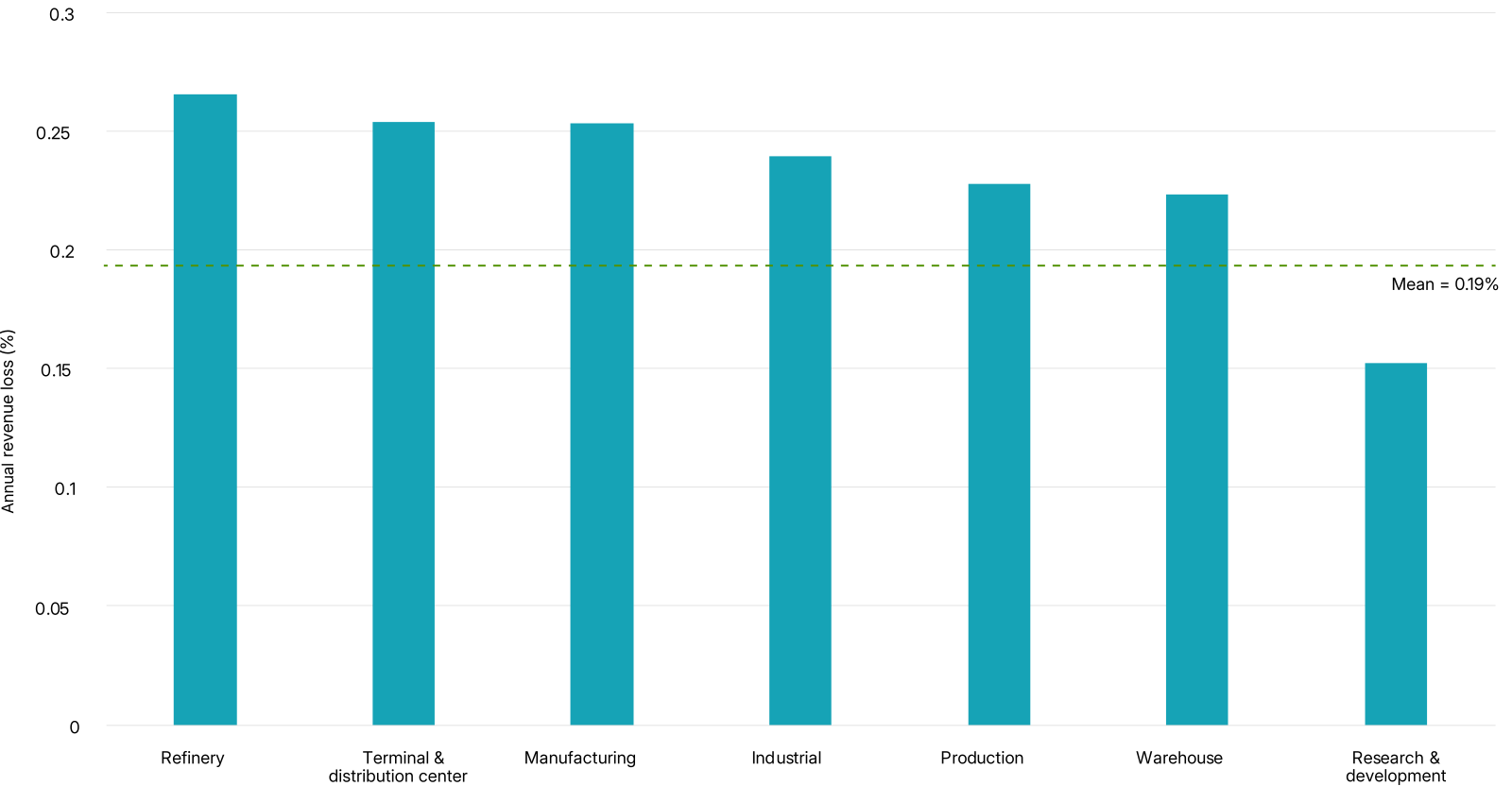
Data as of November 2025. Average annual revenue loss from business interruption due to extreme heat (y-axis), expressed as a percentage of asset revenue in 2050 under the Network for Greening the Financial System “Current Policies” (3°C) scenario for Austria and Germany. Results are shown for assets classified under industrial asset classes (facilities engaged in the extraction, transformation, production and distribution of materials and goods). The average annual revenue loss (green dashed line) reflects the full asset sample of 34,711 assets. Source: MSCI Sustainability & Climate, based on MSCI GeoSpatial Asset Intelligence. MSCI Sustainability & Climate products and services are provided by MSCI Solutions LLC in the United States and MSCI Solutions (UK) Limited in the United Kingdom and certain other related entities.
Under current climate conditions, industrial facilities in the region are estimated to lose, on average, 0.19% of total annual revenue due to extreme heat.8 Assuming no additional adaptation or risk-mitigation measures, this average asset-level loss could increase by around 27% by 2050 under the 3°C scenario and by 44% under a more extreme 5°C scenario.9
Automobile and auto-part companies stand out in particular, reflecting their large manufacturing footprint in the region. The chart below shows the 10 largest automobile companies operating in Austria and Germany, ordered by their current aggregated annual revenue losses related to extreme heat (blue bars) and the projected increase by 2050 (green bars). The financial impact varies by company size: The same percentage loss represents a smaller absolute effect for a large firm with substantial revenues than for a smaller company with a more limited revenue base.
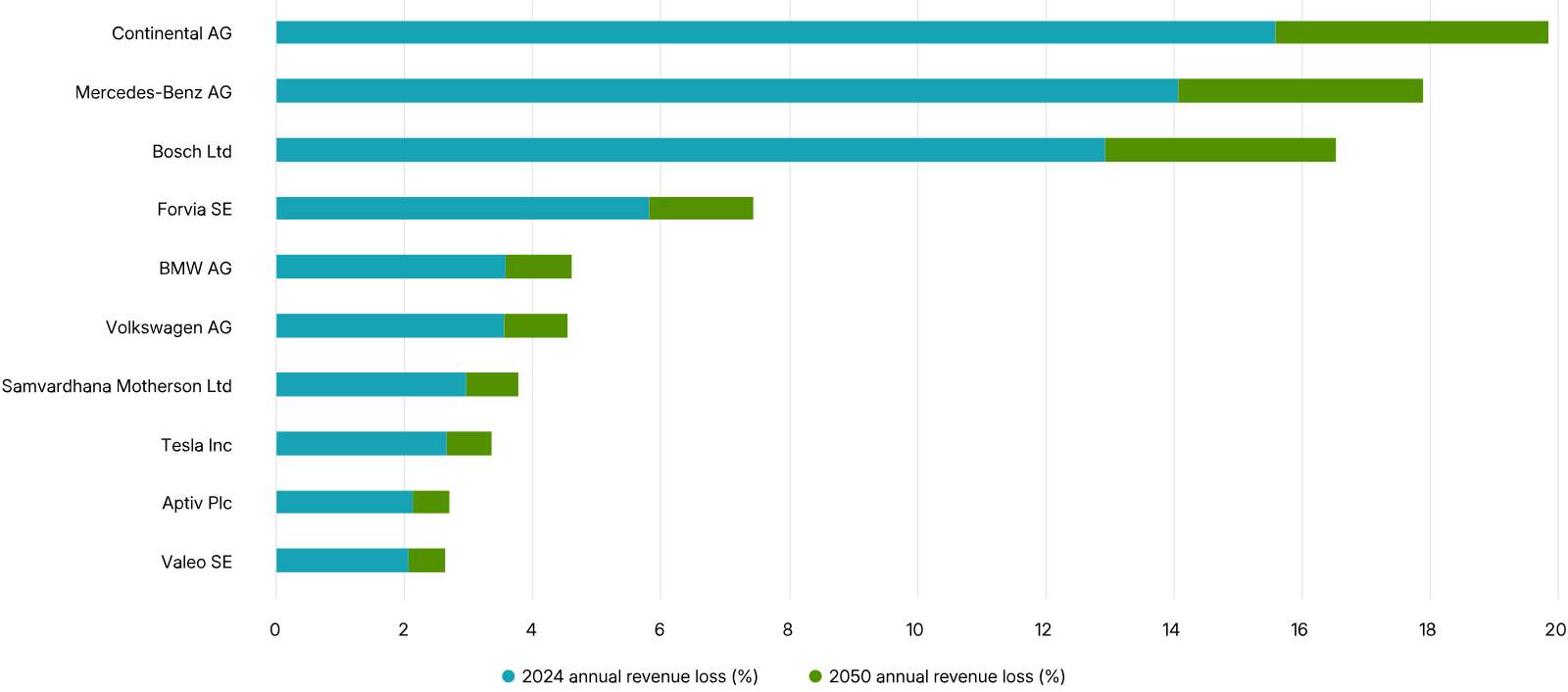
Data as of November 2025. Annual revenue losses from business interruption due to extreme heat, expressed as a percentage of asset revenue, in 2024 under current climate conditions (blue bars) and in 2050 under NGFS “Current Policies” (3°C) scenario (green bars) for companies classified in the automobiles and auto-components industry in Austria and Germany. Results are aggregated across asset activities classified under industrial asset classes. Companies are ordered by the largest projected increase in losses between 2024 and 2050. Source: MSCI Sustainability & Climate, based on MSCI GeoSpatial Asset Intelligence
While extreme heat may not pose a major financial risk on its own, it can become financially material when combined with other climate hazards or existing pressures such as slowing sales and rising operating costs. For banks, this compounding stress can increase risk at both the individual-borrower and portfolio levels.
In our analysis of industrial companies in Austria and Germany — defined as companies generating at least 50% of their revenue in the region — losses from physical climate risks under a 3°C scenario are projected to increase their five-year probability of default by around 10%.10 Depending on a company’s starting point, this increase could be sufficient to trigger a credit-rating downgrade. At the portfolio level, the effect resembles a broad economic slowdown, but one that is structural rather than cyclical.
This type of analysis can help banks identify borrowers most exposed to physical climate risks, particularly those with a significant share of revenue tied to vulnerable assets. Over time, these chronic risks can drive a permanent baseline shift in credit risk, elevating default probabilities at both the borrower and portfolio levels and making climate-related risk management a strategic priority.
Beyond risk management, this approach also helps address rising regulatory expectations. Supervisors such as the European Banking Authority and European Central Bank increasingly require financial institutions to assess and disclose the financial impacts of climate risks.11 Embedding climate data into existing credit-risk frameworks can help banks meet these expectations and gain a competitive edge through more-informed decisions on capital allocation and loan pricing as climate risks become harder to ignore.


Subscribe todayto have insights delivered to your inbox.
From Sustainability and Climate Blind Spots to Actionable Insights
Small and private firms often lack sustainability and climate disclosures. Financial institutions can leverage modeled data to help bridge gaps, improve risk management and address regulatory needs.
How Climate-Transition Risks May Impact Lending Practices
Climate-transition risks are reshaping lending and investment activities. Find out how banks can navigate these challenges with scenario-based risk-management strategies to meet new regulatory expectations.
1 Extreme heat is measured using the daily mean indoor wet-bulb globe temperature (WBGT), which differs from air temperature because it accounts for other atmospheric variables including humidity, wind speed, solar radiation and cloud cover. WBGT is a commonly used indicator of heat stress experienced by humans, particularly under direct sunlight. Extreme heat is assessed using a daily mean indoor WBGT threshold of 20°C, which corresponds approximately to a daily mean outdoor WBGT of 23°C and a daily maximum outdoor WBGT of 25°C — levels at which adverse heat impacts are shown to begin to emerge, based on Dirk Lauwaet et al., “A New Method to Assess Fine-Scale Outdoor Thermal Comfort for Urban Agglomerations,” Climate 8, 6 (2020).
2 “Why are Europe and the Arctic heating up faster than the rest of the world?” Copernicus, July 14, 2025.
3 This analysis includes 34,711 assets across 2,754 issuers for which company revenue data and Global Industry Classification Standard (GICS®) sector classification is available. GICS is the industry classification standard jointly developed by MSCI and S&P Global Market Intelligence. The industrial asset group includes facilities engaged in extraction, production, refining, manufacturing, warehousing and distribution of materials and goods, as well as some research and development facilities.
4 “The heat is on: How high temperatures are impacting workers and the global economy,” World Bank, July 17, 2023.
5 “Climate Change and Occupational Safety: Heat,” Institute for Occupational Safety and Health of the German Social Accident Insurance.
6 Based on the average exposure to extreme heat across all assets in MSCI’s GeoSpatial Asset Intelligence in Germany and Austria, as of November 2025. Results are shown under the Network for Greening the Financial System “Current Policies” scenario, which corresponds to a warming pathway of 2.6°C to 3.0°C. Unless otherwise stated, all 2050 data points reflect assumptions associated with this scenario.
7 Extreme-heat cost estimates are based on sector-specific labor-productivity loss functions, with assumptions reflecting reduced vulnerability from indoor environmental controls (e.g., air conditioning) and worker acclimatization. Regional experience with chronic heat extremes is also taken into account. For full methodology details, see “MSCI Climate VaR Methodology Part 4 - Physical Climate Risk,” MSCI, August 2024 (client access only).
8 Current climate conditions refer to the most recent full calendar year (2024). Average annual revenue loss (%) refers to the estimated percentage of total yearly revenue that an asset may forgo due to disruptions or reduced productivity caused by extreme heat.
9 Under the IPCC SSP 5-8.5 scenario, which aligns with a level of warming of 5.4 °C by 2100.
10 Based on MSCI Climate-Adjusted Probabilities of Default Methodology, using average outcomes.
11 “Guidelines on the management of environmental, social and governance (ESG) risks,” European Banking Authority, August 2025. See also, for example, “Consultation Paper 10/25: Enhancing banks’ and insurers’ approaches to managing climate-related risks,” UK Prudential Regulation Authority, April 2025; “Circular on Nature-related Financial Risks,” Swiss Financial Market Supervisory Authority (FINMA), December 2024; and “Framework for Voluntary Disclosures of Climate-related Financial Risks,” Basel Committee on Banking Supervision, June 2025.
The content of this page is for informational purposes only and is intended for institutional professionals with the analytical resources and tools necessary to interpret any performance information. Nothing herein is intended to recommend any product, tool or service. For all references to laws, rules or regulations, please note that the information is provided “as is” and does not constitute legal advice or any binding interpretation. Any approach to comply with regulatory or policy initiatives should be discussed with your own legal counsel and/or the relevant competent authority, as needed.