
Carbon Removal Via Direct Air Capture: High Integrity, Challenging Delivery
Direct Air Capture (DAC), a technology that removes CO2 directly from ambient air for permanent storage or utilization, ranks among the highest-integrity project types, with an average MSCI integrity score of 4.4 out of 5 across criteria including additionality, quantification and permanence. Where it falls short is delivery risk: DAC’s primary challenge is economic viability, not methodological soundness — a high-integrity technology constrained by cost, not credibility.
In November, European authorities proposed that up to 5% of emission reductions in the EU could come from international carbon credits, with the possibility that carbon removals could be used to abate emissions in the bloc’s flagship Emissions Trading Scheme (EU ETS). This marks a much-needed boost for the CO2-removals sector, which after being heralded as a key climate solution, has come under increasing scrutiny.
The DAC sector has been under heightened scrutiny this year, amid questions about delivery timelines and increasing economic and policy constraints that continue to challenge commercial deployment. And with costs still ranging between USD 200 and 800 per tonne of CO2 removed, DAC remains one of the most expensive ways of removing atmospheric carbon.
Separating high integrity from high delivery risk
For investors or buyers of carbon credits, the question is how to identify which DAC projects will perform. MSCI’s Carbon Project Ratings framework assesses each DAC project against six criteria that can distinguish delivery risk from other drivers of credit integrity. Technical complexity, cost pressures and infrastructure bottlenecks can contribute to high delivery risk in some projects. But when DAC projects work, they can work well: Credits are issued only after verified CO2 capture and storage, meaning that while delivery timelines may be variable, the credibility of issued credits remains high.
Looking ahead, insights from MSCI’s 2025 DAC Market Outlook show why long-term optimism for DAC may rest on declining costs. Modeled costs for solid and liquid DAC systems remain high today but are expected to decline to USD 250–310 per tonne of CO2 by 2050 as technologies mature and scale increases.
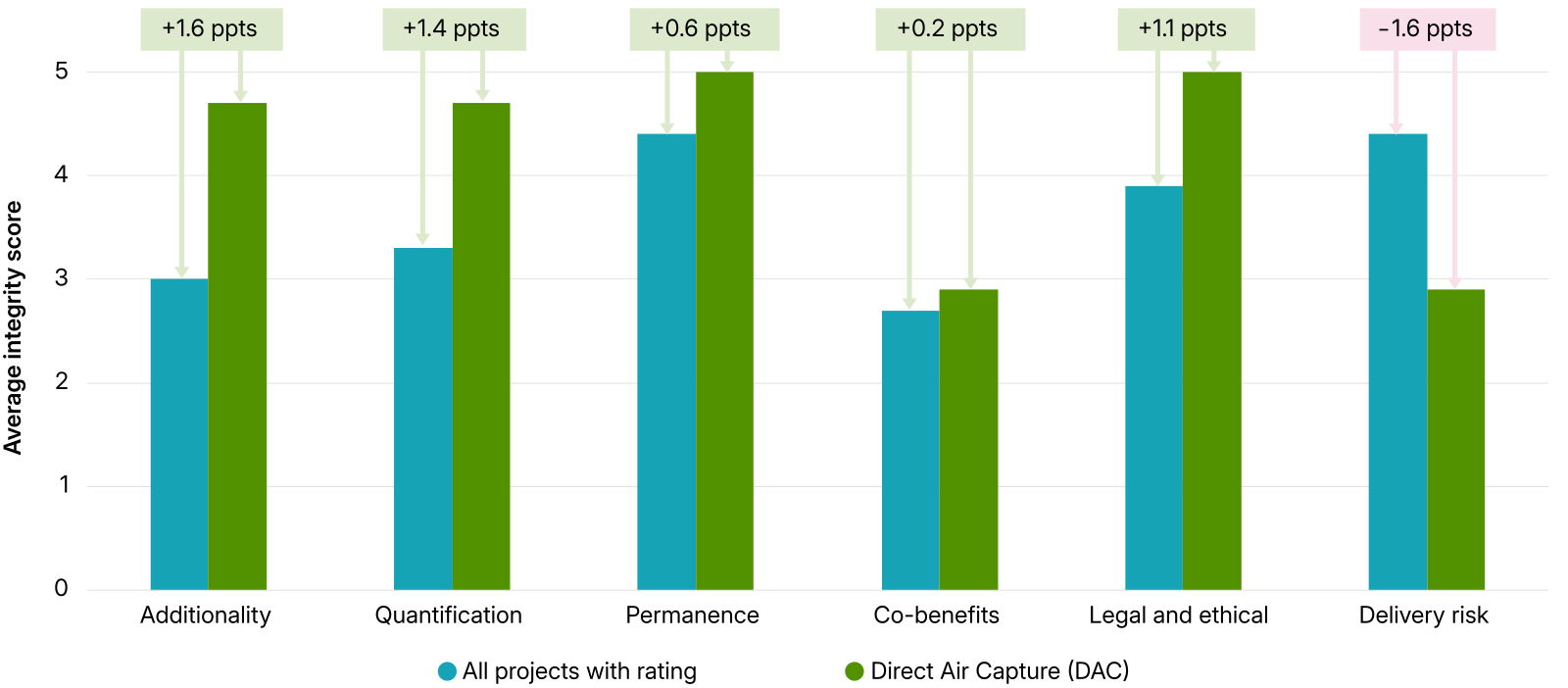
Data as of June 2025. Based on over 4,400 registered projects with an MSCI Carbon Project Rating and four DAC projects with a preliminary assessment. Source: MSCI Carbon Project Ratings


Subscribe todayto have insights delivered to your inbox.
2025 State of Integrity in the Global Carbon-Credit Market
Our 2025 report on the global carbon-credit market shows rising demand for high-integrity credits with stronger ratings, higher prices and new risk frameworks are shaping a more credible market.
MSCI Carbon Project Ratings
Assess the integrity of more than 4,000 carbon projects with our independent, in-depth assessments used by investors, carbon credit buyers and developers market-wide. As of Sept. 18, 2024.
Carbon Market Forecasts
Explore carbon market supply, demand and price projections to 2050. Use interactive tools to generate custom forecasts for CDR and CORSIA-eligible carbon credits.
The content of this page is for informational purposes only and is intended for institutional professionals with the analytical resources and tools necessary to interpret any performance information. Nothing herein is intended to recommend any product, tool or service. For all references to laws, rules or regulations, please note that the information is provided “as is” and does not constitute legal advice or any binding interpretation. Any approach to comply with regulatory or policy initiatives should be discussed with your own legal counsel and/or the relevant competent authority, as needed.