
Private Capital in Focus: VC and Buyout Part Ways on Software
Mentioned in this quick take:
The split in performance between venture capital (VC) and buyout intensified in the first quarter of 2026 due to diverging trends in valuations of information-technology (IT) holdings. VC continued to lead all private-equity strategies after a standout 2025, returning 5.3% for the quarter. Buyout, by contrast, slipped to -1.0% — its first negative quarterly print since 2022.
IT holdings returned 4% inside VC and -5% inside buyout (gross of fees) — a highly unusual divergence within a single sector and a single quarter. The gap reflects what looks more like a structural bifurcation: U.S.-concentrated buyout portfolios repricing the high-multiple software-as-a-service names they bought during the growth era, and a concentrated cohort of AI-native names continuing to attract capital at premium valuations, sustaining VC returns.
Software impacts private credit
Private credit returned 1.1% in the first quarter. Floating-rate income kept flowing, but the same sell-off that hit listed business-development companies in early February reached private direct-lending portfolios with IT-sector concentration, pulling down direct-lending returns to just 0.3%. Opportunistic lending (strategies focused on stressed borrowers) fared better at 2.6%.
In private real assets, natural resources stood out with a 6.5% return due in part to strength in energy commodities. Infrastructure added 1.8% and private real estate posted another return near 0%.
Looking ahead, the dispersion within private equity may widen before it narrows. With a pipeline of late-stage venture-backed IPOs expected through 2026, and recent listings already lifting late-stage venture marks, the AI-native side of software could keep delivering paper gains.1 Legacy software businesses remain under pressure, however. For limited partners in private capital, the question may be less whether their managers have software exposure than which software they own.
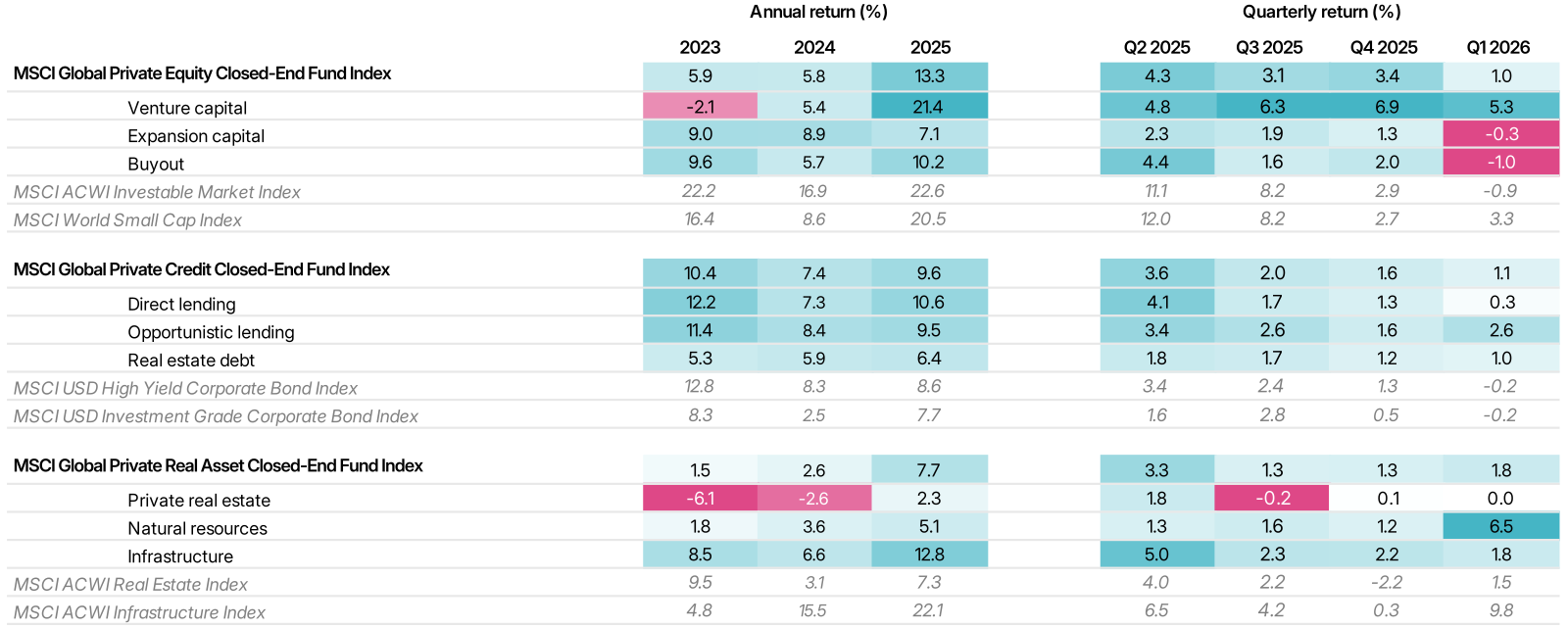
Quarterly returns are calculated in USD using the Modified Dietz method and are not annualized. Calendar-year returns represent compounded quarterly returns. Data as of Q1 2026 from the MSCI Private Capital Universe.


Subscribe todayto have insights delivered to your inbox.
Run Risk or Rational Repricing? Private Credit’s Software Stress Test
The AI update that rattled equity markets in early 2026 also exposed a fault line in private credit. We examine the selloff in business development companies and the wider implications for investors.
From Broad to Bespoke: How Much Should You Customize Your Private-Capital Benchmark?
One index won't cover four different questions for asset owners. Benchmark customization is a ladder — knowing which rung to stand on is the discipline.
Private Capital Intel
Benchmark performance with one of the largest private capital datasets. Report, allocate, pace, report and assess risk and return.
1 An IPO doesn't automatically mean private investors get their money back quickly. While early investors can realize some of their investments during an IPO, it is more typical for VC positions to be realized over a period of several quarters or years afterward.
The content of this page is for informational purposes only and is intended for institutional professionals with the analytical resources and tools necessary to interpret any performance information. Nothing herein is intended to recommend any product, tool or service. For all references to laws, rules or regulations, please note that the information is provided “as is” and does not constitute legal advice or any binding interpretation. Any approach to comply with regulatory or policy initiatives should be discussed with your own legal counsel and/or the relevant competent authority, as needed.