

What are biochar projects?
Biochar is a carbon-rich solid produced by heating biomass in a low-oxygen environment, typically through pyrolysis.
Instead of letting biomass decay or combust and release its carbon back to the atmosphere, pyrolysis turns a portion of that carbon into a chemically stable solid form. When this charcoal-like material is added to soils or used in long-lived products, the carbon remain stored for decades to centuries.
How do these projects work?
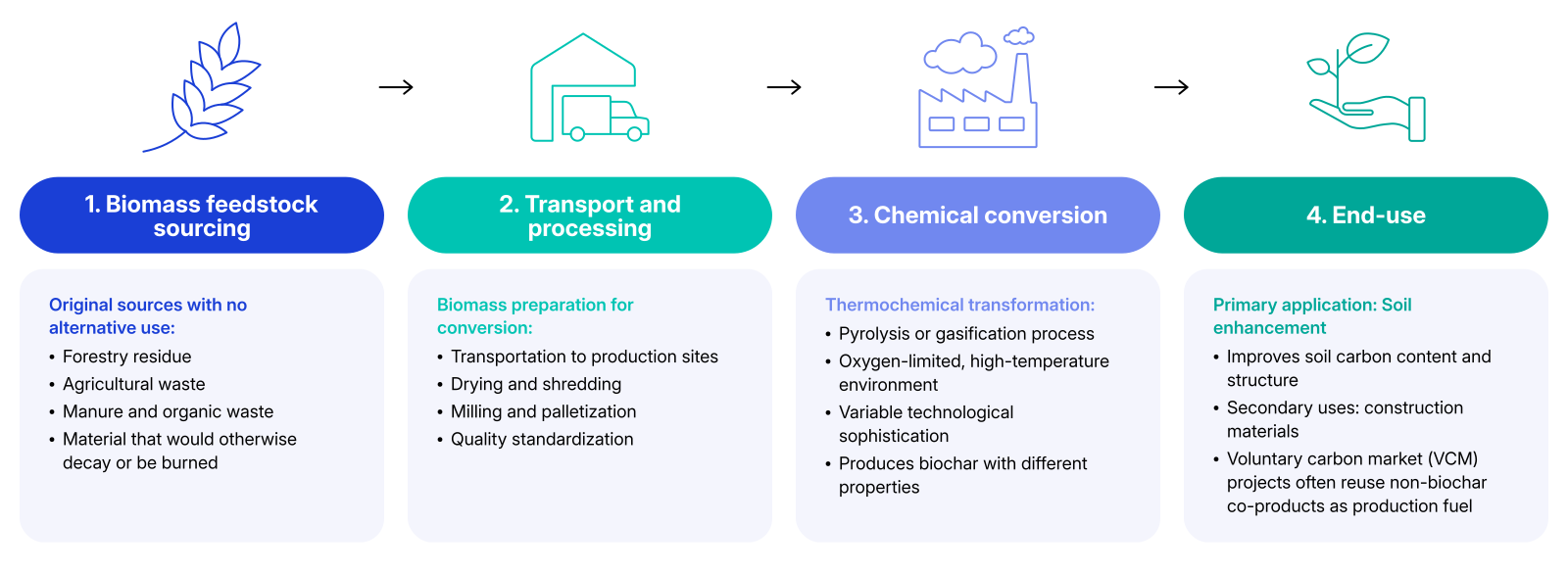
A biochar project typically follows four steps:
- Sourcing waste biomass such as forestry residues, agricultural waste or manure
- Transporting and preparing the feedstock
- Converting it through pyrolysis
- Applying the biochar, most often as a soil amendment.
Credits are issued for the portion of biomass carbon converted into stable biochar, after accounting for emissions from transport, processing and project energy use.
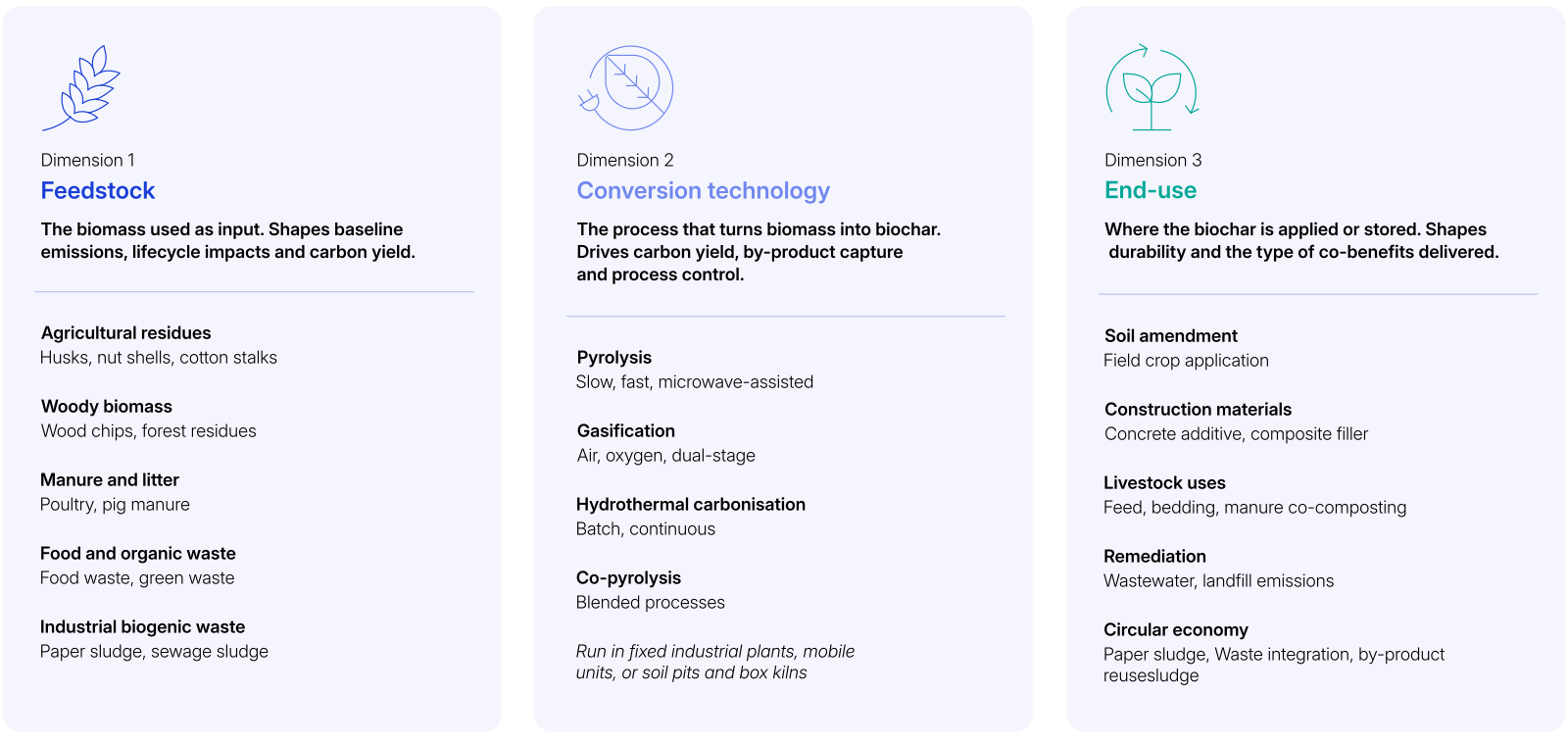
Biochar projects are not all the same. They vary across three factors, and the choices made on each affect the project's integrity profile:
- Feedstock: Agricultural residues, woody biomass, manure, food waste and other organic materials can all be used as inputs. The feedstock determines baseline emissions, lifecycle impacts and the amount of carbon that can be converted into biochar.
- Conversion technology: Slow or fast pyrolysis, gasification, hydrothermal carbonization and co-pyrolysis can be run in fixed industrial plants, mobile units or low-tech soil pits and box kilns. Technology choice drives carbon yield, by-product capture, scalability and process control.
- End-use: Soil amendment is by far the most common application, but biochar is also used as a filler in concrete and polymer composites, in livestock feed and bedding, and in waste-management applications. End-use shapes how long the carbon remains stored and what co-benefits are delivered.
What shapes the integrity of biochar projects?
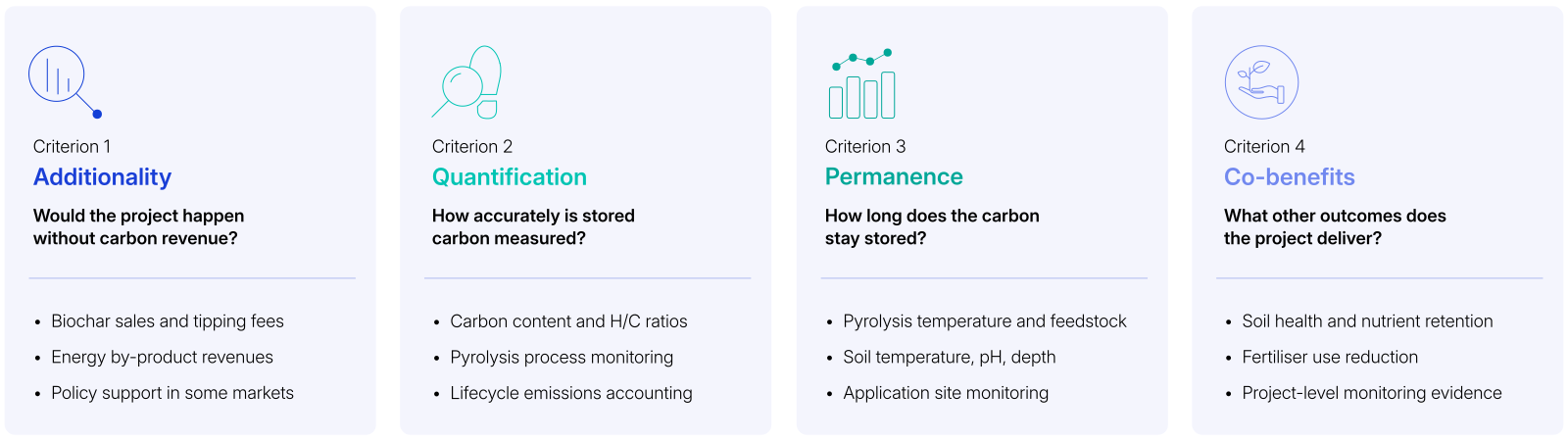
Converting biomass into durable, verifiable carbon storage involves choices at every step, and each of these choices can affect integrity. Four areas tend to drive most of the risk in a biochar project:
- Financial additionality: Biochar producers earn revenue from biochar sales, tipping fees, energy by-products and carbon credits. Where biochar markets are well established or strong policy support is in place, carbon revenue may not be the decisive factor in the investment case. This risk is more pronounced for fixed industrial units operating at commercial scale and may increase as biochar prices and policy incentives increase.
- Carbon content and lifecycle measurement: Quantification depends on lab testing of carbon content, monitoring the pyrolysis process and full lifecycle accounting of emissions. This includes emissions from feedstock transport, processing energy and end-use. Standard stability proxies, such as hydrogen-to-carbon ratios, a common indicator of chemical stability, show meaningful variation across projects and sometimes fall outside accepted benchmark ranges.
- Long-term durability: Permanence depends on two factors. First, production conditions matter. Higher pyrolysis temperatures generally produce more chemically stable biochar. Second, durability depends on where and how the biochar is used. Soil conditions such as cooler temperatures, neutral pH and deeper incorporation all slow carbon loss.
- Co-benefit evidence: Biochar can deliver important co-benefits, particularly for agricultural end-uses, including improved soil health, better nutrient retention and reduced fertilizer use. While academic literature points to potential benefits, these are rarely monitored systematically at the project level.
MSCI Carbon Project Ratings assess these risks at the individual project level, applying biochar-specific sub-criteria across additionality, quantification, permanence and co-benefits.
Conclusion
Biochar can lock carbon away for centuries but only when the underlying project is well designed and rigorously monitored. Feedstock, production conditions and end-use all shape the integrity of the credits that are issued.
Projects and Transactions
Access roughly 30,000 projects spanning more than 15 registries and 1 million transactions.1

Carbon Project Ratings
Investor-grade ratings for over 4,000 carbon projects grounded in granularity and backed by geospatial intelligence.
1 Data and coverage as of December 2024.