
How Has the Market Priced AI Disruption?
- Companies with more labor costs automatable by today's AI capabilities have underperformed since November 2022, but greater competitive resilience has helped offset the impact.
- For equity-portfolio managers and asset owners, AI disruption can create common exposures across companies that appear diversified by sector and country.
- Sector and country diversification may therefore mask concentrated AI risk. Assessing automation potential alongside competitive resilience can provide a more complete view.
Mentioned in this blog post:
AI Exposure Intelligence | MSCI Equity Factor Models (Barra) | MSCI ACWI IMI Index
When online retail scaled through the 2000s and 2010s, its impact did not fall evenly across retailers. For example, Sears, Roebuck and Co. and Amazon.com, Inc. carried the same industry label for years, before one lost more than 95% of its market value and the other has become one of the largest companies in the world. AI may now be drawing another dividing line through portfolios, one that cuts across Global Industry Classification Standard (GICS®) sector and country boundaries.1
That raises two questions for investors. How much of a portfolio's return already reflects the potential for AI to disrupt business models? And could holdings that look diversified by sector and country still share the same underlying AI vulnerability?
Measuring exposure at the company level
Previous research from MSCI looks at the share of a company's labor costs that AI could plausibly automate, tested under three scenarios of increasing AI competency. The language scenario covers analyzing and generating text, code and numeric data. The monitoring scenario adds tracking of physical conditions and processes. Last, the physical scenario extends to AI manipulating objects directly, essentially robotics. Because the estimate sits at the company level, two companies in the same sub-industry may carry different automation exposure, or companies scattered across sectors and countries may share the same one.
To test whether markets already price these exposures, we built factor-return series using an extension of MSCI's global equity risk model (MSCI EFMGEMLT). We isolated returns associated with automation exposure and our disruption assessment — which combines automation potential with indicators of competitive resilience — while controlling for industry, country and standard style factors. The chart shows cumulative factor returns since Nov. 30, 2022, with major AI-model releases marked.
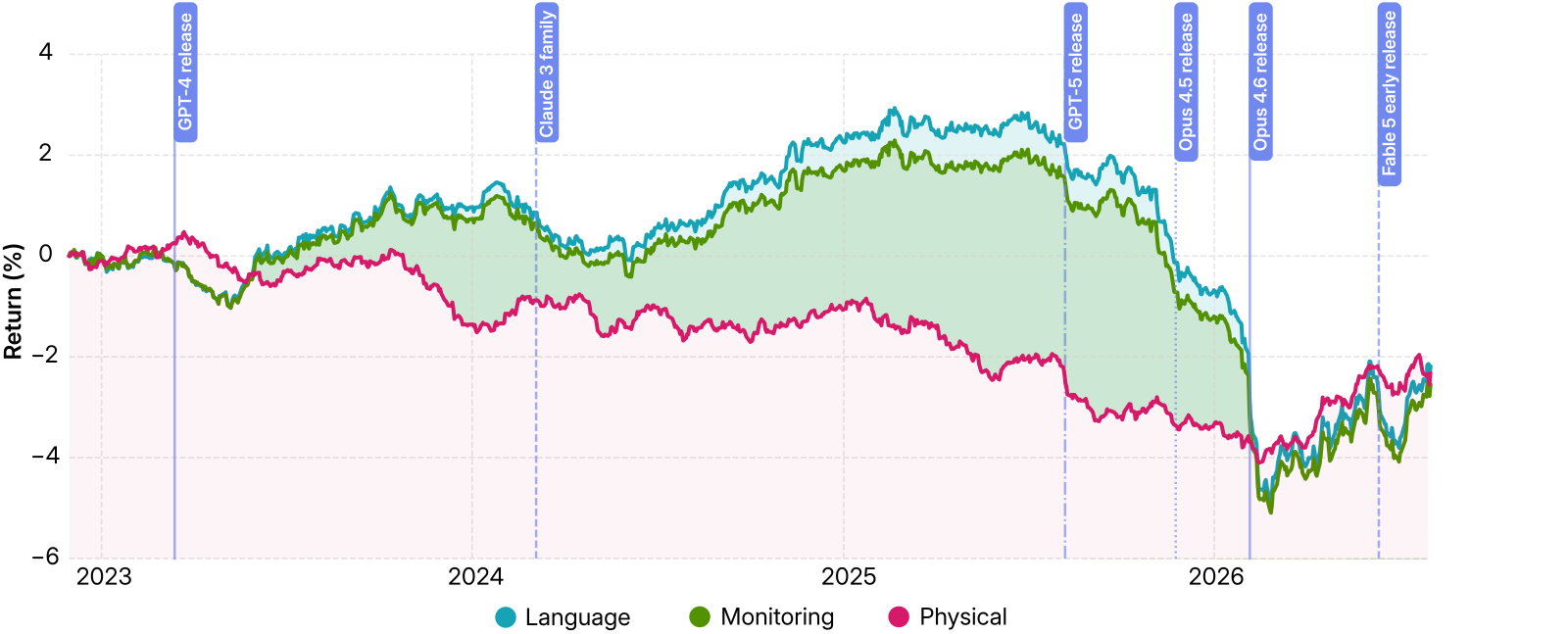
Factor returns based on the extension of the MSCI EFMGEMLT equity-risk model, Nov. 30, 2022, to July 31, 2026. Vertical lines mark the GPT-4 and 5 releases as well as Claude 3, Opus and Fable releases.
Companies with higher automatable-cost exposure under the language and monitoring scenarios rose gradually through the GPT-5 release, then reversed. The larger move came around the Opus 4.5 and 4.6 releases: factor returns fell sharply and continued lower into early 2026, troughing near 5% below the starting level before partially recovering. By late July 2026, both factors remained down roughly 2% over the period.
Physical-capability cost exposure followed a different path, declining more gradually through early 2026 and moving less around individual model releases. The muted response suggests investors may view embodied automation as a more distant risk, either because current AI capabilities do not yet support it or because the expected timeline is longer.
Incorporating resilience led to outperformance
Automation potential alone does not determine a company's vulnerability. Some firms could face competitive pressure from AI-native entrants or pricing pressure from clients opting to take a DIY approach. For more resilient firms, the same automation potential could instead support workforce productivity, revenue growth and margin expansion.
We therefore added layers of competitive resilience, including physical-asset intensity, regulatory insulation, network effects and customer switching costs, to the factor analysis.
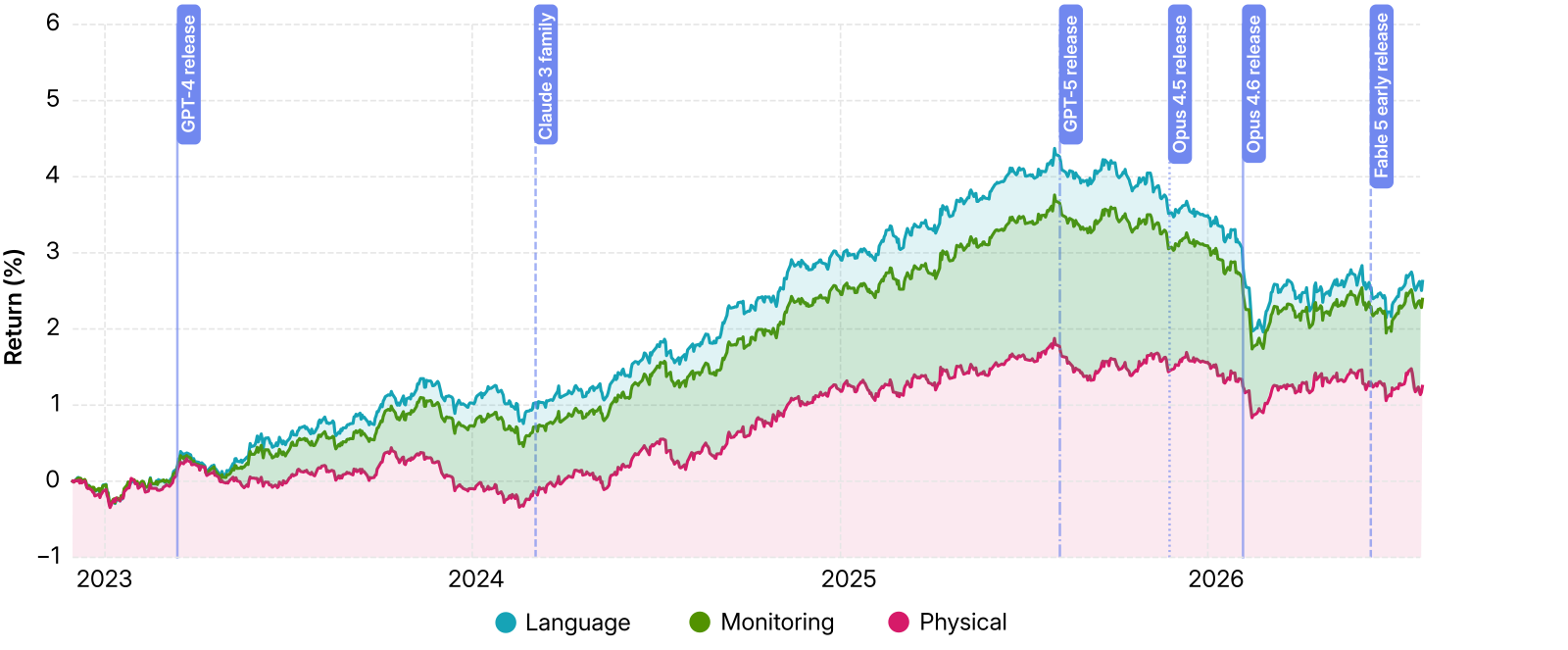
Factor returns based on the extension of the MSCI EFMGEMLT equity-risk model, Nov. 30, 2022, to July 31, 2026. Vertical lines mark the GPT-4 and 5 releases as well as Claude 3, Opus and Fable releases.
Positive factor returns in the chart indicate that companies combining high automatable-labor-cost exposure with a more defensible position outperformed. All three resilience-adjusted factors rose through much of the period to October 2025, before some gains eroded after the GPT-5 and Opus 4.5 releases.
Moves around individual AI-model releases were also smaller for more resilient companies. Around the Opus 4.6 release, the resilience-adjusted factors fell roughly 1%, less than half the decline of the raw automation-potential factors, and recovered faster. Drawdowns around release events were also consistently smaller. Raw automation potential alone looked like a risk; paired with a defensible business model, high automation potential tended to outperform.
Resilience has helped performance in highly exposed sectors
The resilience effect is clearly visible in two sectors with high AI-disruption potential: information technology and communication services.
Since November 2022, companies with higher resilience scores outperformed weaker peers by 15% in information technology and 23% in communication services. The gap has narrowed since the most recent model releases, suggesting that structural protections can help but may not fully insulate firms from AI disruption.
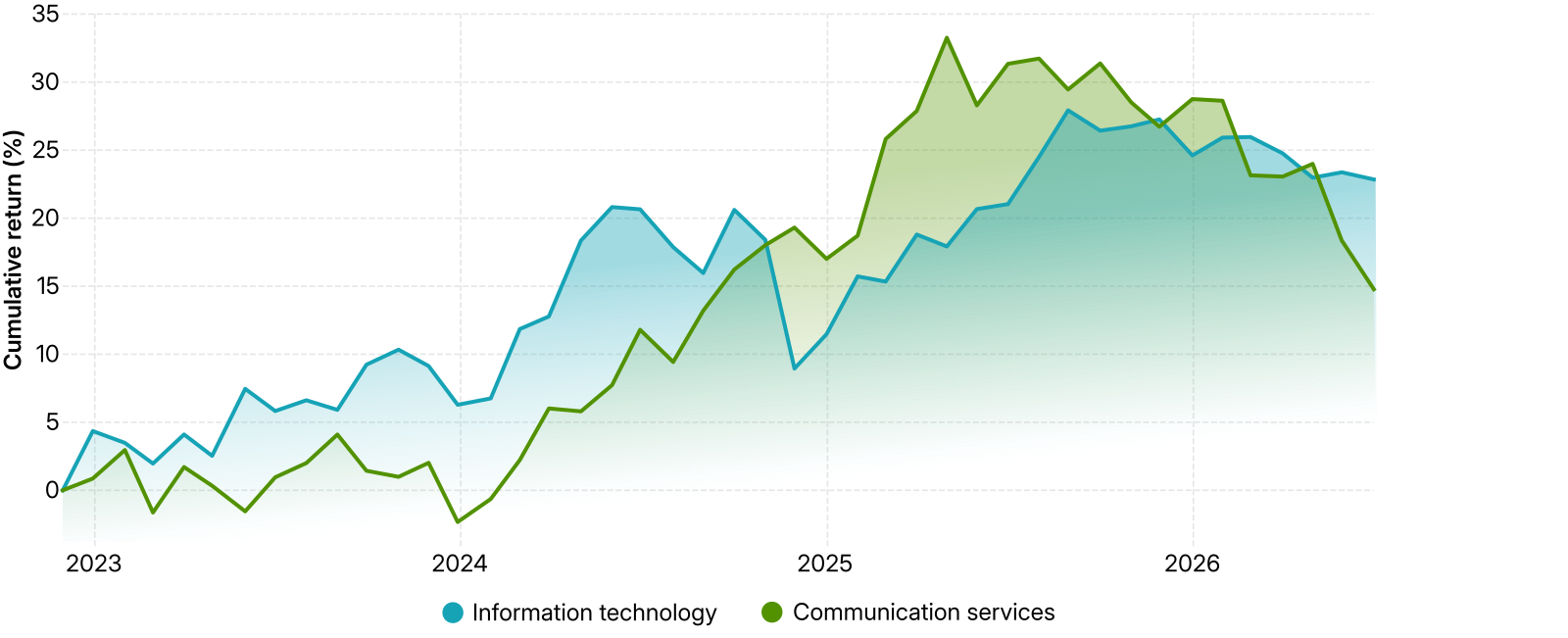
Difference of equal-weighted average local currency return by bucket in the MSCI ACWI IMI Index universe, Nov. 30, 2022, to July 31, 2026, monthly returns.
Concentration risk not captured by industry weights
AI exposure does not map neatly onto sector or country weights. A retailer, a professional-services firm and an industrial company can have similar automation and resilience profiles. A portfolio diversified across sectors and countries could therefore still carry a concentrated exposure to AI disruption. This mismatch can create challenges throughout the investment process, from portfolio construction to risk monitoring, reporting and stewardship.
Our analysis suggests that automatable labor-cost exposure has been a drag on returns over the past three and a half years, but exposure alone has not determined the outcome. Markets have differentiated between business models that appear more resilient to AI disruption and those that appear more vulnerable. Embodied automation appears least reflected in factor returns and could be more exposed to repricing if robotics-enabled AI advances faster than expected. For investors, the implication is to look beyond sector maps and assess AI exposure and resilience at the company and portfolio level.




Subscribe todayto have insights delivered to your inbox.
AI's Job Prospects: How Much Labor Could AI Automate?
As AI moves beyond language and into the physical world, which companies could benefit most — and which might prove most resilient to disruption?
Macro Scenarios in Focus: Assessing Portfolio Resilience to AI and Geopolitical Risks
We stress test a diversified portfolio against three macro scenarios: an AI productivity boom, a disorderly AI transition and a supply-side energy squeeze.
AI Exposure Intelligence
Assess which companies may be most exposed as AI reshapes competitive advantage, revenue and risk — with an independent, auditable classification standard.
1 GICS is the global industry-classification standard jointly developed by MSCI and S&P Dow Jones Indices.
The content of this page is for informational purposes only and is intended for institutional professionals with the analytical resources and tools necessary to interpret any performance information. Nothing herein is intended to recommend any product, tool or service. For all references to laws, rules or regulations, please note that the information is provided “as is” and does not constitute legal advice or any binding interpretation. Any approach to comply with regulatory or policy initiatives should be discussed with your own legal counsel and/or the relevant competent authority, as needed.