
Afforestation, Reforestation, Revegetation (ARR) ProjectsHow ARR projects remove carbon from the atmosphere and what determines their integrity
What are ARR projects?
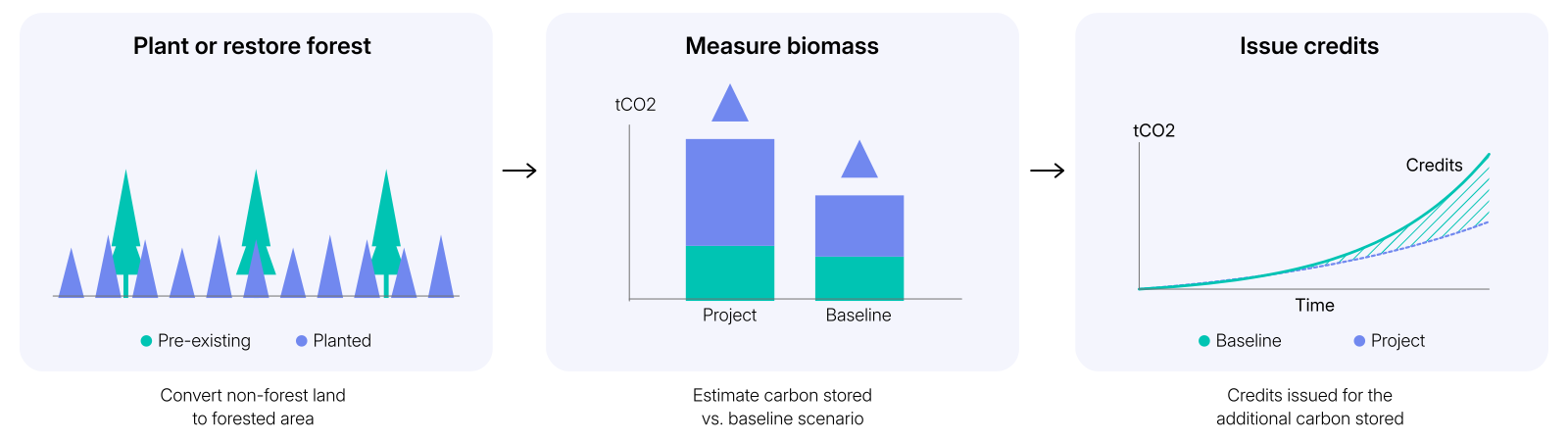
ARR stands for afforestation, reforestation and revegetation. These projects plant trees or restore vegetation on land that is bare, degraded or used for other purposes.
- Afforestation creates new forest where none existed
- Reforestation replants previously forested land
- Revegetation restores plant cover on disturbed soil
As the new vegetation grows, it absorbs carbon dioxide, and credits are issued for the additional carbon stored.
How do these projects work?
ARR is one of the fastest-growing project types in the voluntary carbon market. As of May 2025, more than 750 registered ARR projects had issued over 185 million tonnes of CO₂ credits, with issuances forecast to reach around 50 million tonnes per year by 2030.1
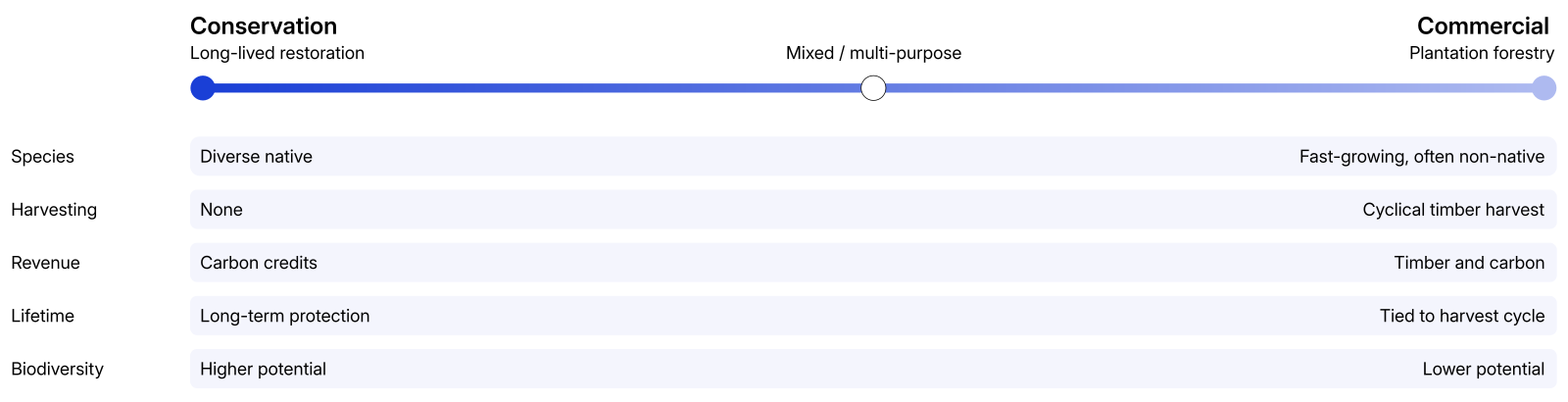
ARR projects vary across species choice (native or non-native), species composition (monoculture or multi-species) and business model. Whether a project is conservation- or commercially focused is one of the strongest determinants of integrity, shaping its economics, lifetime and biodiversity potential.
What determines the integrity of an ARR project?
ARR credits represent carbon removed from the atmosphere by trees and stored over many years. Project integrity determines how real, measurable and durable those removals are.
MSCI Carbon Project Ratings assess ARR projects using a detailed, project-type-specific framework covering over 20 ARR-specific sub-criteria. The analysis draws on project documentation, geospatial data and third-party datasets to form an independent view of project integrity.
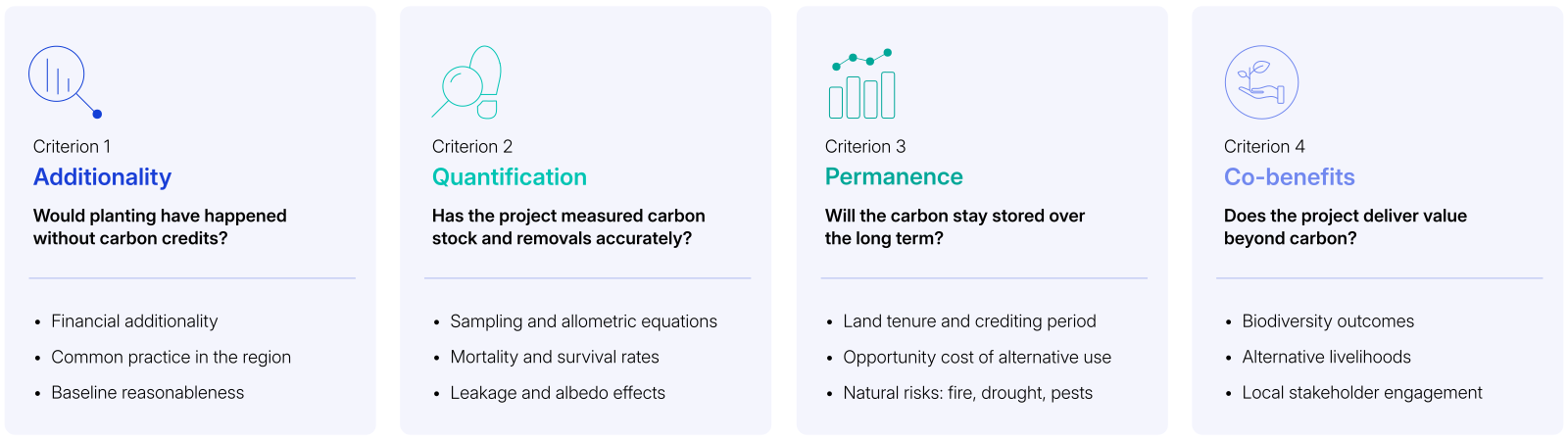
Translating a planting plan into verified, durable carbon removals can be technically demanding. Five areas drive most of the integrity risk:
- Financial additionality: Commercial projects can earn timber revenues with or without carbon finance, weakening the case that credits were the deciding factor. Conservation projects typically depend more heavily on carbon revenues, strengthening the additionality case.
- Baseline reasonableness: Some forest growth may have happened without the project through natural regeneration or a normal harvesting cycle. Projects that do not account for this baseline overstate their impact.
- Carbon stock measurement: Estimating carbon stored across a project area depends on sampling design, biomass models (which estimate tree mass from measurable dimensions) and survival-rate assumptions. Each carries a certain degree of uncertainty.
- Long-term protection: Permanence in ARR is typically shaped more by human factors than natural ones. Land tenure, the length of the crediting period and the opportunity cost of alternative land uses all influence whether the forest is likely to be maintained over decades.
- Biodiversity outcomes: Conversation projecst are more likely to use diverse native plantings, which generally deliver stronger ecological co-benefits and greater resilience than monocultures of fast-growing non-native species.
Conclusion
ARR projects can deliver real, measurable carbon removals, but the integrity of those removals depends on decisions made long before any credits are issued. Species selection, business model and land tenure all influence how credible and durable the stored carbon will be. Ultimately, project‑level assessment is needed to distinguish high‑integrity ARR projects from weaker ones.
Projects and Transactions
Access roughly 30,000 projects spanning more than 15 registries and 1 million transactions.1

Carbon Project Ratings
Investor-grade ratings for over 4,000 carbon projects grounded in granularity and backed by geospatial intelligence.
1 Data and coverage as of December 2024.